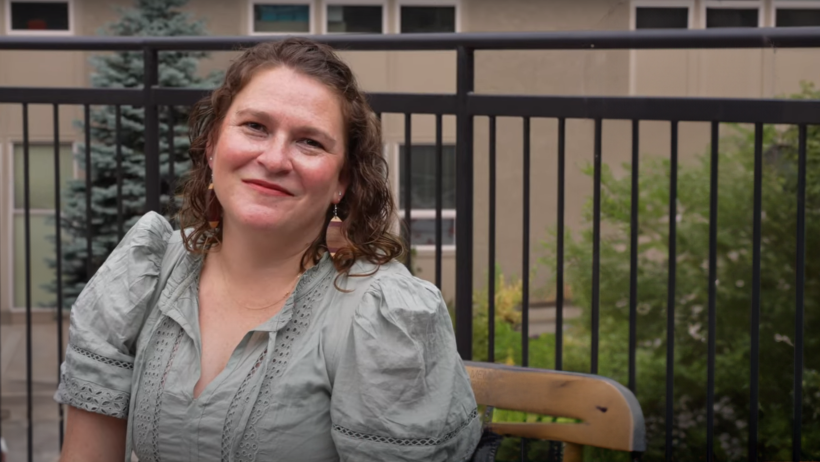
In the wake of the horrific acts of terror this week, the unspeakable brutality against Israeli civilians, it’s hard to find adequate words to describe the overwhelming feeling of helplessness and powerlessness. For our sake, for our children’s sake, and for our community’s sake, it’s important that we find ways, even in dark times, to ground ourselves. If we’re to move forward at all, we must physically plant our feet on the ground, push them into the earth, and feel the earth pushing back. We cannot stand for what’s just and what’s right if we’re not first connected in some way to the ground beneath us.
I hope you’ve had a chance to reset, to notice your body and your breathing. This is something I’ve had to discover and relearn for myself. For so long, my balancing act was to go on a walk, to be in constant movement. I still consider this part of my self-care routine, but it’s the first step of being planted in my own body, feeling the pressure of the earth from my toes to my nose, that I was missing.
This practice, connecting to the earth, is one of the first mitzvot (commandments) that God gives to the people of Israel. This week we read Parshat Bereshit, the first portion of the Torah. We are wowed by the story of creation, specifically the time and care God put into creating each day, each being exactly as God wanted. We learn about the first people and their experience in the Garden of Eden: how they learned to build, grow, and be together. The Torah continues with the story of Cain and Abel, the first sibling rivalry gone terribly awry, and the very real consequences put into place after each of these events. At the very beginning of the Torah, we’re introduced to a concept that recurs throughout the text – God as the parent, creating life and making sure everything has its own place.
Adam, the first human placed in the Garden of Eden, is told what he can and cannot eat of the beautiful bounty, and in addition, the Torah also explains that his purpose there is to “till it and tend it.” Immediately, this suggests that if all of creation is connected through the acts that God took for creation, then humankind, in order to continue their connection to God, must also be a part of maintaining the land. In other words, God could have created a maintenance-free land, but then decided that in order to keep us grounded, we must fulfill the duties of caretakers of the earth.
I’m not suggesting that this type of labor is another post-Eden punishment. Did God want us to have to break our backs caring for the land? I don’t believe so. Instead, perhaps God wanted us to learn what it is to be connected to something from our “toes to our nose.” Perhaps being connected to the land gives us the opportunity to reset ourselves when needed, to literally dig in, and to recognize that we share this planet. May that be our hope for peace as we look to the days ahead.
This is the sermon I delivered on Yom Kippur, September 25, 2023.
I’m Rabbi Posen, for those of you who may be new. Natan Meir, Eddy Shuldman, and Mark Sherman are also part of our fantastic service-leading team. This is how we identify each other, by our names. For all of human existence, we have come to the conclusion that we are the only species that does this, that calls each other by name. Even when scientists study language in other animals, like dolphins, they’ve determined that the changes in their vocalizations aren’t names, they’re simply imitations of the other dolphins’ sounds.
At least, this is what they thought until now. Just a few weeks ago, researchers from Colorado State University released findings suggesting that elephants may in fact call each other by names. Not in the loud trumpet sounds we associate with elephants, but with low-frequency vocal rumbles they use to communicate over long distances.
The team analyzed hundreds of these rumbles and found, using machine learning, that some were specifically directed at individual elephants, and they weren’t merely imitations of the recipient elephant. Then they played back recordings of the rumblings to groups of elephants, and the ones that heard their own names responded by moving quickly toward those sounds.
If this study is peer-reviewed and verified, can you imagine what this means? This completely changes the way we see animals and how they interact. Michael Pardo, a behavioral ecologist from Colorado State, said that these new findings potentially “blur the line” between “what we think is unique to human language versus what is found in other animal communication systems.”
I want you to hold on to this news story in your mind, while I share a personal story.
A few weeks ago I was out for a walk in our neighborhood. That will come as no surprise to most of you. I was listening to an audiobook, just in the zone, taking in the world around me, when a neighbor came up to me. “Do you have a minute for a rabbi question?” He must have seen the split-second change of expression on my face as I decided if I was going to be present for him or keep my focus on my book, because he followed it up with: “I’ll keep walking with you so you won’t have to stop.” So we walked.
His question: Why do some Jews do the unveiling of the headstone at 12 months and others at 30 days? Where did this come from? As with most rabbi questions, this took us down a metaphorical conversation path, not unlike the literal neighborhood path we were on. It lead to a discussion about ritual and tradition, obligations of mitzvot, and how all of this changes over time. We spent about a mile discussing our own traditions, our family histories and origins, and marveled at how we’re connected deeply to our roots by the way in which we celebrate our Judaism today.
I’ve sermonized about death before. Judaism doesn’t shy away from this topic. As human beings, we’re already naturally fascinated by our own mortality, and Jewish tradition comes along and basically says, “I know, right??” The idea that Judaism has outlined a process for everything, including mourning, is part of what made me want to become a rabbi. The whole Jewish grief procedure is partly about providing comfort to the mourners, but also about encouraging us to remember. These time markers – seven days, 30 days, 365 days – they keep loved ones with us. They lengthen their days even after they’ve died.
Last year at the end of Yom Kippur services, a few of you came up to me to ask about my tallit. Some of you may have noticed that I have two tallitot that I wear throughout this service. This (regular) one which is my every Shabbat and holiday tallit, and this one (my dad’s) that I put on only for Yizkor. I’ve done this for the past 16 years since my father passed away.
There are ways in which the people who came before us live on. It’s through the stories we tell about them. It’s through the college fund they set up long ago that their great-grandchildren are finally old enough to use. It’s through the dining room table in our house that used to be in Duncan’s grandparents’ dining room, where Duncan and his family had countless Shabbat dinners and Pesach seders. For me, this tallit is how my dad Steven lives on, l’ma’an ya’arichun y’mecha. Because of this tallit, because of stories, because of Shiri’s own name, because of my last name, my father’s days have been lengthened.
Back to Colorado State University. Do you think that elephants can do what I just did? This would have been a stranger question if I had opened with it. But understanding now what we just found out weeks ago that could possibly make elephants the only known non-human animal to communicate using the abstract construct of names . . . do you think elephants tell stories about other elephants who’ve died? Is it possible that elephants publicly mourn?
It’s fascinating, isn’t it? And not just for the scientific discovery, but also because it builds on what we already know about elephants and their incredible recall. “Elephants never forget” isn’t just a saying. In one study, scientists who researched elephant packs at an East African national park in the early 90s saw that the mortality rate of elephants during a severe drought was much higher for the packs with younger matriarchs because the older ones were able to recall a similar drought from decades earlier that forced them to go in search of alternative food sources. Memory legitimately lengthened their days.
L’ma’an ya’arichun y’mecha. With our memory, we lengthen our days. By recalling memories of loved ones, we lengthen their days. We use the phrase “till 120” to wish someone good health on their birthday, knowing they won’t live to be 120. But in a very real way, they will live well past 120 in our memories. Gematria, the Kabbalistic numerological system, assigns values to words through their letters. It’s why chai is 18, because the values of chet and yud add up to 18. Fun fact: Want to know what the letters pey, yud, lamed, which spells peel, the Hebrew word for elephant, add up to? 120.
How do we carry people with us? Like the Israelites carrying the Tabernacle through the wilderness, we have a history of looking for tangible ways to carry the intangible in our hearts. We carry people through their tallitot. Through their dining room table. Through stories of family vacations, weddings, retelling of old terrible jokes. And through names. It could be the Ashkenazi tradition of naming after someone who has passed or the Sephardi tradition of continuing the legacy while the loved one is still alive.
However we carry them, we lengthen their days. By saying Yizkor, that reminder at certain times throughout the year, and lighting the Yahrtzeit candle, l’ma’an ya’arichun y’mecha. We lengthen their days for as long as their names stay on our lips. For as long as those low rumbles pass on from generation to generation.
If anyone has brought with you a beloved item, or even just a lesson or memory, from a loved one, I invite you to share about it if you’re comfortable doing so.
Before we recite Yizkor, as we think about how our loved ones live on with us, I’d like to share a reading with you. This poem is called “A Man Doesn’t Have Time In His Life,” by Yehuda Amichai.
A man doesn’t have time in his life
to have time for everything.
He doesn’t have seasons enough to have
a season for every purpose. Ecclesiastes
Was wrong about that.
A man needs to love and to hate at the same moment,
to laugh and cry with the same eyes,
with the same hands to throw stones and to gather them,
to make love in war and war in love.
And to hate and forgive and remember and forget,
to arrange and confuse, to eat and to digest
what history
takes years and years to do.
A man doesn’t have time.
When he loses he seeks, when he finds
he forgets, when he forgets he loves, when he loves
he begins to forget.
And his soul is seasoned, his soul
is very professional.
Only his body remains forever
an amateur. It tries and it misses,
gets muddled, doesn’t learn a thing,
drunk and blind in its pleasures
and its pains.
He will die as figs die in autumn,
Shriveled and full of himself and sweet,
the leaves growing dry on the ground,
the bare branches pointing to the place
where there’s time for everything.
This is the sermon I delivered on the first day of Rosh Hashanah, September 16, 2023.
I’d like to let you in on a little secret, but you have to promise not to tell my children. I’m NOT perfect. I know, hard to believe, right? We tend to look to rabbis and teachers as modeling the things we aspire to, and while yes, I am a rabbi, I am also a human being, resplendent in all my imperfections.
Wow, that feels great to get off my chest! Let’s all try it.
Show of hands, how many of you are perfect?
As we’re now officially in the aseret y’mai teshuvah, the ten days of repentance, it’s refreshing to have that out in the open, isn’t it? Wouldn’t it be great if that was all there was to it? But in ten days, we’ll be back here for Yom Kippur, and there’s a lot of work to be done between now and then. The central piece of this work for me comes right after I finish speaking, so I might be up here for a while.
As much as I admire my own rabbinic teachers, I’m not in favor of the “rabbi on a pedestal” attitude. Which I realize is a strange thing to say as I’m literally up here on the bimah. I’m reminded of a line in one of my all-time favorite movies, Keeping the Faith. Ben Stiller and Edward Norton are best friends, one a rabbi, the other a Catholic priest. If you haven’t seen it, you can probably figure out who played who.
The movie is very funny, but also very rich in asking questions about what it is to be a faith leader and the complexities of being held to a higher standard in all aspects of life, when really, we’re all human, as you may remember from two minutes ago. Ben Stiller, as Rabbi Jake Schram, says “Jews want their rabbis to be the kind of Jews they don’t have the time to be.” And Father Brian Finn – Edward Norton – responds, “Yeah, and Catholics want their priests to be the kind of Catholics they don’t have the discipline to be.”
There’s a connection here to Hineni, the prayer which the service leader chants before entering into the Amidah for Musaf on Rosh Hashanah. It’s an unusual prayer. It plays both upon the words we hear repeatedly in the Torah for one of our ancestors standing up and answering a call from God, as well as upon the notion of the humility that it takes to lead a congregation, knowing that they hold you to a higher standard, yet being human nevertheless.
“Here I stand, impoverished in merit, trembling in the presence of the One who hears the prayers of Israel. Even though I am unfit and unworthy for the task, I come to represent your people.” The prayer continues, “Charge them not with my sins and let them not bear the guilt of my transgressions, though I have sinned and transgressed.” There’s more, but we’ll be there in just a few minutes, and I want to leave you with something to look forward to!
Growing up, I remember one of the lessons of the High Holy Days about repentance, which is that the prayers are written in the plural. “We have” done this, “we have” done that. But here, this is in the first person singular. This is the one time when an individual is asked to name their imperfections in front of the kehillah. Why would this be an exception?
It could be the idea of leading by example. After all, it might be easier for you to see your imperfections and name them if I do it too. Surprising no one, we have a method for this as well. Judaism has a process for everything. To quote Rabbi Jake Schram one more time, “What do you want me to do? Flagellate myself? Jews don’t do that, we plant trees!”
True, we do plant trees, but, kidding aside, we also plant the seeds for transformation, regrowth, and the reworking of our own actions and preconceived notions in order to find our next steps forward. We learn this from the Rambam.
Rabbi Moses ben Maimon, philosopher, doctor, scholar, teaches us that repentance and repair require time and intention. He also gives us the steps to take in order to truly make amends and move forward. You’ll note that this process is really more about repairing than forgiving. We are not commanded to “forgive and forget,” as helpful of a sentiment as that may sound. Instead, we’re given steps to follow to change ourselves and work towards earning forgiveness. Here’s what the process looks like, and how we might use these next ten days ahead of us, and perhaps beyond.
Step one: Own the pain you’ve caused. In order to actually begin any process of healing, we have to move past denial and own our actions. And own them without passing the blame. It could be: “I recognize the words I used were hurtful, even if I didn’t mean them that way.” Or “I wasn’t as responsible as I should have been.” Or “I judged someone by their appearance alone.”
Step two: Make a change. Simply owning your actions alone is like an empty promise. There is real work involved, and it starts with step two. In this space we’re implored to get down to it. Repentance is an active endeavor; it happens when we make actual changes to behavior and thought patterns. That’s not easy. Sometimes we all need reminders to keep destructive comments to ourselves. Sometimes we all need reminders that it’s ok to ask for help when you need it. Sometimes we all need that nudge from a friend for a quick reality check.
Step three: Make amends and apologize. To make amends means putting effort behind repairing a relationship. You’ve changed yourself, now figure out how that change can counteract the damage that might have been done. This one is tricky because it requires both interpersonal contact and the openness of the one who was wronged to hear your apology and either accept it, or hopefully at least acknowledge it and allow room for growth.
Don’t try to reverse engineer this step three; I know all your tricks because I’ve used them too. Saying “I’m sorry that YOU felt I was out of line” doesn’t count. That completely skips over step one and step two. Again, apologies without action are empty promises. When you actually put in the work of ownership and change, then you’ve earned the right to say, “I’m aware of my actions, and I apologize for the lapse in judgment that was cause for concern.” Or “I realize my actions crossed a line, and I hope you’ll see how I’ve changed.”
Finally, step four. Step four is the hardest. Of course it is, it’s step four. If it was the easiest step, we’d start with it. Don’t repeat whatever it is you’re trying to change. Don’t fall into the trap of letting this happen again. There’s no magic solution to step four, it just takes practice. And why, again? Because we’re not perfect after all. Don’t we all wish we lived in a world where we could snap our fingers and change behavior? But we don’t. To truly make a change in 5784 or any time requires daily practice and self-control. It takes holding oneself accountable and recognizing when it’s time to return to steps one through three of the process.
This is a good time to remind each other again – this process isn’t really about forgiveness. It’s not about the person who was wronged because you can’t control their feelings, and you shouldn’t try. Repentance is first and foremost about personal change. What’s remarkable in this, as in the Hineni, is that it’s built on trusting the true intentions of another person. Forget all your preconceived notions, forget your snap judgments. Giving the benefit of the doubt is a two-way street. Here’s what I mean. If I’m the one who did wrong, you trust me that I’ve made it to step two. I’m working on me. And at the same time, I trust you that forgiveness will come eventually. It’s not automatic or necessarily quick.
See? Now you know why step four is so challenging. The thing that follows change, the thing we don’t really talk about during the season of repentance, is maintaining. Forgive me – it’s the time for asking, right? – but I’m going to quote a line from a famous Christmas song from 1959, written by a Jewish composer, as all the best Christmas songs were. The great Sammy Cahn, who wrote the lyrics to hits like “High Hopes” and “Ain’t That a Kick in the Head?” wrote the words, “It’s not the things you do at Christmas time, but the Christmas things you do all year through.” I don’t think the Jewish Mr. Cahn would mind if we adapted it just slightly. It’s not the repenting you do at the Yamim Noraim. It’s the changes you make all year through.
In a few minutes, after the act of recognizing the imperfections of leadership, we will recite the Unetanetokef prayer, the one which asks “Who will live and who will die, who by fire and who by water, etc.” We often read this prayer as placing all these decisions on God, removing our personal ownership in the outcomes for the future. Personally, that theology doesn’t make me feel more connected to God, it makes me feel less connected to myself.
To quote Rabbi Ed Feinstein on this text, the answer to each of these questions in the Unetanetokef is “I have the power to decide.” We are not greater or more powerful than God, but each of us does have the small power to change the way in which we live. Not for this small window of ten days, but for much, much longer. However, we use these seasonal reminders of forgiveness and repentance, when done with honesty and conviction, to change our world so there is a little bit less anger, hurt, and judgment in it.
One of my favorite Jewish musicians, Dan Nichols, in his prayer for the body, sings “I thank you for my life, body and soul, help me realize I am beautiful and whole. I’m perfect the way I am, and a little broken too, I will live each day as a gift I give to you.”
Friends, I’m a little broken too. About two years ago, I myself fell into a very deep depression that I have not talked much about publicly, except for bits and pieces here and there. This is my public opportunity to say that throughout the journey of leaving that depression, I made my share of mistakes. My step two occasionally resembled an out-of-order escalator, and any of you who’ve had similar experiences know how stuck we can get. Therapy, friends, nature, and simply time have allowed me to stand here today, acknowledging my missteps on the journey to being the kind of Jew I want to be, and want to make time to be – thank you, Rabbi Schram.
As we perch on the precipice of 5784, I ask for your forgiveness. As is the High Holiday tradition, I’m moving to step three. But as you already know, forgiveness is not automatic. Neither yours nor mine. But it’s the changes we make in step four – the “all year through” part of the song – that let us rebuild and reshape and recommit. I invite you to join me in tearing down whatever notion of perfection you have and walking through the world seeing each other the way we are. A little broken too. Together, repentance, forgiveness, and a lot of community, kehillah, can bond us to each other and inscribe us in the book of life this coming year.
There’s a rumor going around the 1990s boy band NSYNC might be reuniting for a new Trolls movie, and this has my teenage self fangirling big time. By my late teens, I was already well acquainted with boy bands, crushing on New Kids On The Block when I was younger, and then later NSYNC and Backstreet Boys. But I’m not writing about my love of pop music for this drash; I’m focusing on the name of the group. What does it mean to be “in sync”? For Justin Timberlake and company, it meant singing (albeit cheesy songs) together in harmony. Their voices and bodies were all perfectly choreographed and moved as a synchronized group.
When we say “in sync” we’re not always talking about music or dance. To be in sync with others can mean a few different things. It can mean that you’re moving metaphorically in the same direction, for the same purpose. It can also mean that you’re on the same emotional wavelength. The thing these definitions have in common is how people interact with each other. So what does it mean, though, to be in sync with yourself?
This week we read Parshiyot Nitzavim and Vayelech, the two parshiyot that often surround the High Holy Days. Appropriately, Parshat Nitzavim reminds us that we always have a choice in life and that the proper path is to repent, follow the rules, and generally be good people. Parshat Vayelech teaches us about Moshe’s process to transfer leadership to Joshua and the final words he will share as the leader of the Israelite nation. These final words begin Moshe’s good-bye to the people Israel.
As God is giving instructions to the people about how to live and work together in the Land of Israel, we are reminded: “No, the thing is very close to you, in your mouth and in your heart, to observe it.” What a perfect way to illustrate the notion of being in sync with yourself. It’s when something is in your mouth and in your heart. When we can accurately convey our feelings, then our words and our thoughts match.
What God is asking of the Israelite people is that their hearts guide them, and their words follow suit. To believe one thing but act differently is not what living in community is all about. To plant the roots of this new society with the idea that we should be in sync with ourselves means there’s a much better chance of being in sync with others. As we walk into this new year and bid the old year “Bye Bye Bye,” may we strive to align our beliefs with our actions, our thoughts with our words.
Life as a homeowner means being in a constant state of looking around to see what our next project might be. When we bought our house, in fact, we bought it knowing that we would one day lift the roof over the attic and turn that space into a fourth bedroom. Before we had even moved in, before we even purchased the house, we already had plans to change it. It’s not that the house wasn’t inhabitable, it fully was; it was that this house would become the place where our family would grow, change, learn, and make mistakes. It was perfectly imperfect, which made it right for us.
There are other ways to experience this feeling of perpetual creative evolution. Perhaps it is a piece of artwork that you keep coming back to, changing one piece or adding something new. Perhaps it is your garden that appears just right, and then you find that one spot you just have to alter. In our Torah portion this week, the Israelites learn about entering the Land of Israel, and they too learn about being settled in the perfectly imperfect.
Our Torah portion this week, Parshat Ki Tavo, brings us closer to the final lessons God wants the Israelite nation to learn before they enter into the promised land. Our text reminds us again of the blessings and curses that come to us as we choose to follow or ignore the laws of the Torah. Specifically, we learn of the requirement to make an offering of “first fruits” for the priests in the Beit HaMikdash, and the different ways in which we are supposed to thank God and give praise (before prayer was a daily activity). Finally, the text reminds us of how we’re supposed to take time to rebuke one another when we’ve made a misstep and the ways in which we can do so with compassion and kindness.
As the Israelites prepare to enter the land, God instructs them to “build an altar of unhewn stones.” That is, they aren’t supposed to mess with the stones or try to make them perfect. The altar for God in the land that God had promised them needs to be made up of stones that are imperfect and broken, that fit together the best they can, and aren’t too carefully constructed.
This is because, like moving into a new home and finding all the ways you can change the space, the Israelites needed to explore it, live in it, feel it in all its imperfections. As much as we might like to keep adjusting and fixing, The Torah reminds us not to jump into crafting and changing things the second we see them, but instead take time to notice the ways in which a little crack here or a weird corner there can actually be holy too.