You Are Comfort

This is the d’var Torah I delivered at Congregation Neveh Shalom on Saturday, July 25, 2026


Sometimes the hardest thing to say to someone who is hurting is also the simplest: “I’m here.”

It’s not, “Everything happens for a reason.” It’s not, “Look on the bright side.” It’s not even, “It’s going to be okay.” Just: “I’m here. You are not alone.”

That may be the deepest meaning of Shabbat Nachamu. This morning we read Parshat Va’etchanan. The name itself means, “I pleaded.” Moses tells us that he begged God to allow him to cross the Jordan and enter the Promised Land. After forty years of leadership, sacrifice, complaints about manna, complaints about water, complaints about the complaints, surely Moses has earned this. But God says no.

And what strikes me is that God does not give Moses an especially satisfying explanation. Moses doesn’t receive an answer that makes everything okay. Instead, God tells him to climb to the top of Pisgah and look.

“Lift up your eyes westward, northward, southward, and eastward, and see with your eyes.” Moses cannot enter the land. But he can see it.

And then God tells him something else: strengthen Joshua. “V’chazkeihu v’amtzeihu.” “Strengthen him and give him courage.” That may be one of Torah’s most profound responses to disappointment. When you can’t change what has happened, you can still strengthen someone else for what comes next. That’s the journey we make from Tisha B’Av into Shabbat Nachamu.

On Tisha B’Av we don’t pretend that Jewish history has been easy. We remember destruction, exile, persecution, and loss. And this year especially, those memories don’t feel safely tucked away in ancient history. We know the anxiety of watching antisemitism grow. We carry the pain of war, the vulnerability of Jewish communities, and uncertainty about what kind of world our children will inherit.

Then Isaiah speaks: Nachamu, nachamu ami—Comfort, comfort My people. Not: Forget what happened. Not: Everything will be fine. Comfort.

And perhaps comfort is less about finding the right words than about helping another person find the strength to take the next step. This is what Moses ultimately does. He can’t cross the Jordan, so he prepares Joshua to cross it. He can’t lead the next chapter, so he teaches the next generation the Shema. He can’t control the future, but he can transmit the values that will help his people meet it. There is extraordinary strength in that.

Our tradition doesn’t promise that every broken thing will be repaired in our lifetime. Tisha B’Av certainly teaches us otherwise. But Judaism does insist that despair never gets the final word. So our charge on Shabbat Nachamu is not simply to seek comfort. It is to become comfort.

Call someone who is struggling. Listen without trying to solve. Strengthen someone who is afraid. Teach our children that being Jewish carries both vulnerability and extraordinary joy. Remind one another that whatever the world brings, we face it as a community.

Moses looks across the Jordan and sees a future he will not inhabit. And then he strengthens those who will. Perhaps that is nechamah: not knowing that everything will be okay, but knowing that whatever comes next, we will give one another the strength to meet it.
With Feeling

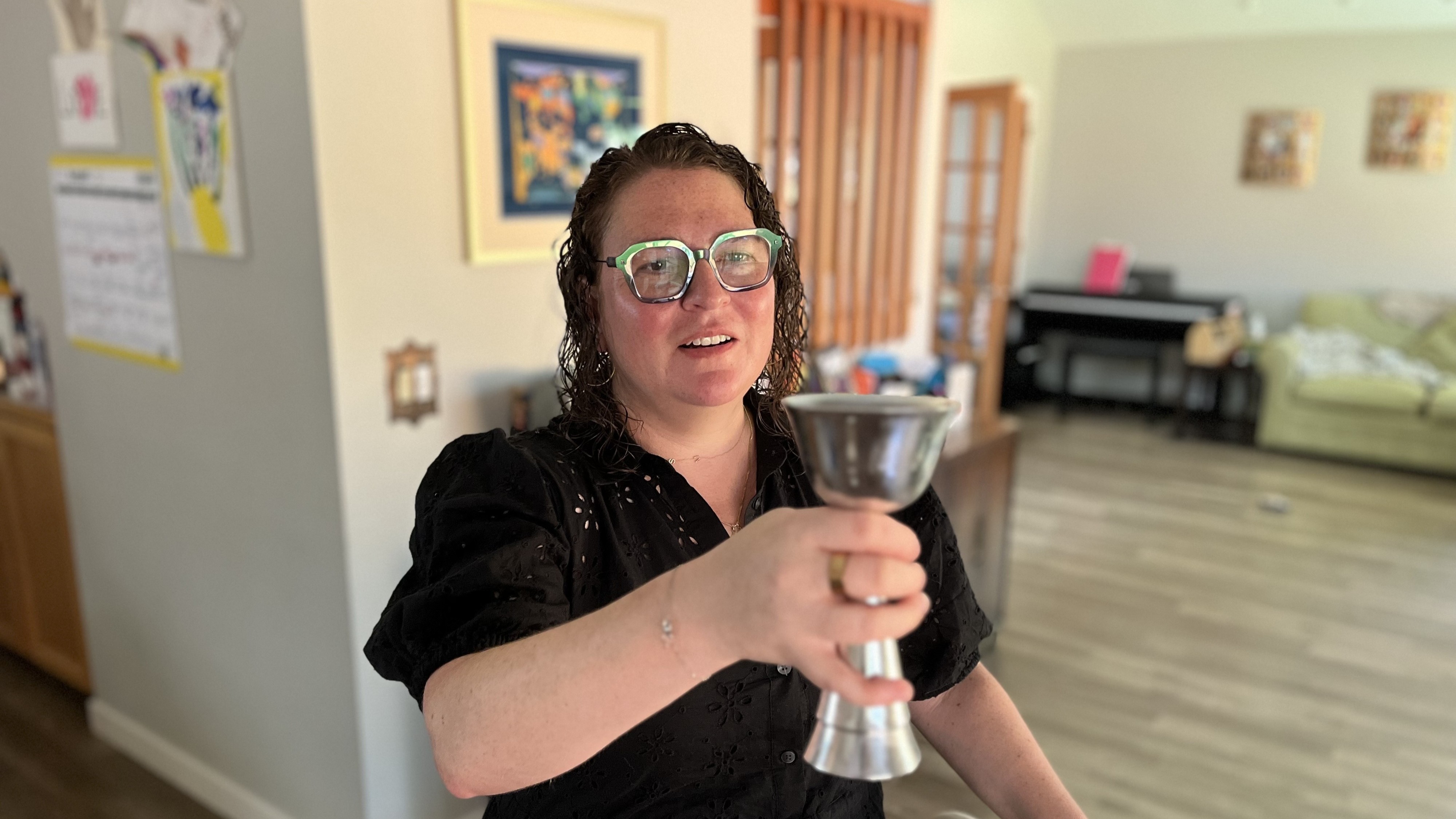
As I like to joke, Cantor Rabbi Bitton’s job is certainly safe with me around. But while I’m not known for my vocal skills, I’m comfortable in the music and melodies of our liturgy. If I had to pick one prayer that always feels easy and natural, it would be the Kiddush, the tunes for both Shabbat and for holidays. I hear my father’s voice in my head, and that always makes it a sacred moment for me. 

Beyond my personal memories, there’s something about the sound of Kiddush that evokes home. Whether it’s sung around a Shabbat table with a full spread or whispered beside a hospital bed with a mini challah and grape juice cup, the words of Kiddush root us. They declare that even when the week spins with demands, there is a sacred pause—an invitation to remember who we are and where we belong.

Parshat Vaetchanan is similarly packed with memory and meaning. After recounting his own plea to enter the Promised Land, Moses pivots to legacy. He repeats the Ten Commandments and delivers the Shema—foundational texts that anchor Jewish identity. It’s a parshah of retelling and reaffirming, of choosing covenant again and again. Amid all this, the holiness of Shabbat is once more commanded: “Guard the Sabbath day and keep it holy, as the Lord your God has commanded you” (Deuteronomy 5:12).

This verse differs subtly from its twin in Exodus, where we are told to Remember (zachor) the Sabbath day.” Here in Deuteronomy, we are told to “guard” (shamor) it. Our tradition famously teaches that both words were spoken by God in a single utterance: zachor v’shamor b’dibbur echad. Kiddush, the sanctification of Shabbat, blends these themes. When we lift the wine and recite Kiddush, we remember the acts of creation and guard the sanctity of time through ritual and restraint.

Kiddush is more than a pre-dinner ritual. It’s a declaration of values. It reminds us that our worth isn’t measured by productivity, that time can be holy, and that rest is resistance in a world that demands constant motion. This Shabbat, I invite you to listen closely to Kiddush. Let it be more than a recitation; let it be a reset. A recommitment to living with intention, to protecting what is sacred, and to remembering that holiness doesn’t just happen—it’s something we choose to create, together.

Place of Refuge – Parshat Vaetchanan 5784

I love visiting summer camps; it’s a highlight of every summer. I just visited Camp Solomon Schechter earlier this month, and walking through the gates of Schechter or BB Camp and seeing the vast expanse of nature and the cheerful sounds of joyful kids brings me peace and contentment on a whole other level. Do you know what’s funny about that? I hated being a camper at overnight camp. To clarify, I tolerated most of camp. From 8 a.m. to 8 p.m. I was a pretty happy camper. It’s just that by the end of the day, I was peopled out. Back in the 80s and 90s, we didn’t understand sensory processing disorders or introversion the way we do today. There was no safe place for me to take refuge when the noise and excitement of camp got too overwhelming for me. So while camp is supposed to be a refuge from the rest of the chaos in our world, it started out for me as its own chaotic space that just left me wanting for quiet.  

Yet, this time in my childhood represents one of my most important and treasured experiences because of the lesson it still provides. As a rabbi now, this is a constant reminder to me to hold the balance between the variety of needs our congregants have in order to feel a place of calm. It has often been said that we lead from the place of our own brokenness to create a new wholeness, that is indeed true not only of my own leadership, but of Moses as well.  

Parshat Vaetchanan continues with the retelling of the laws here again in the book of Deuteronomy. We also read about God’s persistent refusal to allow Moshe to enter the Land of Israel. The Torah then issues a caution to uphold the mitzvot as the key to building an Israelite society. Moshe then sets three cities of refuge, and we receive probably the most well-known instruction in the Torah, the Shema.  

In chapter 4, verses 41-42 the text reads: “Then Moses set aside three cities on the east side of the Jordan to which a manslayer could escape, one who unwittingly slew a fellow without having been hostile to him in the past; he could flee to one of these cities and live.” These verses follow an address but were not directly spoken by Moses; it’s simply narrative. Commentary asks the question “Why would this act be so important to Moses that it interrupts his address to the nation?” The answer is because Moses himself had to flee when he struck a man in Egypt. In other words, as a leader, Moses knows what it is to need a place of refuge to regroup and understands the importance of those places in a society. 

Parshat Vaetchanan makes it clear that a place of refuge can look different for each person. What matters is not what or where the place is, but how we can be supportive of the environment that allows for refuge to take place. As we move slowly to the final encampment of the Israelites in the land of Israel, Moses and the Torah give us this message: find your place, find your peace. 

The Blame Game – Parshat Vaetchanan 5783

“It wasn’t me.” It’s a common phrase among kids when a situation has gone south. However, adults seem to be just as guilty of passing blame when no one wants to take responsibility for what’s gone wrong. Why? Because as humans it’s usually in our nature to do that which is right, and we’ll try to avoid shame at all costs. It can be hard to tell when someone is ashamed because we humans have evolved into amazing actors. A dog puts their tail between their legs, but humans have a range of emotional subtleties and better mechanisms to hide our true feelings. Does that mean there’s some evolutionary reason behind passing the blame?

Avoiding responsibility could have any number of causes. Perhaps it’s the weight of feeling like you’ve let someone down. Perhaps you feel you did your part and it was someone else who didn’t, and there’s no easy way to say that. Whatever the circumstances, sharing blame always feels easier than shouldering that burden on our own. 

The Torah often gives us glimpses into understanding temptation and the motivation that goes with it, and this week’s Torah portion is no exception. Parshat Vaetchanan continues with the retelling of the laws here again in the book of Deuteronomy. We also read about God’s persistent refusal to allow Moses to enter the Land of Israel. The Torah then issues a caution to uphold the mitzvot as the key to building an Israelite society. Moses then sets three cities of refuge, and we receive probably the most well-known instruction in the Torah, the Shema. 

As Moses moves towards the end of his tenure as the leader of the Israelite nation, it’s clear that he is devoted to doing what is right for the people, but after so much time arguing on their behalf and defending them, he’s a little bit worn out. In chapter 4, verse 21 he suddenly changes his language. Instead of arguing for ALL the people, including himself, he argues “the Lord was angry with me on your account.” Such to say, God is mad at me because I am responsible for you. 

One could argue that it was Moses’s missteps as a leader that set him up to take responsibility for the missteps of the people in this text. Another argument could be that Moses did all he could to guide the people, and yet they still made mistakes, they didn’t listen, and they caused harm. But the bigger message here is that leaders, like Moses, do more than inspire or rally or blaze a trail. They are willing to accept responsibility, for better or worse.

Temptation Looms – Parshat Vaetchanan 5782

Am I the only one who can’t keep certain foods in the house because I can’t keep myself from eating them? Pre-Covid, our house had just a small assortment of salty snacks, mostly because I simply could not eat them in moderation. When we found ourselves home all the time with two children who were constantly hungry for a snack, we quickly tired of constantly putting food in bowls and then washing those bowls. Instead, we opted for single serving packages of all their favorites (Chex Mix, potato chips, Cheez-Its, Cheetos) so we could put them in an easily accessible place and not have to spend the whole day portioning food. While we’ve gone back to bulk sizes to avoid waste, unfortunately now we’ve gotten in the habit of having all my favorite snack foods readily available at home, and I’ve had to find a way to keep myself from grazing on them all day every day. 

The truth is I’m a big believer in moderation and learning my limits, I just didn’t want to with these foods. My original plan of keeping minimal pantry items may have worked for me, but it wasn’t the right choice to keep them from my other family members who enjoy them. As with so many parts of our lives, temptation is best overcome by digging in and understanding our limits and boundaries. 

The Torah periodically shows us types of temptation to avoid, and each time is another reminder of how powerful our choices can be. Parshat Vaetchanan continues with the retelling of the laws here again in the book of Deuteronomy. We also read about God’s persistent refusal to allow Moshe to enter the Land of Israel. The Torah issues a caution to uphold the mitzvot as the key to building an Israelite society, Moshe sets three cities of refuge, and we receive what is the most well-known instruction in the Torah, the Shema. 

Among these rules and rehashing of appropriate worship, in chapter four we read about all the objects and beings of God’s creation. The sky, the sun and stars, animals, human kind. And, while talking about how awe-inspiring those creations are, the Torah tells us not to worship them. This is a warning against the sultry seduction of the idolatry practiced in the nations that surround the Israelites. But this section of text makes you wonder: if the Torah is concerned that we’ll stray from our worship of God to worshiping the natural world, why were these celestial bodies and earthly wonders even created? In other words, if I can’t keep my hands out of the bag of Cheetos, why keep them in the house?

For one thing, the rest of creation is critical to our survival. Clearly there’s a difference between humankind needing the sun’s light and my “needing” a bag of Cheetos. But even more than that, the gift of choice is one of the signs of the divine spark within us. The free will we have to choose to eat for nourishment (and maybe occasionally for pleasure) and to choose to maintain our faith is the true gift of life.