Playing Favorites – Parshat Ki Tetzei 5775

Playing Favorites

If you’re like many Americans, you spent some time this spring living vicariously as citizens of the Commonwealth, anticipating the arrival of a second child to Prince William and Duchess Kate.  Though we can assume baby Princess Charlotte will be her older brother’s equal in the eyes of her parents, in the royal line of succession, she will always be behind him. Prince George has the same parents, the same upbringing, and the same lineage, yet as heirs to the British throne, he will always be ahead of his sister.  Tough break.  And if you’re up on your royal family knowledge, you also know that both Prince George and Princess Charlotte are in line ahead of their uncle, Prince Harry. Tougher break.

In this case there was no “picking” a favorite. Will and Kate have no choice in the matter; they are bound by a set of laws that have been in existence for centuries.  In fact, similar rules even go back to the Torah in parshat Ki Tetzei, which we read this week.  

This portion of Torah contains in it more laws than any other single portion of Torah.  In it we have laws that govern our fields, our interactions with others, how we treat ourselves, returning lost items, signs of purity, merits involved in various acts, and a whole lot more.  But among the first items the text covers are the laws of a first-born.  

The text states:

“If a man has two wives, one that he loves and another that he hates, and the one he hates gives him a child first, he must not treat as first-born the son of the loved one in disregard of the son of the unloved one who is older.  Instead, he must accept the first-born, the son of the unloved one, and allot to him a double portion of all he possesses; since he is the fruit of his vigor, the birthright his due.”

Basically, a child’s rights are to remain intact regardless of whom the mother is or how the child behaves. That child must still be loved and supported.

I often look to the Torah as a guide for how to educate and adapt in today’s world, and this week’s parshah provides us with a deep and meaningful lesson as we begin a new school year. Even though teachers try not to play favorites, that doesn’t mean they won’t have favorites. There will be children we love and children we’d rather not put up with.  There will be students and parents who push our buttons, and those who are nothing but understanding.  But even if we get on one another’s nerves, we must remember to treat each other with the respect due to other human beings.  Each child, each parent, each teacher, each administrator is entitled to the same respect, love, and compassion, no matter what relationship we have with them.  

May we always strive to move away from dividing the world between those we love and those we hate, and instead use categories like those we respect, those we admire, those who challenge us to be better, and those who are a gift simply because of their presence in our lives.

[photo credit: Royal Baby_031 via photopin (license)]
Context Clues – Parshat Shoftim 5775

Context Clues

Is there anything more unnerving than walking into a room while people are having a conversation, and at the moment you enter, the conversation stops?  There’s a good chance the conversation just hit a natural pause or lull, but it’s easy to jump to the conclusion that the conversation must have been about you.

Or how about this scenario: you walk into a room during a conversation, and the first thing you hear sounds completely ridiculous or highly inappropriate. Just like the pause, it probably made total sense and seemed completely natural in the context of the conversation, but you weren’t present for the rest of the dialogue.

Context is key. So much of our lives and understanding of the world around us is about knowing the recent history of people, conversations, and events.  This is especially true in the legal world.

This week we read from parshat Shoftim, a section of Torah that completely focuses on the legal system, on justice, and on context.  This text includes the commandment to establish judges and officers, as well as a listing of punishments for certain transgressions against mitzvot.  We also learn about the laws surrounding false witnesses and murder.  The notion of motive comes to light as the Torah discusses the challenge in proving intent.  

Chapter 17, verses 8-9 teach, “If a case is too baffling for you to decide, be it a controversy over homicide, civil law, or assault – matters of dispute in your courts – you shall promptly repair to the place that the Lord your God will have chosen, and appear before the levitical priests, or the magistrate in charge at the time and present your problem.”

Of note in this verse is the phrasing of “the magistrate in charge at the time.”  That is to say that the authority needs to know not only the law, but also its context in the society at the time.  The Torah is quick to teach that only a judge living in today’s world can understand how to apply the law today.

This holds true for conservative Judaism, which is based on the idea of tradition and change. The balance between the two is the beauty of our movement.  Our tradition and our practice truly rest on the fine line between Jewish law and the modernity of our world. Just this week, Rabbi Jeremy Fine of Temple of Aaron in St. Paul wrote an interesting piece for Jewish Journal about the dwindling number of traditional conservative rabbis. Whether or not you agree with his definition of “traditional,” at the heart of his argument is the truth that rabbis and congregants alike get out of our religion what they put into it. The conservative movement will not thrive without Jewish communities actively participating in their Judaism.

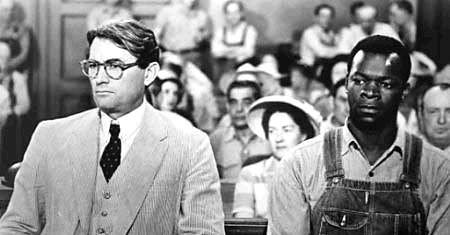
However, that same contextual perspective (the context lens, if you will) also reminds us that although we may know what is best for ourselves and for our families, it is not for us to judge others because we simply cannot know the entire story. Do you remember the perpetual moral compass of Atticus Finch in To Kill A Mockingbird?  The character sums it up perfectly in the third chapter, when he advises Scout, “You never really understand a person until you consider things from his point of view . . . until you climb into his skin and walk around in it.”

The Torah’s message is clear.  It is impossible to judge without fully understanding another person’s context, and even then it’s best left to legal professionals.  Our role is to live in our time, to make tradition, ritual, and mitzvot meaningful and relevant to the world in which we’re living.

Touchy-Feely – Parshat Re’eh 5775

Touchy-Feely

Two friends are out walking their dogs, and one friend says to the other, “Yesterday I taught my dog to whistle.” The second friend turns and says, “That’s incredible! Can I hear it?” The first one says, “Of course not. I only taught it to him – he didn’t learn it.”

I’m not sure this concept is obvious until you actually stop to think about it. Teaching doesn’t automatically equal learning, in the same way that cooking dinner doesn’t automatically mean a certain two-year-old is going to eat it. I’m not talking about anyone in particular, of course. The point is that it’s the responsibility of the learner – or the eater – to digest the information.

In rabbinical school, my classmates always made fun of me because of the way I sat with my pen and paper and outlined every piece of reading material we were ever assigned.  That was how I learned the information best, by the tactile nature of handwritten note-taking.  I could never take notes on a computer; to this day, I need to write by hand in order to remember.  These notes and outlines were the key to my success in school, and I still have them.  If there’s ever a “rabbi edition” of the TV show “Hoarders,” you’ll get a first-hand look at my boxes of handmade flashcards.  

There are multiple theories as to when and why absorption of data happens, but the way we interact with our world and the way we take in information differs from person to person and from subject to subject. You may have heard of the theory of multiple intelligences, developed by Howard Gardner, a psychologist who determined that there are eight modalities that are used in order to hold information.  The theory suggests that for a lesson to stick, or material to be learned, we must take it in in a way that speaks to us individually.

The Torah is perhaps the first curriculum written for multiple intelligence learning.  We read parshat Re’eh this week as the Torah races to the finish line of its lessons.  In our parshah we learn about the blessings and curses that will come with observance (or lack thereof) of the mitzvot we’re given.  We receive some final warnings about following the laws against idolatry, laws for keeping kosher, and the importance of treating each other as equals.  Finally, we receive some more information on our three pilgrimage festivals.  

The parshah begins with Re’eh, “see the blessings and curses,” but just a verse later we read “if you do not hear the commandments…”  The Torah understands that we absorb information differently – some by seeing, some by hearing, and some by touching.  There are Israelites who might have heard God’s booming voice at Sinai, but because they couldn’t see it, didn’t believe it.  There are those who might have seen the grand show from Sinai, but needed to actually hear God’s voice in order to take it all in.  

I mentioned before that there are multiple learning theories. There’s also the theory that it’s the subject matter that is the bigger factor in successful learning. If you’re going to learn how to drive, how would you like to learn? By reading about driving, by engaging in a lively debate about driving, or by getting behind the wheel? Learning to drive needs a hands-on approach. Now let’s say you’re learning about the subject of legal ethics and pose the same question. Most of us go for the lively debate, right?

The Torah gives us the subject-based side of the coin too. We have commandments based on intellectual and spiritual concepts:

Hallow God’s name. (Lev. 22:32)

Don’t bear a grudge. (Lev. 19:18)

And we have commandments that are purely tactile or auditory:

Hear the sound of the shofar. (Num. 29:1)

Eat matzah on the first night of Pesach. (Ex. 12:18)

To live a Jewish life, we have to engage our intellects and our senses. What a concept!

As I reminded my classmates back in school, we all learn differently, and, guess what, we all graduated.  This week as we read parshat Re’eh, we are reminded that Judaism is experienced uniquely by each of us and in each of the ways we are commanded to do so. Listen to the Shema, see the flame of the candles, taste the sweetness of the wine, celebrate Shabbat. Most importantly, make it your journey of learning.

Stubborn and Stiff-necked – Parshat Eikev 5775

Stubborn

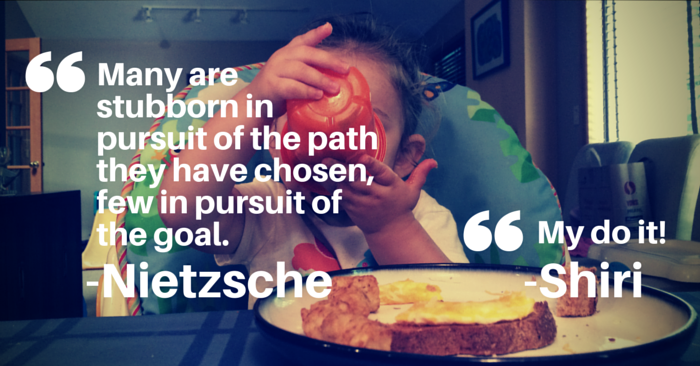
I can be stubborn. It’s innate, and it’s among my less than desireable qualities. My mom will tell you I was a stubborn child, and I have no doubt she’s right, given the stubbornness Shiri exhibits more and more as she approaches two years old. However, I’m also convinced our stubborn ways aren’t closing us off to other ideas and opinions; they simply mean we stick to our guns where things like what we want to do with our days or exactly what we want to eat are concerned.

Shiri does things on her own terms, whether that means waiting to walk until well into her fourteenth month, refusing food until we can identify what she’s craving, or waking up early simply so we come in and hug her.  I’ve heard countless times that a strong will is a good quality to have, as it usually means she will advocate for her needs. This independent stubbornness will most likely serve to her benefit as she grows. At the same time, it is extremely trying in a two-year-old.

We learn in our parshah this week, parshat Eikev, that raising a stiff-necked child is nothing new.  The the Israelites were also stubborn.  The parshah begins with a reminder of the blessings and rewards of success that will come to the Israelites if they guard and observe the Torah and all of its commandments.  We are then reminded of our responsibility to remove idolaters from our midst.  The final section of the parshah is a reminder of the Israelites’ experiences in the desert, their missteps and what they learned from each of these moments.

Chapter 9, verse 6 teaches, “Know, then, that it is not for any virtue of yours that the Lord your God is giving you this good land to possess; for you are a stiff-necked people.  Remember; never forget how you provoked the Lord your God in anger.”  This is basically a scolding of the Israelites, reminding them that they are receiving the Promised Land not because of their excellent behavior, but because they earned it in a battle of endurance.

“Stiff-necked” is not usually a compliment; we often think of it as a negative trait.  It makes you think of people who are unwilling to change, who can’t take criticism. However, the commentary Exodus Rabbah gives this section of our text a different spin.  “The stubbornness of the Jews in the face of persecution has enabled us to remain Jewish through the centuries.”  In other words, without this stubborn nature, the Jewish people would not have stood the test of time.

And when you think about it, the very narrative we live by is the most stubborn part about us. When you think of the Torah scroll, what comes to mind? The atzei chayim, the handles at the ends of the center dowels, are incredibly stiff-necked to support the weight of our history. The text contained within it is a stubborn, unchanging document, and the stubbornness is reinforced year after year because we cycle through the exact same parshiyot.

Yet, as conservative Jews we have managed to find the balance between sacred, stubborn tradition and lifestyle choices that don’t hermetically seal our culture and cut it off from the world.  We argue, we question, we test our limits. Welcome to Judaism 101 – yes, you’re in the right place. Maybe that’s why as frustrating as Shiri’s stubbornness can be, it’s also a huge relief, because I know that even at her young age, she’s embracing her heritage. Now if I could only get her to eat carrots.

Seeing is Believing – Parshat Vaetchanan 5775

Seeing is Believing

The Shema is the crux of monotheism: “Hear O Israel, Adonai is our God, Adonai is one.”  It’s one of the first prayers our children learn, and we assign it a variety of rituals.  We might ask the children to make the Hebrew letter shin (showing 3 fingers) with their hands as they cover their eyes to teach that Shema begins with shin.  In our house the Shema is a part of our bedtime ritual, sending our daughter to dreamland with one last bit of Jewish faith before she falls asleep.  Traditionally, this is also the last prayer Jews will say upon their death bed.  Whatever ritual you primarily associate with the prayer, the Shema is universal among Jews, and known by many outside the Jewish religion.

This week we read parshat Vaetchanan, the second section of text in the book of Deuteronomy.  It is perhaps one of the most famous texts in our Torah.  Moses requests to enter the land of Israel, but God remains firm in his punishment of forbidding Moses from stepping foot in the promised land.  The Torah sends out a caution to observe the commandments therein and reaffirms that idols are prohibited, which we learn in the Shema, stating there is only one God.  We also receive the second giving of the Ten Commandments and are to teach these words to our children.

There is extra attention paid to the idea that Judaism must be lived, it cannot simply be learned.  Chapter 4, verse 9 teaches, “But take utmost care and watch yourselves scrupulously, so that you do not forget the things that you saw with your own eyes and so that they do not fade from your mind as long as you live.  And make them known to your children and to your children’s children.”  The Torah is insistent that Judaism hinges upon experience, and it provides pathways for those who were not able to witness the Exodus firsthand.  None of us today were there at Sinai, but we certainly have the ability to live, breath, and experience Judaism on a daily basis.

The phrase “people of the book” is often used to lump together many of the so-called Abrahamic religions.  Jews, Muslims, Baptists, Methodists, and others have embraced this way of aligning ourselves with the laws that define our various traditions.  But if there was one term to distinguish Jewish tradition, you could make a strong argument for “witness.”  We are a people of witnesses, and it is demanded of us that we see and engage in the world through a Jewish lens.  That is the beauty of Jewish living.

The final letters of the first and last words of the Shema are ayin and daled.  Ayin is the last letter in the word shema, and daled is the last letter in the word echad.  Combined, they spell eid, witness.  Our parshah this week teaches us that living our lives as Jews means that we are witness to the power of experience and the power of community.  We cover our eyes to show our belief in God when we recite our central prayer, but we open our eyes in order to experience the wonder that is Jewish living and learning.

I’ll leave you with a final anecdote that is one of my favorite experiences as a rabbi so far.  The religious questions that rabbis get from kids are the best.  When is God’s birthday?  Were there dinosaurs on Noah’s ark?  An inquisitive first grader once asked me, “Why is the Shema written in the prayer book if we always cover our eyes when we say it?”  What an astute observation.  The sentiment is well represented in this week’s parshah.  Clearly, there would be no need for our main tenet of faith to be written in the siddur if we all internalized these essential words the way we teach our children to do.

[photo credit: Black & White Justice via photopin (license)]