
Enough Is Enough – Parshat Lech Lecha 5776

Enough is Enough

I remember when I learned that the Hebrew word for “enough” was “dy.” I was just a little kid in Hebrew class, and when you’re young, it’s a little jarring when your teacher says, “Die, die!” As I learned, she didn’t actually wish me ill, although if you knew me as a child, perhaps the sentiment was fairly close.

You might know this word from the Passover seder, when we sing “Dy-dyainu,” about what would have been enough for God to do for the Israelites. There is something somewhat poetic about a word that in English means the end of a life and in Hebrew means an adequate quantity of something. Of course we all want to feel at the end of our lives that we’ve lived enough, to look back on a full, complete life.

This week we read parshat Lech Lecha, which is often noted as the true beginning of the Israelite nation as we know it in the rest of the Torah. In this text we are introduced officially to Abraham and Sarah. We learn of their marriage and their problems trying to conceive. More than that, we see Abraham lead his family into new territory (religiously and physically) and struggle with what it means to be an outsider. At the very core of this section of text is the narrative of God and Abraham coming to an agreement and bonding with each other for the future. This is the moment that marks the establishment of ritual and tradition that has evolved to become the Judaism of today.

In chapter 17 of Genesis we read, “When Abram was ninety-nine years old, the Lord appeared to Abram and said to him, ‘I am El Shaddai. Walk in my ways and be blameless. I will establish My covenant between Me and you, and I will make you exceedingly numerous.’” This is God’s call to Abraham (then Abram) to step up and take on the leadership of an entire nation.

Unique to this single passage is the name God uses here; “El Shaddai” isn’t a clear name for God. A midrash teaches that this is the phrase “El sh’dai,” which can be translated as “the God who says enough.” One possible interpretation is that God has had enough of people acting without righteousness, without responsibility. God turns to Abraham and says, “Enough of this!” and demands righteous behavior of them. Abraham accepts this decree, affirming the covenant with his circumcision, and he steps up to teach humanity what a God-ordained life can mean.

The Torah reminds us this week that exclaiming “Dy!” (Enough!) isn’t just about ending a negative action or a frustrating situation. It also signals the start of a positive one. History is filled with “enough” moments, from Moshe to Rosa Parks, from Hannah Szenes to Harvey Milk. A call for “enough” can mean standing up for what needs to change or taking control of a situation to make that change happen. May we have the courage to be able to say “enough” and the awareness to be able to know when.

Do It Myself – Parshat Noach 5776

Do It Myself

Now that Shiri is reaching the true height of toddlerhood, we have a whole new dynamic going on in our house.  Shiri is Miss Independent and wants to do things all by herself.  This initiative is often helpful. She now feeds the dog regularly, takes off her own coat, puts things in the garbage, and cleans up her toys.  

However, sometimes she comes across a task that is beyond her current mental or physical capabilities.  While it would be lovely for her to open the fridge and take out and pour her own milk, she just isn’t tall or strong enough to do it.  Naturally, I intervene by starting to take the carton out myself. That’s when I hear, “No, no, no!” and screamy Shiri has reemerged.  She has switched on her mode of “I do it.”  

I don’t blame her for wanting to do more. Shiri, like all of us, loves the sense of accomplishment she feels when she successfully completes a task.  And while I don’t love the screaming and complaining, I do love her independence and admire her desire to take ownership of her world.

Taking ownership of our actions is an essential theme throughout the Torah.  We start with Adam and Eve figuring out how to own their actions when they disobey God. We are similarly confronted with ownership of choices as Cain responds to God, “Am I my brother’s keeper?”  The first parshah of the Torah, which we read last week, focuses intently on the importance of owning our actions and decisions.

It is no surprise that in this week’s parshah, Parshat Noach, we are again faced with a society in need of a similar ownership over action.  Parshat Noach details the misbehaviors of the people who inhabit the earth.  We read about Noah as a beacon of hope among the despicable people of his town.  God instructs Noah to build the ark, put the animals on it, and escape destruction under God’s protection during the flood.  Noah’s story is capped off with a covenant between God and mankind to never again destroy the world, but the beauty of the rainbow is quickly tainted as we learn of the misdeeds committed by a new mankind in trying to reach up closer to God.

The story of Noah brings to light many questions about God’s actions and innate human behaviors.  Notably, why did God command Noah to build an ark and save himself, when surely our all-powerful God could have intervened directly and saved Noah, his family, and all the animals.  The Tanchuma suggests that perhaps God hoped the construction project would serve as a warning, moving onlookers to contemplate their actions.  Or perhaps Noah needed to participate hands-on in his own salvation in order to help save and rebuild mankind.  After all, doing is often the best way to learn.

Reading this narrative we see a fledgling society, deep in their “toddlerdom” if you will. Like my sweet Shiri, Noah and the people need to do it themselves in order to feel a sense of accomplishment.  As a parent, it’s easy to swoop in and help out our children when they’re frustrated, but perhaps their do-it-myself reaction stands as a reminder that we should act as God did and allow some (safe) trial and error.  

This week, let us consider the ephemeral nature of the rainbow. The sign of the covenant is fleeting, but the rewards from keeping promises and owning up to our actions leave a lasting mark.

Why I Believe in God – Parshat Bereshit 5776

Chaplain

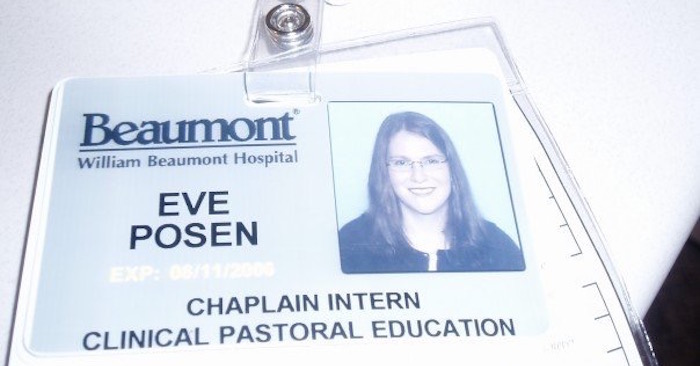
During rabbinical school I spent one summer doing a unit of clinical pastoral education at a hospital in Michigan.  My reasoning for spending that time in a hospital setting was twofold. First, I needed to get over some of my fear of the hospital environment and learn how to bring the most comfort to the most vulnerable.  Second, I have long had a fascination with medicine, and this intensive program put me on overnight on-calls, trauma teams, and in the ICU standing right with the medical professionals.  This was a lifechanging experience for me on so many levels, but most notably with my belief in God.  

I was honored to be invited to sit in on an autopsy as the team worked to identify the cause of death.  I stood in the room with my colleague and watched as the professionals went to work.  To my amazement, their tools included a saw. Our bones are so hard and strong, they need the force of a heavy saw to cut open, and yet this woman died from bleeding caused by the tiniest pinhole tear.  In that instant I became truly aware of the complexities of the human body, the intricacies with which we are created.  In that moment I knew God existed.  In a sense, for me this was the beginning.

This week we read parshat Bereshit, the first portion of the Torah.  We begin again with our familiar story and move quickly from the days of creation through the narrative of Adam and Eve in the beautiful Garden of Eden to the first time someone challenged God.  From there we experience the narrative of Cain and Abel and the first explosive sibling rivalry.  The entire section of texts ends by careening us forward in time to the line of Noah.  

But we begin with the beginning.  “When God began to create heaven and earth, the earth being unformed and void with darkness over the surface of the deep…” The Torah begins with this sentence, acknowledging the beginning of all beginnings.  Rabbi Akiva, a Talmudic sage, taught, “Just as the existence of a house testifies to the builder and the existence of a garment testifies to the weaver, so the existence of the world testifies to God who fashioned it.”  

On the surface, Rabbi Akiva’s proof of God rests in the mere existence of the world, but what he is implying is that the divinity of the architecture is in the complexity of it. The beginning of my belief in God was that moment in the hospital.  I believe in God because I saw firsthand what unique systems and works of art our bodies are, and they are beyond anything my mind can consider creating. In that small, sterile basement room, I met God, and it was a moment that opened my eyes to a miracle which I cannot understand outside the realm of faith.

It’s not my job to persuade you to believe in God. As far as explanations go, you might take an approach that is purely divine, one that is purely scientific, or one that falls somewhere in between. Nevertheless, starting our year and our Torah cycle anew does compel us to see the world in a new light. However the story of creation resonates with you, in this new light may we find moments of belief, moments of clarity, and perhaps moments that acknowledge the presence of God in some way.