Remember the Alamo

This is the d’var Torah I delivered at Congregation Neveh Shalom on Saturday, August 22, 2026


I was in San Antonio last Shabbat with my nieces and in-laws. And there was something there that I was supposed to remember, but for the life of me, I don’t know what I was supposed to remember.

I’m kidding; of course I remembered the Alamo. We made a special trip to take a photo in front of the iconic mission building so we would never forget the Alamo. Do you know how the city has made sure that no one ever forgets the Alamo? There are hundreds of businesses in San Antonio named after it.  

There’s Alamo Xtreme AC & Heating, Alamo Aquatic Pets, Alamo Area Beekeepers Association, Alamo Succulents. I imagine telling Davy Crockett, “Don’t worry, we remember the Alamo. We have Alamo Urology Associates to remind us.” 

The Torah portion is in here somewhere, I promise. There are weeks when Torah gives us one big idea to wrestle with. And then there is Ki Tetzei. 

Ki Tetzei contains 74 mitzvot, more commandments than any other parshah in the Torah. It can feel almost breathless: laws about family relationships, returning lost objects, building safe homes, paying workers on time, caring for the vulnerable, honest business practices, treatment of animals, and how we conduct ourselves even in war. 

It is as though Torah is saying: there is no part of human life exempt from the demands of being a decent human being. 

And then, after all those laws, Ki Tetzei ends with something entirely different: Zachor et asher asah lecha Amalek. “Remember the Amalek!” Well, sort of. It’s “Remember what Amalek did to you.” 

The Torah tells us that Amalek attacked the Israelites from behind, targeting kol hanecheshalim acharecha, those who were weakest, exhausted, and straggling behind. “Remember the Alamo” was about avenging the loss, but our rabbis take a different approach to remembering Amalek.  

Rashi, commenting on the word karcha, that Amalek “happened upon you,” suggests that Amalek represents a cooling of moral urgency. When human beings can look at suffering and become indifferent to it, that’s when Amalek enters. 

Perhaps that is why this reminder comes after 73 mitzvot. Ki Tetzei has spent an entire parshah teaching us that there is no arena of human life in which our moral obligations disappear. Not our homes. Not our businesses. Not our relationships with strangers. Remarkably, not even war. 

Earlier in the parshah, Torah commands that the military camp itself must remain kadosh, holy. Torah knows that war is messy and frightening, that human beings make impossible choices under impossible circumstances. And still it insists: even here, there are boundaries. Even here, human dignity matters.  

That is an enormously challenging teaching; the Torah asks us not to surrender our moral voice. Not only in global conflict, but in our local communities. When someone is demeaned, excluded, intimidated, or treated unfairly, our first question cannot be, “Whose side are they on?” It must be, “What does Torah require of me here?” 

Maybe that is why Ki Tetzei ends with Amalek. 

Amalek attacked hanecheshalim acharecha, those who were vulnerable and straggling behind. Torah commands us to remember because a sacred community is measured, in part, by what happens to the people who are easiest to overlook. 

Our charge, then, is not to have the perfect political analysis. It is to refuse moral indifference. To notice. To question. To speak when necessary. And perhaps hardest of all, to remain willing to examine our own camp with the same moral seriousness with which we examine everyone else’s. 

Seventy-four mitzvot remind us that holiness lives in the details. Amalek reminds us that holiness also requires courage. We remember, and in the remembering, may we have the courage to stand firmly for our beliefs while not losing the qualities that make us all human. 
Blessings for Daily Life and Responsibility

Think about the little blessings in your daily life. Not just the words “Baruch atah Adonai” that start our prayers, but the moments that remind you to pause: fastening your seatbelt, checking in on a friend, holding the door open for a stranger. These small acts don’t always feel holy, but they are the threads that bind our communities together. 

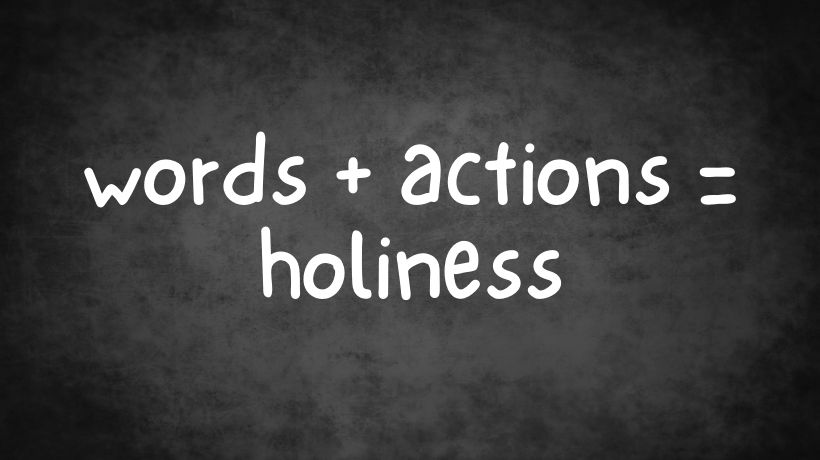
Parshat Ki Teitzei is overflowing with mitzvot—more than 70 in total—spanning topics of family, justice, compassion, business, and community. Some seem weighty, like laws of inheritance or capital punishment. Others seem small, almost ordinary: return your neighbor’s lost ox, build a guardrail on your roof, send away the mother bird before taking eggs. The Torah presents a vision of holiness not only in great rituals but in the everyday details of how we live together.

Each of these mitzvot invites us to respond with a blessing formula: Baruch atah Adonai, asher kid’shanu b’mitzvotav v’tzivanu. “Blessed are you, Eternal One, who has sanctified us with commandments and commanded us…” The words remind us that holiness isn’t only found within the walls of Neveh Shalom or in our homes on Shabbat, but in our daily responsibilities. For example:

  • Returning a lost object (22:1–3) transforms inconvenience into kindness.
  • Building a fence around your roof (22:8) turns private property into shared responsibility, preventing harm to others.
  • Sending away the mother bird before taking eggs (22:6–7) teaches compassion and gentleness toward even the smallest of creatures.

These mitzvot, and the blessings that accompany them, create a rhythm of sanctity in daily life. By reciting blessings, we pause, notice, and elevate acts that might otherwise pass by unnoticed. In doing so, we acknowledge that safeguarding life and practicing compassion are not optional extras but the very core of Jewish living.

Ki Teitzei challenges us to see our daily actions as opportunities for blessing. Each time we care for another person, act with responsibility, or protect the vulnerable, we are living the words asher kid’shanu b’mitzvotav. This week, don’t wait for Shabbat or holidays to sanctify your life. Make a blessing with your actions: return what isn’t yours, put up your “fences” of care and caution, and treat others with compassion. In doing so, may our ordinary days be filled with extraordinary holiness.

To Live Forever – Parshat Ki Teitzei 5784

As a rabbi I am privileged to be with families in their most joyful moments and in their lowest moments. I am often the confidante with whom people share their fears, desires, and wishes when they have nowhere else to turn. It is in this work that I have often been asked about what happens to our loved ones after they die. And the truth is, I don’t know. No one does. Well, physically we know that our bodies decompose and go back to the dust of the earth from which we were formed. Spiritually, however, we just don’t know. While we have people who have been miraculously revived after a medical death, we don’t have concrete or consistent data. While we might believe that the soul “returns” to God after we die, the question remains, does the soul survive in any significant way? Is reincarnation real? Can my deceased loved one still be present in my life?

My answer to these questions is generally one of inquiry and wonder: what do you think? I could argue both sides of any theory on what happens spiritually to our souls after we die. What we’re really asking in this question is to know, perhaps, that our lives mattered, that when we die we’re not simply vanished from the world.

Perhaps there’s some guidance, if not definitive answers, in this week’s Torah portion. This week we read Parshat Ki Teitzei. We receive laws about war and taking care of hostages, laws about our clothing, laws about family relationships, including parents and children, laws about taking care of the poor, and so much more. Ki Teitzei is actually the Torah portion with the most number of mitzvot (commandments) in it, but the recurring theme is how we should execute and fulfill the mitzvot prescribed to us.

Chapter 25, verse 6 discusses a levirate marriage in which a married man dies childless and his brother takes the widow as his wife to father a child who will be considered as the son of the deceased man. Why is this the prescribed process? The Torah explains that it’s because his name should not be blotted out. This seems to reflect the belief that death does not put an absolute end to an individual’s existence. A person’s name should not disappear forever once they die. Instead, our names and even our presence in the world live on forever by virtue of our actions in the world while we were alive.

There might be different ways of phrasing the question of life after death and just as many guesses as to the literal answer, but the one thing we know for certain is that what we do in life determines how we’re remembered in death. Not in the way that fame and celebrity provide their own version of a legacy, but in the way that people will remember how you made them feel.

Respect, Just a Little Bit – Parshat Ki Teitzei 5783

When it comes to ethical decisions, the Torah will often offer specific scenarios. For example, “Do not deduct interest from loans to your fellow Israelites” or “When you see the ass of your enemy lying under its burden and would refrain from raising it, you must nevertheless help raise it.”

This week we read Parshat Ki Teitzei. We receive laws about war and taking care of hostages, laws about our clothing, laws about family relationships, including parents and children, laws about taking care of the poor, and so much more. Ki Teitzei is in fact the Torah portion with the most number of mitzvot (commandments) in it, but the recurring theme is how we should execute and fulfill the mitzvot prescribed to us.

Among these verses is a law about what to do if one stumbles upon a bird’s nest in a tree or on the ground with fledglings or eggs and the mother sitting with the nest. What are you to do if you want the eggs?

In theory, this is talking about whether we should chase away the mother, or take the mother along with the eggs. It sounds like a conversation about food or the necessity of materials. However, the Torah is clear in specifying that to take the mother along with the young is brutal and forbidden. Rather, respect for the mother earns one the reward of long life. 

There are only two places in the Torah where long life is the reward for observing a commandment; this is one of them, and the other is in the commandment to honor one’s parents. In other words, “respecting the mother” is highly valued whether or not the mother is human. “Long life” is the promise of fulfillment and joy, and the Torah teaches that a mitzvah as important as respect deserves a reward as meaningful as life itself.

Happy Accidents – Parshat Ki Teitzei 5782

Fans of Bob Ross may remember that part of his teaching philosophy was about embracing those “happy accidents” that happen when something unintentional turns into something beautiful and artistic. It reminds me of the notion of the unintentional mitzvah, an idea as old as the Torah itself.

This week we read Parshat Ki Teitzei. We receive laws about war and taking care of hostages, laws about our clothing, laws about family relationships, laws about taking care of the poor, and so much more. Ki Teitzei is actually the Torah portion with the most number of mitzvot (commandments) in it, but the recurring theme is how we should execute and fulfill the mitzvot prescribed to us.

In particular, the laws cover taking care of the more vulnerable members of the community. While earlier in the Torah we learn about leaving the corner of the fields for those who might be hungry so that they can maintain their dignity and pick the food, Parshat Ki Teitzei offers one more way we can support those in need.

Chapter 24, verse 19 presents an interesting unintentional mitzvah when it states, “When you reap the harvest in your field and overlook a sheaf in the field, do not turn back to get it; it shall go to the stranger, the fatherless and the widow.” No one, in this scenario, is purposefully choosing to overlook a sheaf of grain. For whatever reason, the harvester accidentally missed that sheaf, but that accident is now a mitzvah.  

We encourage our children to give tzedakah and donate to worthy causes. In fact, we have deemphasized big Hanukkah gifts (those come from other family members) in favor of a small donation each of the eight nights. It feels good to give something back, whether that’s signing up for a meal on someone’s Meal Train or supporting Ukraine through a local campaign. Most of the time, Duncan and I coordinate these so we know how much money is going where, or who’s responsible for dropping off dinner to a friend. Once in a great while, though, we accidentally double up – an unintentional mitzvah, if you will. And if you’re going to make a mistake, what better kind of mistake to make than doing an extra mitzvah?

Accidents, by nature, aren’t choices. However, we do have the choice in how we react to something we’ve overlooked. True, it was our intention to donate once or add just a few coins to the tzedakah box, but if a mistake unintentionally supports the community or helps someone else who might not have otherwise benefited, then our mistake becomes a bigger gift. Parshat Ki Teitzei and this specific commandment are meant to remind us that sometimes it can be better to let it go, to embrace the happy unintentionality and make a mistake that might just lift someone else up.