The Shema and V’ahavta, which appear in this week’s parshah, are two of the most well-known passages of the Torah. These lessons of listening and loving are also two of the most important things we teach our children.
Do You Love Me? – Parshat Devarim 5776
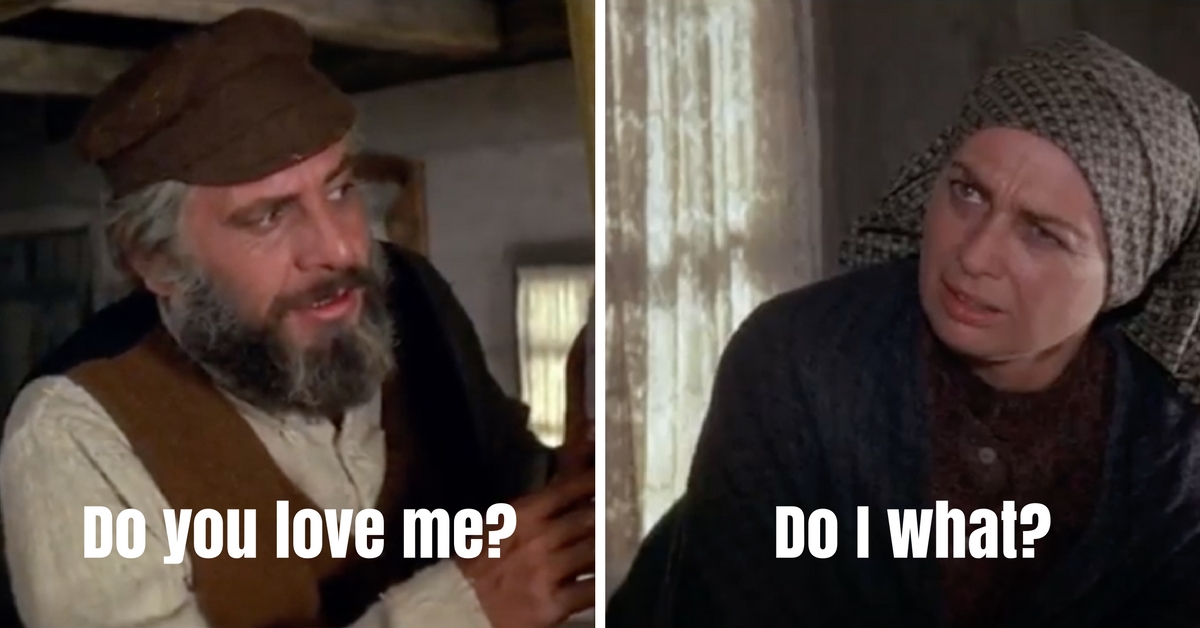
One of my favorite scenes in Fiddler on the Roof is when Tevye and Golde sing their duet “Do You Love Me?” It’s a moment of pure honesty when Tevye questions the state of their marriage after all these years. This kind of emotional check-in is natural; it’s a part of continuing to build a relationship and partnership together. Do you love me? Do you like me? Are you mad at me? These moments happen all the time, perhaps because we’re questioning our own emotions and therefore seek to validate them.
This week in our parshah, we enter into the final book of the Torah, Devarim (Deuteronomy). Devarim stresses the covenant between God and Israel and looks toward Israel’s future in a new land as they build a society that pursues justice and righteousness. The central theme of this section of text is monotheism – the belief in one God – and the summation of the laws we’ve been given over the course of the four previous books.
Chapter 1, verse 27 reveals the Israelites’ conversation with Moshe: “It is because the Lord hates us that He brought us out of the land of Egypt to hand us over to the Amorites.” Though their theory is incorrect, it’s understandable that the Israelites would express this concern. They’ve been moved out of the only land they’ve ever known. They’re scared, and so they blame their fear on God instead of reflecting rationally on the situation.
In fact, Rashi interprets this line as “If God really loved us, God would have given us the land of Egypt and sent the Egyptians into the wilderness.” Their fear blinds them to the possibility that, as difficult as the journey has been, it is because God loves them that they left Egypt. In other words, because I love you I’ve given you the chance to grow, change, and build a whole new nation.
“Do you love me?” is mostly a rhetorical question in the musical. We know they love each other. Sometimes we ask questions when we already know the answers, and as our parshah teaches, this validation is often all we need. Even Tevye and Golde acknowledge: “It doesn’t change a thing, but even so, after 25 years it’s nice to know.”
Parenting by the Parshah – Devarim
With two similar experiences (like having two children, for example), it’s human nature to draw comparisons. But it’s those differences that make both of the experiences unique and special.
Stops Along the Way – Parshat Matot-Masei 5776

Duncan and I love taking road trips. For us, the stops along the way are equally as exciting as the final destination. When we traveled pre-children, we would simply leave with a destination in mind and an amount of time we had to get there. We’d stop when we were tired or if we happened upon a fun diversion. As you can imagine, Shiri has made our trips a bit more purposeful. We still know where we need to end up, but now we try to do it in as little time as possible. I’m sure when our children are a little older, we’ll be able to refocus some of the travel time on stops along the way, but for now these road trips are all about the final destination and not really about the path we take to get there. I’ll be honest – I prefer the leisurely, scenic approach.
This week we read the final sections of text from the fourth book of the Torah, Bamidbar. Parshiyot Matot and Masei begin with the discussion of the different vows Israelites might make, and then they detail the requests of the various tribes as they get ready to enter the Promised Land. The chapters end with the final placements of all the tribes as they prepare to divide their land inheritance.
Parshat Masei begins with what appears to be a dry list of places. Basically, here’s where we stopped for a night along the way to our destination (Israel). However, our sages view this list as God telling Moshe, “Write down all the places through which Israel journeyed, that they might recall the miracles I wrought for them, guiding them safely through human and natural dangers.” This list, according to the midrash, was actually a recap of how blessed the Israelites were on their journey, not just a directory of the DoubleTrees where they stayed. (Of course when the Israelites stayed at a DoubleTree, it was literally just two trees.)
The point is the Torah could have simply recounted the miracles that occurred, but instead it lists the locales, and by doing so, intimately connects physical space to emotional space. Too often we read the Torah and assume the goal of wandering in the wilderness was to get from Egypt to Israel. Our Torah portion this week reminds us that the journey is about what happens at every step along the way to achieving that goal. Each interaction with another city helped build the character of the Israelites. Each stop let them experience the world a little bit more as free people after they left their life of slavery in Egypt. The stops along the way mark the transitions that the Israelites needed to go through in order to arrive prepared and open-minded in the land of Israel.
On a road trip, you never know what restaurant, landmark, or hidden treasure you’ll find if you just take the time to open your eyes, look around, and enjoy. There are certain times when it’s necessary to stick to the road and get to the destination as fast as possible, but this week’s parshah suggests that equally important in the journey are the stops we make along the way.
Parenting by the Parshah – Matot-Masei
Where do you go when you just need a little personal space to yourself? Parenting truly makes you value those moments, and this too is Torah.

