Acknowledging What Is – Parshat Vayelech 5783

As you may know, I loved the Harry Potter series. I read it as an adult, mostly because Shiri wanted to read it, and I wanted to know what we were getting ourselves into. Shiri quickly became obsessed, so I dove headlong into the series in order to have a background on all the things she was starting to talk about, including what she learned from friends who were already enthralled with the books. While Shiri was falling in love with the series, Harry Potter’s author J.K. Rowling was in the news, not because of a new novel or movie, but because of statements she made about certain views she held. These views were not only in opposition to those that our family holds dear, but the statements were directly hurtful and harmful to many people. 

This is when Duncan and I, as a parenting team, had a decision to make. Shiri really wanted us to purchase ALL THE HARRY POTTER THINGS, and we didn’t really feel like we could spend our money adding to the wealth of someone who didn’t represent our values. Should we just say no to everything, or was there a middle ground? Could we purchase the books, but not the LEGO sets and outfits? And then how would we explain it to Shiri? If you’ve ever spent time with a seven-year-old, you probably know there would be a lot of explaining to do. As parents, and as humans, part of our decision was based on how to explain the complexities of this to our very aware young daughter.

As tricky as it may have felt to us, this example is certainly easier than what Moshe has to deal with in this week’s Torah portion as he reconciles the fact that he is nearing the end of his life. Our Torah portion this week, Parshat Vayelech, recounts a way in which God plays hide and seek with us. Parshat Vayelech speaks of the difficulty leaders have in transferring over their power. We read of the final days of Moshe and the gift of life he had in living 120 years. The Israelites approach the land promised to them and witness the transfer of “power” to Joshua. Finally, Moshe writes the words of the Torah and passes down the commandment to the Kohanim to read the Torah. Moshe’s final moments with the Israelites are near, and he prepares by coming up with a transfer of legacy, tradition, and history.  

Moshe finds himself in a liminal moment; he knows the Israelite nation is nearing the Land of Israel, and he knows he won’t be allowed in, thus he knows his time is coming to an end. Until this point, he hasn’t fully accepted this as reality. It’s only after God, in chapter 31, verse 14, reminds Moshe directly, “The time is drawing near for you to die” that Moshe is willing to accept this reality and begin to share his final wishes for the people and his final leadership moments. 

When it came to our decision about Harry Potter, we decided not to quash or discourage Shiri’s love of the books. Reading them out loud with her has made her love reading, even before she had the confidence to read on her own. But we did have a meaningful conversation about how the author’s personal views are different from ours. We wanted to model what it looks like to accept reality and deal with it on reality’s terms. 

Early on, when Moshe refuses to acknowledge that he won’t live forever, he interferes with the new leadership and actually starts to hold the new nation back. While I didn’t want to have to explain to my seven-year-old why J.K. Rowling could be a great writer and also could say things we disagree with, it was incredibly important to have that conversation on her level to show her how to act when you’re conflicted. Parshat Vayelech teaches us that some situations have no easy answers. But when we decide to accept reality and allow ourselves to be vulnerable to a little discomfort, sometimes that’s when we help our society and ourselves to move forward.

Lessons in Humility – Parshat Nitzavim 5782

The privilege and good fortune of a full life on earth carries with it countless inescapable lessons of humility along the way. Whether it’s the result of saying, “Watch this!” as a child or being let go from a job you’ve held for years, humans don’t have to learn to be humble. It’s forced on us.

This is also the reality we’ve learned after two and a half years of navigating Covid. You can wear a mask, get vaccinated, practice good hygiene, and keep your distance from others, and still get Covid. It’s clear these preventative measures help slow the spread and lessen the severity, but you can’t convince Covid that you’re too good or too proud to be susceptible. 

The Torah, naturally, suggests that this isn’t the first time humanity has encountered a reminder like this, and it surely won’t be the last. This week we read Parshat Nitzavim, which teaches us this lesson, albeit in a slightly cryptic way. 

This Torah portion is primarily about establishing ourselves as a people and the warnings against becoming complacent. It begins with God telling the Israelites about the covenant they’re making together and how binding it is. Nitzavim is typically translated as “stand firmly,” which makes sense as one of the final moments of the Israelite nation receiving direct guidance from God and from Moses before they enter the Land of Israel.

While much of the parshah talks about what not to do, one verse focuses on the intention behind those transgressions. Deuteronomy 29:18 states: “When hearing the words of these sanctions, such a one may imagine a special immunity, thinking, ‘I shall be safe, though I follow my own willful heart’—to the utter ruin of moist and dry alike.” 

It’s not entirely obvious what is meant by “moist and dry alike,” but the message is that no one is immune, so to speak. Overconfidence and arrogance – these are the characteristics that make us believe that our actions somehow don’t affect the rest of the community. In reality, though, what we do sends ripples into the world, branching out like a contagion. 

There’s a quote attributed to the 19th-century Jewish scholar Rabbi Bunim of P’shiskha that combines two opposing Jewish teachings. “Everyone must have two pockets, with a note in each pocket; one should read: ‘For my sake was the world created,’ and the other should read: ‘I am but dust and ashes.’”

We must see value and worth in ourselves, and at the same time acknowledge the relative insignificance of this ephemeral gift we’re given. That just gives us all the more urgency to make the most of the time we have, and there’s no time like the new year to get started.

Discomfort Over Resentment – Parshat Ki Tavo 5782


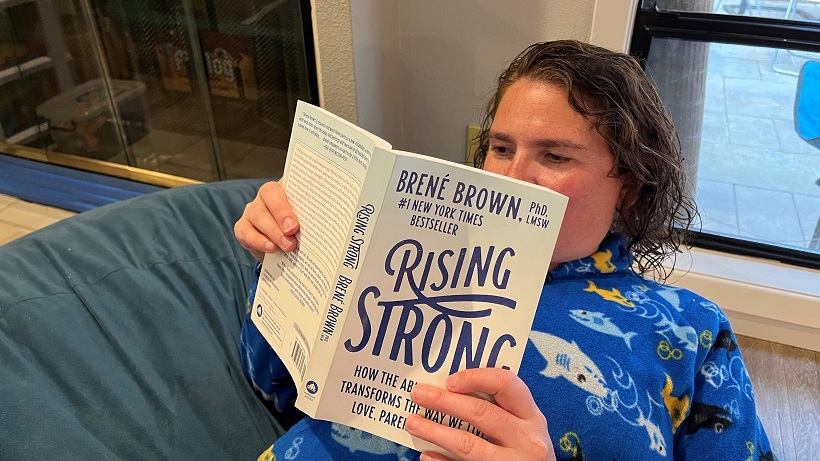
I absolutely love Brené Brown. She speaks my language. I’ve listened to almost all of her books as well as her podcast. I’ve got her quotes about leadership and vulnerability hanging in my office. One of the best pieces of learning I’ve taken from her is about discomfort over resentment. In recounting all those times she said yes to an obligation that she wishes she’d said no to, Brené suggests that we often say yes to something to avoid discomfort, only to have it bring up resentment later, which ends up lasting a lot longer than the discomfort.

For example, if she’s asked to bake four dozen brownies for a bake sale, but doesn’t really have the time, Brené shares that if she agrees to the baking, she’ll then resent the entire situation, and her attitude will show it. When she delivers those resentment brownies, her words might be, “Here’s your brownies. I had to stay up all night to make them. They were a big hassle; I hope you’re happy.” That kind of resentment can really hurt relationships. On the other hand, had she been honest at the outset by saying, “I cannot make four dozen brownies by tomorrow, but I’d be happy to either buy some or contribute some funds for someone else to bake them,” she would’ve had to endure being uncomfortable for about three minutes, but then could have moved on. 

In teaching this skill, Brené reminds us to ask ourselves in these situations if we prefer “discomfort now over resentment later.” This really resonated with me, probably because I never really knew how to express it before. As someone who has had struggles like this, applying this perspective has been immensely helpful in setting new priorities and boundaries. This concept helps to make sure that I lead with gratitude and joy instead of bitterness and hostility. Plus, there’s a link to our Torah portion (you knew I was getting there).

Our Torah portion this week, Parshat Ki Tavo, brings us closer to the final lessons God wants the Israelite nation to learn before they enter into the Promised Land. Our text reminds us again of the blessings and curses that come to us as we choose to follow or ignore the laws we’ve been given. Specifically, we learn of the requirement to make an offering of “first fruits” for the priests in the Beit HaMikdash, and the different ways in which we are supposed to thank God and give praise (before prayer was a daily activity). Finally, the text reminds us of how we’re supposed to take time to rebuke one another when we’ve misstepped and the ways in which we can do so with compassion and kindness.

Chapter 28, verse 47 teaches, “Because you would not serve the Lord your God in joy and gladness over the abundance of everything.” This statement comes in the midst of blessings and curses given for following the mitzvot to varying degrees, but it’s more about the attitude we adopt rather than the commandment itself. The real curse comes when we don’t serve in joy, when we’re resentful of the commandments our faith has prescribed. The Torah is reminding us that it’s ingratitude that keeps us from true connection to God or any sort of joy at all.

How true this is for our interactions with others too. Resentment, just as Brené Brown illustrates, keeps us from joyful connections with our fellow human beings. Like Parshat Ki Tavo teaches, mitzvot are the focus of Torah, but it’s the joy and gladness of Judaism that keep us full-hearted.

Happy Accidents – Parshat Ki Teitzei 5782

Fans of Bob Ross may remember that part of his teaching philosophy was about embracing those “happy accidents” that happen when something unintentional turns into something beautiful and artistic. It reminds me of the notion of the unintentional mitzvah, an idea as old as the Torah itself.

This week we read Parshat Ki Teitzei. We receive laws about war and taking care of hostages, laws about our clothing, laws about family relationships, laws about taking care of the poor, and so much more. Ki Teitzei is actually the Torah portion with the most number of mitzvot (commandments) in it, but the recurring theme is how we should execute and fulfill the mitzvot prescribed to us.

In particular, the laws cover taking care of the more vulnerable members of the community. While earlier in the Torah we learn about leaving the corner of the fields for those who might be hungry so that they can maintain their dignity and pick the food, Parshat Ki Teitzei offers one more way we can support those in need.

Chapter 24, verse 19 presents an interesting unintentional mitzvah when it states, “When you reap the harvest in your field and overlook a sheaf in the field, do not turn back to get it; it shall go to the stranger, the fatherless and the widow.” No one, in this scenario, is purposefully choosing to overlook a sheaf of grain. For whatever reason, the harvester accidentally missed that sheaf, but that accident is now a mitzvah.  

We encourage our children to give tzedakah and donate to worthy causes. In fact, we have deemphasized big Hanukkah gifts (those come from other family members) in favor of a small donation each of the eight nights. It feels good to give something back, whether that’s signing up for a meal on someone’s Meal Train or supporting Ukraine through a local campaign. Most of the time, Duncan and I coordinate these so we know how much money is going where, or who’s responsible for dropping off dinner to a friend. Once in a great while, though, we accidentally double up – an unintentional mitzvah, if you will. And if you’re going to make a mistake, what better kind of mistake to make than doing an extra mitzvah?

Accidents, by nature, aren’t choices. However, we do have the choice in how we react to something we’ve overlooked. True, it was our intention to donate once or add just a few coins to the tzedakah box, but if a mistake unintentionally supports the community or helps someone else who might not have otherwise benefited, then our mistake becomes a bigger gift. Parshat Ki Teitzei and this specific commandment are meant to remind us that sometimes it can be better to let it go, to embrace the happy unintentionality and make a mistake that might just lift someone else up. 

Punishment Fits the Crime – Parshat Shoftim 5782

One of the parts of parenting that Duncan and I struggle with the most is giving reasonable and logical consequences. We’ve gotten better at it now as the children are older and are a tiny bit more rational than when they were in preschool, but it still isn’t easy. It’s much easier, in the frustration of a slower than necessary bedtime routine, to demand, “If you don’t get out of the bathtub right now, there’s no iPad time tomorrow.” This consequence is threatened in the heat of the moment, and it’s not at all logical or relevant to bath time. Plus, enforcing it often causes more pain to us than to our children because we need those 30 minutes of screen time while we’re making dinner as much as they do.

Even God struggles with determining logical consequences throughout the Torah. Remember, Moses isn’t allowed into Israel because he didn’t listen to God, who instructed him to talk to the rock, but Moses instead remembered and acted on an earlier instruction to hit the rock to get the result he wanted. Seems like an outsized punishment for Moses’s mistake, doesn’t it? As a parent figure, it seems that God has to learn about logical consequences too. And in fact we finally have some workable guidance in this week’s Torah portion. 

Parshat Shoftim is a section of Torah that completely focuses on the legal system, justice, and context for the laws. This text includes the commandment to establish judges and officers, as well as a listing of punishments for certain transgressions against mitzvot. We also learn about the laws regarding false witness and murder. 

In chapter 19 God reiterates a lesson that has been shared before in the Torah (twice, actually). You may know it as “eye for an eye,” but a more complete reading includes “Life for life, eye for eye, tooth for tooth, hand for hand, foot for foot.” These are not meant to be taken literally, but as an instruction to have the punishment fit the crime, and neither more nor less harsh than the original transgression.

It’s easy to go on consequence overload when you’re in an emotional moment. The Torah is itself, however, a grounding resource. Reading these same texts year after year is what grounds us emotionally and spiritually, and it reminds us, especially in this week’s portion, that only when we’re in that grounded space can we act justly.