Time for an Update – Parshat Matot-Masei 5781

I recently saw a Facebook memory pop up. It was a very frustrated me as a rabbinical student when I woke up one morning to go to class and found my computer locked in the midst of an epic system update. It was 30% done, and that meant I wouldn’t have been able to take my computer with me for classes or finish my homework, and basically being without my computer felt like a type of mental paralysis. This was pre-smartphone, so there was no backup option of using my phone to get work done. However, my computer hadn’t crashed; it was making itself better. When I got home that night, I had an extremely awesome working computer that was all updated and ready to do the work I needed. And these days either the updates happen faster, or I’ve figured out how to time them appropriately. 

More and more things in our lives receive regular updates: our phones, our TVs, even our refrigerators connect to the internet for firmware updates. We’re always finding ways to take something and make it safer or more secure. Think of the number of car safety features that have become standard over the last decade or so. Now there are back-up cameras, automatic brakes, passing alert sensors . . . despite the too frequent use of cell phones while driving, we’ve never been more informed and aware as drivers. We don’t just update our digital lives. As information changes, health recommendations change, languages change, and books get new, revised editions. All this is to say that as our world changes, so does the information we need to be a part of it. 

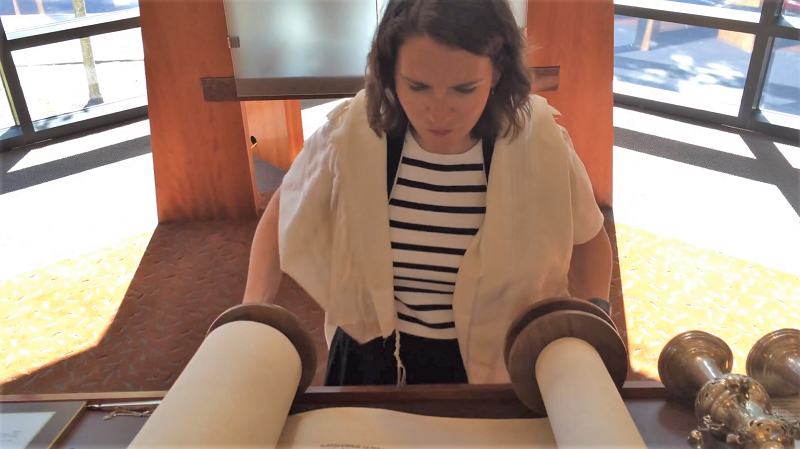
There is one book, however, that does not receive regular updates or revised editions. The Torah we read today is still the same Torah inspired by God and interpreted through Moses. In our parshah this week, we read the final sections of text from the fourth book of the Torah, Bamidbar. Parshiyot Matot and Masei begin with the discussion of the different vows Israelites might make, and then they detail the requests of the various tribes as they get ready to enter the Promised Land. The chapters end with the final placements of all the tribes as they prepare to divide their land inheritance.

As the text begins we find ourselves in this section of laws dealing with vows. Chapter 30 specifically deals with the vows of women. Basically, the Torah tells us that if a woman makes a vow while she is still young, her father can decide to validate the vow or invalidate it. The same then holds true for her husband; he too can choose whether or not her words are valid.

This stated subordination is certainly problematic for the world we live in, but it was troublesome to the sages in the Talmud as well. Already at that time they tried to limit the applicability of this law by restricting the time one could annul another’s vows. And yet, the law still exists in the Torah, and we read it year after year.

For better or worse, the scroll we call the Torah isn’t updated. We can’t change the words themselves because, as words of God, the story is static and unchanging. Fortunately though, we have rabbinic scholars who have worked for millennia and still work daily to understand the intent of the commandment, so that it can apply in a modern form to our lives today. In fact, this is the work of the Committee on Jewish Laws and Standards for the conservative movement. 

While we might not change the main body of the United States Constitution, we have amendments that allow for new interpretations and even changes. In a similar way, the Torah is in a sense the first draft, and the Talmud (and even this drash) are the updates. That first draft is still critical. To update anything, we must start with a solid foundation. The Torah is our foundational document, and this week’s portion is a reminder that we continue to update it using the spirit and intention of the law in order to guide us in our lives today. 

Morning, Noon, and Night – Parshat Pinchas 5781

Want a great way to quickly get to know someone? Ask them to describe their ideal day. When Duncan and I were first dating, we discussed our “perfect days.” I challenged him to write up a whole itinerary. Where would he be? Who would he be with? What would the day look like from start to finish? And then I created an itinerary for mine. The elements in my perfect day always involve someplace near a body of water. I’m with my family enjoying the sun and the open sky, but I’ve also built in some alone time. The ideal day always begins and ends with me taking a long walk to set my intention for the day, and then reflect back on the day before bed, respectively.

Despite the fact that these ideal days almost always include some hypothetical components that may change with age, the morning and evening reflection is a constant. I am my most grounded self when I have those two touch points in my day. I think my attraction to the idea of starting and ending my days with a connection to the earth, to God, and to my body also offers some insight into my love of Judaism. 

Jewish living is structured around prayer – daily prayer – and that comes from our Torah portion this week, Pinchas. Parshat Pinchas begins with the story of Pinchas (identified as Aaron’s grandson) and the extreme action he took toward those who defied the prohibition against idolatry. Then we move to the daughters of Zelophechad (Joseph’s great-great-great-grandson), who want to inherit land after their father’s death because he had no sons. Then Joshua is appointed Moshe’s successor, and we end with the sacrifices we are to make for Rosh Chodesh and the holidays.

This is a big, long, full section of Torah that walks us through conflict and resolution in multiple ways, and then ends with a recitation of how we might find balance and connection to God in celebration of holidays and daily moments. It lays out this structure according to sacrifices. Chapters 28 and 29 list the sacrifices for the daily offering, the new moon, the Passover offering, Shavuot, Rosh HaShanah, Yom Kippur, Sukkot, and Shemini Atzeret. Each one is delineated by what offerings are made, how we make them, and why they are important. 

The daily offering, the Tamid, the one which is our constant, is said to have been offered in the morning and at twilight. It is an offering that is funded by the people, not just the leaders or the rich, but one that is made by all of us together. When the Israelites were no longer able to practice daily sacrifice, the rabbis determined that prayer, the Amidah, would fulfill this obligation. That is to say that the sages couldn’t imagine a world without a daily interaction with God, both at the beginning and the ending of the day.

Parshat Pinchas is the reminder that each day needs grounding in holy purpose, whether it’s a formal Yizkor service or an hour gardening. But I challenge you to make it your job not necessarily to be the people of Israel in this comparison, but to be the Tamid, the constant. You keep alive the flame that ignites the holiness in the rest of our holy community.

The Big Picture – Parshat Balak 5781

As a kid I used to love those brain teaser books that showed you one small part of a bigger picture, and you had to guess what the big picture was. These puzzles are a wonderful metaphor for our lives. What conclusions do we make based on just a small part of the picture? When you only hear one side or one snippet of a story, do you jump to conclusions on the assumption that you understand the situation in its entirety, when in reality you only know the smallest amount? This is also true about communities. Our community is made up of many individuals who come together to create something bigger than themselves. This is what makes a community beautiful. 

In a sense, we do this with the Torah by reading one portion at a time. Although we know the story after reading it over and over again each year, these small portions eventually add up to the story of the Israelite nation from birth to entry into the Land of Israel. The text each week gives us one deeper layer than the week before into understanding the bigger picture. Since we, the readers, are with the Israelites from beginning to end, we know them in their entirety, but when the Israelites encounter other communities on their journey, they’re only observed bit by bit. In other words, if you were to encounter the Israelite nation halfway through the Torah, you’d have no context for who they were or what they had been through. That happens in this week’s Torah portion. 

This week we read Parshat Balak, a narrative filled with opportunities for taking the right or wrong action and saying the right or wrong words. You know this parshah – it’s of course the one with the talking donkey. Parshat Balak is the story of Balak, son of Tzipur and king of Moav, who solicits Balaam the “prophet” to curse the children of Israel. God allows Balaam to go to the land of Moav, but only if he will speak what God tells him to say. On the way there, Balaam finds himself frustrated with his donkey, who refuses to move. As it turns out, the donkey sees an angel of God in the road. Balaam cannot see the angel, only the donkey can, so Balaam gets angry at his stubborn animal and beats the donkey.

In laying out the scenario to Balaam, King Balak says about the Israelites, “You will see only a portion of them.” One interpretation suggests that in order to curse them, Balaam had to see them with his own eyes, but Balak didn’t want Balaam to get the full view in case he ended up siding with them (which he eventually does). According to another theory, the purpose of this statement is to tell Balaam that while the small number of people he would encounter might not seem impressive, their numbers were actually much greater, and they needed to be fearful and on guard. But in either interpretation, Balak is acknowledging and even admitting that Balaam isn’t getting a complete picture of this nation of people. Instead, Balak is playing mind games and withholding his predisposed and misinformed beliefs.

This is what made these past 15 months truly difficult. For almost a year and a half, we’ve only been seeing a portion of each other at a time. Birnbach Hall wasn’t full of people on Rosh Hashanah. Families weren’t shoulder to shoulder at my house for Fourth Fridays. Even those times when we had a hundred or more people on Zoom together, you can only fit a certain number of people on the screen at a time. If you “only see a portion” of the people, it’s nearly impossible to get a sense for what this community really means.

As the world starts to open again and more restrictions are lifted, we’re almost at the point where we can once again see the big picture. And as one of the people who has been fortunate to have the vantage point of looking out at our community in its entirety, I can’t wait to have that view again.

Our Empathic History – Parshat Chukat 5781

It’s difficult to see someone you love in pain. This is certainly the case for me. It hurts me to see people hurting, emotionally or physically. When one of my children – or even my husband – has a bad cut or scrape, I can’t look at the injury or hear about it without my heart sinking into my stomach or even feeling a little lightheaded. It isn’t so much that I can’t stand the sight of blood, it’s that I feel deeply in my body the pain of other people. I carry their hurt with me. Sometimes this is called sympathy pain (although maybe it should be called empathy pain) or even just being sensitive. Regardless, our ability to “feel” with another and to hold each other’s feelings and pains is one way in which human beings can support and show compassion for one another. 

In addition to feeling physical pain, there is a different experience of sharing non-physical pain, the kind of pain brought on when someone’s honor is damaged or disrespected. The question explored in this week’s Torah portion is who shares that type of pain when you experience it? Is it your immediate family? Is it your circle of friends? Or could that pain possibly be shared with people who came long before us?

This week we read Parshat Chukat, which is full of plot twists and new experiences for the Israelites. The lands of Sichon and Og are conquered, both Miriam and Aaron die, and we learn that Moshe will not be allowed to enter into the land of Israel. In the middle of these major developments, we are also given a purification process that seems somewhat out of place in the context of the significant events that follow it.

As the Israelites travel out from Kadesh, Moses sends messengers ahead to the king of Edom. He shares the following in chapter 20, verses 14-16: “Thus says your brother Israel: You know all the hardships that have befallen us; that our ancestors went down to Egypt, that we dwelt in Egypt a long time, and that the Egyptians dealt harshly with us and our ancestors. We cried to the Lord and He heard our plea, and He sent a messenger who freed us from Egypt.” It’s quite a dramatic message, and ultimately a message of faith to say, “We’ve been hurt and abused, but we’ve got God with us.”

One line feels a bit odd, however. What does it mean for the Egyptians to have dealt harshly “with us and our ancestors?” The word used is avoteinu, which is the way the Torah refers to Abraham, Isaac, Jacob, Sarah, Rebekah, Rachel, and Leah. But we know that aside from Jacob, none of the rest of our ancestors were in Egypt, which means none of them were dealt harshly with. So why phrase it this way?

Bamidbar (Numbers) Rabbah interprets this to mean that when Israel suffers, our ancestors in heaven feel their pain. We often talk about how the pain of the present can affect future generations, but we don’t often think that our past can feel our current pain. If you think about it, though, it makes sense in relation to how we already think about the past. I’ve heard plenty of times “Your dad would be so proud.” Do they mean that he would only be proud if he were still alive? Or is there a deeper connection that suggests he’s still proud on some level that we believe in, but can’t really understand? Or could I make the memory of him proud? And if the memory of him can be proud, can the memory of him also feel shame or hurt or pain? 

This week our Torah portion sends us a hopeful message, especially as we’re finally renewing relationships with people in person. The message is that we are all connected in many more ways than through either our stories or through our physical interactions. Rather, it’s both. And perhaps coming to this realization that we can feel each other’s pain, see each other’s vision, and help each other achieve greatness would make our ancestors proud.

A Place for Rage – Parshat Korach 5781

We live in a world where it’s becoming increasingly socially acceptable to express your disdain, outrage, or disagreement in a public forum rather than privately with the person against whom you have the complaint. On the one hand, it can be constructive to call out misdeeds and to call out hate and bigotry, with the hope that we’re better able to hold people accountable for their actions. At the same time, this means that we’re constantly forgetting the power and importance of one-on-one conversations when we’re angry, upset, or frustrated. The repercussions from public rebuke can be extreme for both parties; at the same time the lack of consequence or follow through for private response is also troubling. So we’re left with a choice. Which is better: a public shaming with big repercussions, or a private shaming with measured response, but perhaps no significant change?

Our Torah portion this week, Parshat Korach, debates this as well. This week we read the narrative detailing the revolt of Korach. Korach breaks apart the priesthood and prepares a revolt, while Datan and Aviram, two other troublemakers, begin a revolt of their own. Chaos breaks out in the camp, and those who don’t see a purpose to the fight pull away, which turns out to be solid decision making as the earth opens up and swallows Korach and his followers.

The reason for Korach’s revolt is that he feels he and his people don’t have a voice in the current leadership. Moses is upset, he’s trying to do the best he can, and doesn’t know how to move forward. They are at an impasse. Korah decides to make a big public display, airing his grievances and making sure that everyone knows why he is upset. Moses, on the other hand, tries to make amends and find common ground and perhaps a way forward. Tragically in the end, it results in death and destruction on top of the hurt feelings and hate. 

What do we learn? It’s hard to know when to speak up and turn a disagreement or difference of opinion into a bigger deal and when a private, more quiet approach is a better way forward. What we can say for certain after reading Parshat Korach is that it’s always best to consider all options before acting. If there are atrocities, if there is corruption, by all means, call it out. And at the same time remember it’s ok to be deliberate and strategic about how you approach delicate or potentially controversial issues. It doesn’t seem to be the preferred method in an age driven by social media and every minute news, but if this week’s Torah portion teaches anything, it’s that the measured response deserves a seat at the table.