We all know that satisfaction is the greatest reward, blah, blah, blah. But sometimes a tangible reward is the most helpful one. You guessed it – this too is Torah.
Author: Eve Posen
Seeds of Change – Parshat Behar 5776

When we talk about “planting the seeds of change” or “reaping what you sow,” we’re not merely speaking in metaphors. Certainly there are examples of nature and agricultural symbolism throughout our sacred texts, but this week we learn that the laws of the land (the literal land) are directly related to how we establish a just and equitable society.
This week we read from parshat Behar, the penultimate section of text in the book of Vayikra. The text details the laws of the returning of the land in Israel during the shmitta (jubilee year) and how slaves and land are returned to their prior status. We also read about what happens to Jewish-owned land in the diaspora in the jubilee year and how we are to help those who are in need within our own communities. The text ends with another warning against idolatry.
The Torah also uses a significant amount of space dealing with agricultural laws, which is odd given that the name of the Torah portion is Behar, which means “on the mountain.” We’re talking about a mountain in a desert far from a farming community, and yet here we receive all sorts of laws that don’t apply (yet). As you might expect, the commentators found this odd and looked for an answer.
One medieval commentator shares that perhaps we received these laws at Sinai because at that point no one owned any land yet, so no one could object that a particular law deprived people of what they had worked to acquire. In other words, it is much easier to impose laws at the outset before other norms or traditions become standard operating procedure. The system described is the precursor to the way in which modern Judaism champions social justice.
Or perhaps teaching laws of agriculture among laws of equality and justice is, like much of our religion, symbolic of both the deeply rooted tradition and the potential for growth. The power of social change is the power to change the world. As Jews we may be relatively small in number, but we are mighty as a people.
Parenting by the Parshah – Behar
Call it what you will (nap time, down time, rest time), but taking time to reset is simply part of good health. And this too is Torah.
I Got a Name – Parshat Emor 5776
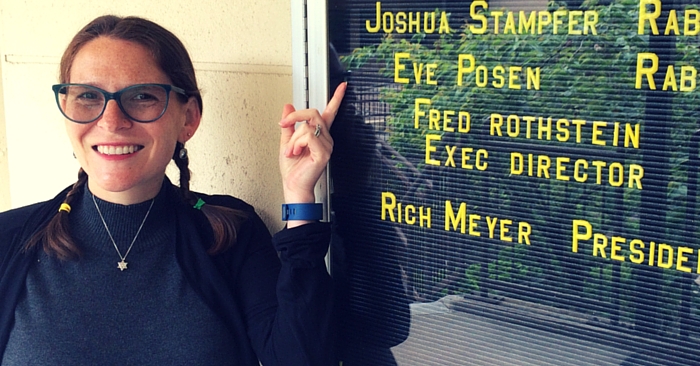
People ask me why I chose to keep my maiden name when I married Duncan. There are a few reasons. First, I was already making a name for myself as a Jewish educator, and I didn’t want to lose that name recognition. Second, my sister and I are the only grandchildren on my father’s side; thus, with us the Posen name ends. Finally, and perhaps most importantly, I wanted to honor my family. My parents and my grandparents are the main reason I fell in love with Judaism. In sharing my passion with the world, I wanted to honor their work as well as their love and commitment to me. Being called “Rabbi Posen” brings me joy when I think about the great legacy of Jewish education and tradition in my family.
Well before I became a rabbi there were times when I was recognized as a Posen and reminded that my actions were a reflection on both me and my family. For better or worse, how we behave and act in the world reflects on the values of our upbringing and broader community. For example, when Bernie Madoff’s crimes were exposed, the Jewish community felt pain not only because Jewish organizations were victims of fraud, but also because it was one of our own committing these atrocities. At the opposite end of the spectrum, when gold medalist Aly Raisman became the most decorated American gymnast at the 2012 London Games, the Jewish community felt tremendous pride at what a member of “our tribe” had accomplished.
This week we read from parshat Emor, which begins with the specific rules and regulations of the priests as well as the laws about what we’re supposed to put into our bodies. The text continues with an in-depth look at the laws of our holidays and special times and concludes with the punishments brought upon those who have broken mitzvot of trust in relationships. With the laws about the priesthood comes one of the defining mitzvot about representing the Jewish community publicly.
Chapter 21, verse 6 states in reference to the priest as leader: “They shall be holy to their God and not profane the name of their God; for they offer the Lord’s gifts, the food of their God, and so must be holy.” This verse teaches that we are obligated to act in a way that reflects well on God, the Jewish people, and our traditions. When we act in this way, in the manner of kiddush HaShem, we are acting in a way that adds goodness and justice into the world. In doing so, this brings pride to our name and to our people. On the other hand, we are also taught to refrain from acting in a way that would bring dishonor to God, our people, and our traditions.
Parshat Emor, like so many other parts of our text, reminds us of the power in our actions. Like the priests in Torah and Temple times, today each of us is an ambassador for our families and our religion. You have the sacred responsibility of putting your best foot forward and bringing only joy, positivity, and good to the name and people you represent.
Parenting by the Parshah – Emor
How do you look beyond the matzah, the dreidels, and the shofar and make sacred time special time? This too is Torah.
 Rabbi Eve Posen