If you take a toy to the potty with you, there’s a chance it will fall in. The lessons that stick with us are the ones in which we can experience (and be reminded of) real consequences. This too is Torah.
Author: Eve Posen
Original Recipe – Parshat Vaetchanan 5776

On my father’s side of the family, I come from a line of what I like to call “creative in the kitchen” people. My Nana was an excellent cook and baker, and my Uncle Larry is an executive chef who loves recipe development. There are certain dishes that played starring roles in family meals for as long as I can remember. If you ever want to talk food, ask me about rancho beans or my Nana’s peanut-butter-wrapped, chocolate-dipped cherries. Those, by the way, were a featured dessert treat at our wedding reception.
I inherited this duality of a love of the classics plus a willingness to add my own spin. No doubt the basic recipes are fantastic, but I also like to experiment in the kitchen. That might just mean playing around with my challah recipe by adding chocolate chips or a cinnamon sugar crust if I’m in a sweet mood. For me, the recipe on its own is merely the starting point for the adventure, but in general, following the directions will lead you to the expected outcome.
The Torah provides us with a similar guideline. It’s considered the instruction manual for living a Jewish life, or in other words, the recipe book. But one of the biggest puzzles in Judaism is determining how much can we stray from the original recipe and still maintain the integrity of the flavor and structure of the dish, so to speak.
Parshat Vaetchanan, the Torah portion we read this week, continues with the retelling of the laws again here in the book of Deuteronomy. We also read about God’s persistent refusal to allow Moshe to enter the Land of Israel. The Torah then issues a caution to uphold the mitzvot as the key to building an Israelite society. Moshe then sets three cities of refuge, and we receive probably the most well-known instruction in the Torah, the Shema.
Here’s where we step into the kitchen. Chapter 4, verse 2 reads, “You shall not add anything to what I command you or take anything away from it, but keep the commandments of the Lord your God that I enjoin upon you.” Well, that seems clear. Right there the Torah tells us that this is a recipe for the community to follow to a T. And yet, as you may have noticed, the world we live in is different than the biblical world of the Torah. No big shocker. You just have to go back to the red heifer in Bamidbar to see that many of our original mitzvot aren’t applicable today. So we’re left with the dilemma of how to live in a Torah-dictated, post-Torah world when we’re commanded not to change it?
The way we’re able to do this without rupturing the space-time continuum is by acknowledging the truth in the words “etz chaim hi.” It is a tree of life. We see the Torah as a living organism, and we have precedent for clarifying and extending the laws so that the Torah can change and evolve, adapting to present day. The tree that is watered and pruned thrives. The tree that is confined and starved does not.
Going back to the recipe for Jewish living, we’re not taking anything away from the Torah when we apply a modern-day philosophy. Instead, we’re adding to the recipe to ensure its success for years to come. Parshat Vaetchanan warns us about changing something that has lived, breathed, and inspired for so many years because it’s a good basic recipe. But the Torah as a whole teaches us that recipes, like our laws and traditions, are the foundation. They tie us to the past and give us a jumping-off place for the future. Your Judaism means adding dash of this, a pinch of that. The point is just get in the kitchen and cook. No matter what, you’re going to make Nana proud.
Parenting by the Parshah – Vaetchanan
The Shema and V’ahavta, which appear in this week’s parshah, are two of the most well-known passages of the Torah. These lessons of listening and loving are also two of the most important things we teach our children.
Do You Love Me? – Parshat Devarim 5776
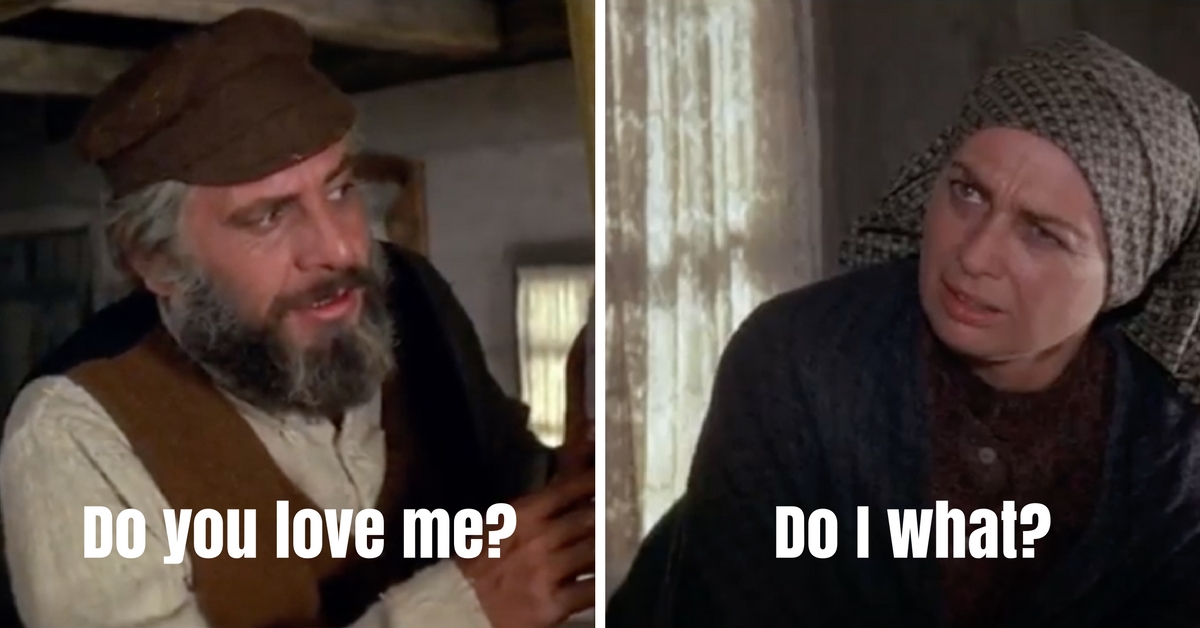
One of my favorite scenes in Fiddler on the Roof is when Tevye and Golde sing their duet “Do You Love Me?” It’s a moment of pure honesty when Tevye questions the state of their marriage after all these years. This kind of emotional check-in is natural; it’s a part of continuing to build a relationship and partnership together. Do you love me? Do you like me? Are you mad at me? These moments happen all the time, perhaps because we’re questioning our own emotions and therefore seek to validate them.
This week in our parshah, we enter into the final book of the Torah, Devarim (Deuteronomy). Devarim stresses the covenant between God and Israel and looks toward Israel’s future in a new land as they build a society that pursues justice and righteousness. The central theme of this section of text is monotheism – the belief in one God – and the summation of the laws we’ve been given over the course of the four previous books.
Chapter 1, verse 27 reveals the Israelites’ conversation with Moshe: “It is because the Lord hates us that He brought us out of the land of Egypt to hand us over to the Amorites.” Though their theory is incorrect, it’s understandable that the Israelites would express this concern. They’ve been moved out of the only land they’ve ever known. They’re scared, and so they blame their fear on God instead of reflecting rationally on the situation.
In fact, Rashi interprets this line as “If God really loved us, God would have given us the land of Egypt and sent the Egyptians into the wilderness.” Their fear blinds them to the possibility that, as difficult as the journey has been, it is because God loves them that they left Egypt. In other words, because I love you I’ve given you the chance to grow, change, and build a whole new nation.
“Do you love me?” is mostly a rhetorical question in the musical. We know they love each other. Sometimes we ask questions when we already know the answers, and as our parshah teaches, this validation is often all we need. Even Tevye and Golde acknowledge: “It doesn’t change a thing, but even so, after 25 years it’s nice to know.”
Parenting by the Parshah – Devarim
With two similar experiences (like having two children, for example), it’s human nature to draw comparisons. But it’s those differences that make both of the experiences unique and special.
 Rabbi Eve Posen