It’s perfectly normal to have anxiety when your child makes the transition from being solely in your care to daycare or preschool. In fact, it’s not so different from the anxiousness Israelites might have felt as they prepared themselves for new leadership after Moshe.
Vayelech
Something For Everyone – Parshat Vayelech 5776
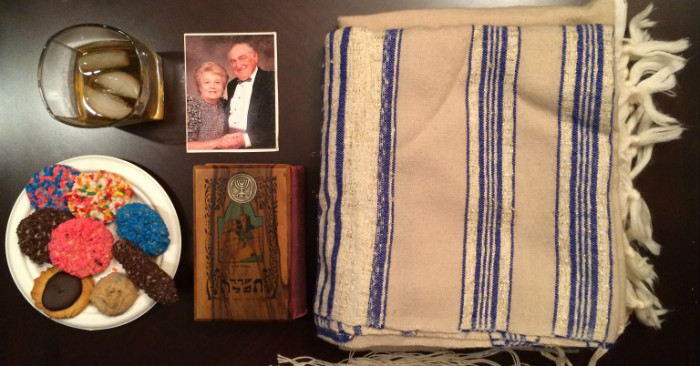
One of my favorite shul memories from my childhood is going with my Zayde to services on Shabbat morning. He had a regular ritual that during the Haftorah he and his friends would disappear from services into the small kitchen for a l’chaim. I remember this was called the “key club” because someone from the group had to provide the keys to let them into the otherwise locked space. The men would enjoy a beverage and a chat during Haftorah, and return to sing their hearts out during Musaf.
Likewise, there was a group of women that had a special ritual too. Toward the end of the service I remember the women exiting to the social hall to set out kiddush.
And the children? We too had our special time, and of course it was the best ritual of all. During the Torah service, I was whisked away on a parade through the sanctuary to a special kids-only space where I could play, pray, and learn without having to be quiet.
What was great about the Shabbat mornings of my memory, and those just like it in synagogues all over, was the emphasis on the idea that Jewish ritual and practice are open to all. Everyone finds a way to connect.
This week we read from parshat Vayelech, which speaks of the difficulty leaders have in transferring over their power. We read of the final days of Moshe and the gift of life he had in living 120 years. The Israelites approach the land promised to them and witness the transfer of “power” to Joshua. Finally, Moshe writes the words of the Torah and passes down the commandment to the Kohanim to read the Torah. Moshe’s final moments with the Israelites are near, and he prepares for this by coming up with a transfer of legacy, tradition, and history.
The Torah teaches us in chapter 31 that as Moshe is going through this transition, he makes the following request to gather the people. “Gather the people, men, women, children and the strangers in your communities – that they may hear and so learn to revere the Lord your God and to observe faithfully every word of this Teaching. Their children too, who have not had the experience, shall hear and learn to revere the Lord your God.” Everyone is invited to learn, and everyone is considered to be an inheritor of our tradition. This also means that we are individually responsible for engaging and enjoying this rich tradition in a personally meaningful way.
Most notably, Moshe mentions the children “who have not had the experience.” It is commanded in the Torah that we bring children into our communities so that they can learn. Imagine Mt. Sinai as the world’s biggest Tot Shabbat. Noisy as it must have been, that idea is what Jewish learning is about.
Whether you come for the l’chaim, the kiddush, the d’var Torah, or the communal davening, the Torah’s lesson this week is that one need only show up to partake. Judaism is for us all, men, women, and children, and the job we share is to gather together to teach, to learn, and to listen so that our beautiful traditions live on.
Objects in Mirror are Closer Than They Appear – Parshat Nitzavim Vayelech 5773
Change isn’t easy. It has become cliche, but it’s evident whenever circumstances take a directional turn. Think about your last move or even your last spring cleaning. Did you pack up with dispassionate efficiency or did you reminisce as you looked at each piece of paper, book, or memento? Did you purge the old to make room for the new? What seemed like a straightforward process has now taken three times as much energy, and what’s worse, it feels as if you’ve taken steps back and not moved forward at all.
This week we read parshiyot Nitzavim and Vayelech, the two parshiyot that often surround the High Holy days. Parshat Nitzavim reminds us that we always have a choice in life and that the proper path is to repent, to follow the rules, and to generally be good people. Parshat Vayelech teaches us about Moshe’s process to transfer leadership to Joshua, and the final words he will share as the leader of the Israelite nation. Wedged within these words is the commandment of teshuvah, repentance.
The text informs us in chapter 30 that repentance is a mitzvah in its own right. God teaches that if we repent and open our hearts to understanding the wrong we have done and make actual effort to change, then God will bring us comfort, love, and wellbeing. The Torah presents repentance both as an obligation and as something innately human. But, it also understands that this act can be difficult. Chapter 30, verse 11 states, “Surely, this instruction which I enjoin upon you this day is not too baffling for you, nor is it beyond reach.” The rabbis of the Talmud understood this verse as referring to the entire Torah. God is reminding us that while the laws might seem intricate and complicated, they are exactly within our reach.
The great Medieval commentator Rabbi Moshe ben Nachman (RamBaN) narrows the focus of this verse to refer only to the laws of repentance. He teaches that it is difficult to break a bad habit, to fully repent, and to change one’s way of life. And yet, every day there are people who prove that it can be done. In fact, according to RamBaN, repentance is a lot like the give and take of packing. A midrash also offers us the metaphor of a mirror. The figure we see in the mirror seems to be twice as far from us as it really is. But with every step we take toward the mirror, the reflection takes a step toward us. So it is with repentance. Our goal seems so far off, but God says to us, “Take one step toward Me, and I will do the same and meet you halfway.”
In this season of repentance, we are reminded that life is a give and take. In order for this to work in any relationship, you must make the first move, the first step towards giving. Whether in regard to decluttering a space, mending existing relationships, or even getting through life day by day, meeting each other halfway can make all the difference in the world.
Carpe Diem – Parshat Vayelech 5773
YOLO. It took some context clues and hearing it a few times to figure out what these four letters stand for. At the end of last year, I asked the students to share with me their favorite quotes, movies, books and songs. At least half of the students cited this acronym as their favorite quote. The frequent texter that I am, I’m familiar with LOL, TTFN, FWIW, but this one I had never seen. In a great moment of enlightenment this summer, I figured it out. “You only live once.” It became famous as “YOLO” after the singer Drake (Jewish, BTW) wrote it into his song “The Motto” this past year. While it seems teenagers are using this phrase to excuse or justify risky or inappropriate behavior, this phrase also highlights the importance of this time of year.
We are at Shabbat Shuva, the Shabbat between Rosh HaShannah and Yom Kippur, two of the “big days” in the Jewish year. This time is set up as a time of reflection and repentance, often calling us to take into account the year that was and make changes for the year to come. In doing so, we are able to see what we’ve done, where we might like to improve, and make the best of the time ahead. Why? YOLO.
It comes as no coincidence then that we also read about Moshe as he enters his final days as both the leader of the Israelite nation and as a living, breathing person. Parshat Vayelech, which we read this Shabbat, describes the steps taken by Moshe as he finishes preparing the Israelites for the future. Moshe knows that he has lived a full life, and sees these final moments as time to teach his Torah, teach the lessons and values that he could not have lived without. Moshe reminds Joshua and the Israelites of the need to come together at least once a year and listen to the words of the Torah. Moshe insists that it not just be the adults, but the children too who will have the experience of learning to live by the code of community.
In Moshe’s final days, his focus is on the life that he has lived and the lives that future Israelites will live. He wants to ensure that he sends the message of living the Mitzvot with love and the idea of “YOLO” into the future for all who are a part of this community.
What does YOLO mean for us as we continue through this, one of our holiest times of the year? You only live once, so we must make sure that we live our lives in a way that continues to build community, not destroy it, just as Moshe taught. You only live once, so our lives should be filled with meaning and purpose, with bringing joy into the world. You only live once, so instead of carrying on destructive behavior or a grudge from the last year, live life with passion, with reflection, and by holding onto only what really matters.
We welcomed in 5773 this week and know that this year holds with it the potential for greatness. Make this year the year that you consciously make an effort to live life to the fullest with your family, friends and community. Don’t waste it . . . YOLO.
THIS TOO IS TORAH: Drake may be the most recent famous Jew to support living in the moment, but it was Hillel who first suggested we seize the day. Im lo achshav, ay-matai. If not now, when?
Heaven is a Place on Earth – Parshat Nitzavim-Vayelech 5771
A Talmudic dispute: the Talmud tells of a dispute among scholars over a technical point of Jewish law. They go back and forth. Rabbi Eliezer starts, “If the law is like me, let the carob tree lean.” And the tree leaned. The Sages responded, “We don’t get our proof from a tree.” Rabbi Eliezer continued, “If the law is like me, let this river turn directions of flow.” And the river switched directions, but the Sages responded again, “We do not take proof from a river.” Rabbi Eliezer continued, “If the law is like me, then let the walls of this Beit Midrash, house of study, start to lean.” The walls began to lean. R. Yehoshua called out to the walls, “We are arguing over Halachah. This is not your affair!” The walls stopped falling, to honor R. Yehoshua. To this day they remain bent, in honor of R. Eliezer. R. Eliezer: If the law is like me, Heaven should show it. A voice from heaven calls out, “Why do you argue with R. Eliezer? The Halachah always follows him!” R. Yehoshua: “It is not in Heaven.”
This story is a classic Talmud story, one of the first sections I learned in rabbinical school. At its heart is the conflict of government deciding on matters of religious domain such as circumcision or marriage rituals. While we have a strong hold to our Torah, the laws divinely inspired and passed from God to Moshe and humanly interpreted for our day, we might also find ourselves wondering why God, the heavens might be prescribing our daily lives, rituals and actions. Rabbi Eliezer appears as the staunch believer, putting his system of practice in line with the Torah, not taking into account the condition of present society. One can envision Rabbi Yehoshua enraged as he arises to make his statement. He replies that matters of Halachah, the Jewish legal system taken on by the rabbis to prescribe law and observance in our modern society, is not a matter for heaven to interfere with.
This statement, lo bashamayim he, meaning “it is not in heaven,” has its roots in our parshah this week, parshat Nitzavim-Vayelech. These two parshiyot come together right before Rosh HaShanahas a means to allow us to reaffirm our covenant with God and with our religion, to secure our place in the land of Israel and to prepare us mentally for the work of repentance, repair and rebirth that happens with the Yamim Noraim, these coming days of awe.
In D’varim chapter 30, verses 12-14 we learn: “It is not in the heavens, that you should say, ‘Who among us can go up to the heavens and get it for us and impart it to us that we may observe it?’ Neither is it beyond the sea, that you could say, ‘Who among us can cross to the other side of the sea and get it for us and impart it to us, that we may observe it?’ No, the thing is very close to you, in your mouth, and in your heart, to observe it.” The text almost reads as a rebuke to the people building the Tower of Bavel: Don’t try to reach the heavens, that’s not where you’re meant to be. The laws, the passion and the beauty of Judaism are not meant to be out of reach, they are meant to be within our grasp, within our souls. Torah, God and Mitzvot are not for those who are overly pious and self restrained, they are for every human being and have been entrusted to us to study and to interpret.
The challenge of this idea is made clear a few verses later in 30:19. “I call heaven and earth to record this day against you, that I have set before you life and death, blessing and cursing; therefore choose life, that both you and your seed may live.” We have a choice. We can choose to leave ritual and Jewish practice for others, or we can choose to take on the responsibility of Jewish practice, striving to build a relationship with those around us, with God and with our heritage. We can choose to see the Torah as a book of the past, irrelevant to our lives, or we can rejoice in the blessings of connecting to our past and our future.
While the laws of the Torah, of Kashrut, of Shabbat, can seem overwhelming, we should remember that it is not out of reach, they are not in Heaven; rather, they are right here, waiting to be discovered, uncovered and learned and loved by each of us.
ללמוד To Learn: ללמד To Teach: Ask a Rabbi or Phone a friend. The best way to learn is with a guide to help you down the path. Pick up the book It’s A Mitzvah to start your journey with step by step suggestions, or find a mentor to help teach you whichever mitzvot you choose to take on next.
לשמור To Keep: לעשות To Do: As we approach the Jewish New Year, make a resolution. What do you want to learn this year? What do you want to teach your children? Let me know how I can help make Judaism within reach to be loved by you.
 Rabbi Eve Posen