Some moments in life leave us speechless, often because there’s an intense emotion (or emotions) attached. The birth of a child, the death of a loved one, or a wonder of nature, just to name a few. It’s in these moments when I’m grateful to be Jewish because we have words and even full blessings that give us somewhere to turn when there’s nothing to say.
One of these blessings is the one we recite when receiving bad news, usually at the moment we learn of a death. This blessing is rooted in the Torah portion this week, Parshat Chayei Sarah. In this section of the Torah, both Sarah and Abraham die. When Sarah dies we see Abraham momentarily pause and then get straight to work with finding a burial spot for her, creating a family plot, and looking toward the future. Then at Abraham’s death, Isaac has married Rebekkah and it becomes clear that Abraham and Sarah’s faith will continue on.
In moments like this, we’re asked as Jews, before we move into action, to pause. We recite the phrase “Baruch dayan ha’emet.” “Blessed is the true judge.” This instruction comes from the Mishna, the corpus of Jewish text that was created based on Torah law once the Temple no longer stood in Jerusalem. The Mishna is inviting us to recognize that challenges, pain, suffering – these are also a part of life. When we say “Blessed is the true judge” in moments of hardship, we’re not blessing the suffering itself; we’re affirming our faith in God’s wisdom and justice, even when we cannot understand it.
When I was in rabbinical school, I spent a summer doing an intensive unit of chaplaincy in a level-one trauma hospital in Michigan. Over that summer I learned about what it means to be with people in their highest of highs and lowest of lows, as well as how a multitude of religions approach healing and comfort. Our group of 10 clergy spanned six different faiths, and I was the only rabbi in the group. Every morning we would begin with a centering prayer, led by a different student. Some mornings we did meditation, others we studied text, and others we looked at liturgy. Then we’d break into our teams of two students each and go to our assigned floors and visit every patient.
It seemed almost every time we entered a room, someone asked the chaplain to pray for them. My chaplain partner Jen would then ask them what they’d like her to pray for, then they’d close their eyes and hold hands, and she’d offer an extemporaneous prayer. And I would stand there, terrified they’d ask me. I knew the Misheberach, the traditional prayer for healing in Judaism, but I had never been asked to offer a spontaneous prayer aloud. That summer, more than anything else, I learned the power of a unique, personal, unscripted blessing.
Oddly, it took until graduate school for me to figure this out since the Torah is filled with extemporaneous prayers, including in our Torah portion this week. We read from Parshat Chayei Sarah, which makes the transition from one generation to the next. Beginning with Sarah’s death, we learn about Isaac and his courtship with Rebekah, the list of Abraham’s descendants, and the death of Abraham and his burial at the cave of Machpelah. Through it all, the family continues to carry themselves forward from experiences of loss and grief into the next chapters of life.
As Rebekah is preparing to go meet Isaac, her family asks her if she is willing to travel to meet him. When she agrees, they send her off with a blessing: “O Sister! May you grow into thousands of myriads; May your offspring seize the gates of their foes!” This wasn’t asked for or expected, it just happened.
There’s a certain power in offering blessing one person to the other in moments of transition. While the siddur is a beautiful guide for the notion of prayer, the prayers are meant to be just that, a guide, not a set-in-stone limit to what we can offer. May we read this moment in the Torah as an invitation to open our hearts to others, to speak the words of our hearts, and to fully be present in everything we do.
Would there be reality television without dating shows? The first episode of The Bachelor aired 20 years ago, and now there are too many “find love on TV” shows to count. Love Island, 90 Day Fiancé, Love on the Spectrum – these are just a few of the dozens and dozens of dating show iterations that are now staples of our television landscape. Currently one of the most popular shows is a Netflix series called Love Is Blind, a “social experiment” where single men and women look for love and get engaged, all before meeting in person.
Full disclosure: I’ve not watched a single one of these reality shows. It’s not out of judgment at all; on the contrary, it’s simply because I’m more of a Keeping Up With the Kardashians kind of rabbi. The common denominator is my desire to see how intimate relationships are formed. Reality TV plays into the romantic notion that falling in love is part magic and part serendipity. Actual reality, though, is much more complicated, but in a way, makes a lot more sense.
Perhaps this week’s Torah portion can help explain. We read from Parshat Chayei Sarah, which marks the transition from one generation to the next. Beginning with Sarah’s death, we learn about Isaac and his courtship with Rebekkah, the list of Abraham’s decedents, and the death of Abraham and his burial at the cave of Machpelah. Through it all, the family continues to push their way through experiences of loss and grief into the next chapter of life.
As Abraham is working to build a sustainable future for his son Isaac, he considers which lessons will be the most impactful and which values will be the most beneficial in a mate. We’ll never know exactly how he came to this answer, but he tells his servant that in looking for a partner for Isaac, “She must feed the animals and you, she must not worship ‘other’ gods, she must be willing to follow you.”
To be clear, neither partner in a marriage should be subservient to the other. Rather, the deeper concern Abraham is expressing is that morals and values between parties line up. From better communication with each other to providing a stable environment for raising a family, having this basic shared foundation simply makes sense.
In my years as a rabbi, I’ve been asked to officiate many weddings. In the early discussions with a couple, one of my first questions to them is based on this week’s Torah portion. What are your values? What are your guides in life? Love at first sight (or “at first episode”) is a romantic idea, but a successful marriage needs time for this exploration. What we learn from Abraham in his last moments in our story is that shared vision and values are truly what make strong and lasting partnerships.
Has anyone ever offered to “pray for you” because they sincerely believed you were going to hell for being Jewish and not following their beliefs? It happened to me in Texas. Or maybe someone of another faith has come knocking on your door trying to spread the “good word”? It’s frustrating enough when someone insists that their way is the right way, but even more so when it’s about religion. I love Judaism (I’m a rabbi, after all), but that doesn’t mean I think Judaism is for everyone or that it’s the only right answer.
In 2017, comedian Ricky Gervais, famously an atheist, had a fascinating and friendly debate with devout Catholic Stephen Colbert on The Late Show. As a point to challenge Colbert’s belief in God, Gervais retorts, “So you believe in one God, I assume? Okay, but there are about 3,000 to choose from. Basically, you deny one less God than I do. You don’t believe in 2,999 gods. And I don’t believe in one more.”
In other words, who’s to say that they are absolutely right when it comes to religious belief? As a rule, Jews don’t proselytize. We don’t seek to convert others to Judaism. Like me, this is one of those Jewish facts you’ve probably known your whole life. This is why it puzzled me when, as a teenager, I saw representatives from the local Chabad standing on the sidewalk outside my public high school on Friday afternoons trying to teach the boys how to put on tefillin. I also clearly remember going up to them one week when I was feeling very brave, having my own tefillin with me,and showing them that I could do it too.
What was Chabad doing outside my public high school? They would argue that they weren’t proselytizing because, of course, they wouldn’t ask people of other faiths to put on tefillin; instead, they were trying to help other Jews fulfill the obligation. If that’s true, though, why stand outside the public high school? Why not stand outside a synagogue before daily minyan?
Perhaps the answer is found in this week’s Torah portion. We read from Parshat Chayei Sarah, which makes the transition from one generation to the next. Beginning with Sarah’s death, we learn about Isaac and his courtship with Rebekkah, the list of Abraham’s descendants, and the death of Abraham and his burial at the cave of Machpelah. Through it all, the family continues to push their way from experiences of loss and grief into the next chapter of life.
As Abraham is trying to find land for burial and also a wife for Isaac, we read in chapter 24, verse 2: “Put your hand under my thigh and I will make you swear by the Lord, the God of heaven and the God of earth . . .” By using the phrase “the God of heaven and the God of earth,” our midrash suggests that Abraham was bringing awareness to the fact that God does not only rule in heaven, but also on earth. Throughout this passage he refers back to the fact that God rules both in heaven and on earth.
So what does this have to do with proselytizing or not proselytizing? Midrash teaches that Abraham was the first individual to recognize this and to try and teach it to others. However, Abraham didn’t go out looking for others to join him on his journey of following God. He didn’t go out and preach to everyone of God’s truth. Rather, he shared this special connection, this special teaching, with those in his circle whom he knew needed to hear it. He looked for others who might already share this belief and tried to bring them all together. For example, when he looked for a wife for Isaac, he wanted someone who already shared this belief in God to make their community that much stronger.
I don’t think either Ricky Gervais or Stephen Colbert were actually expecting the other person to completely change their viewpoint. Similarly, Chabad’s presence outside my high school wasn’t about converting anyone to something that they didn’t previously believe. While that public act might make some people uncomfortable, that public act also reminded the Jews who were there what it means to be Jewish and what it means to have community. Likewise, Abraham also wasn’t out to change people’s minds; he was hoping to bring people closer together in love and faith. May we work to live in a world where we’re not trying to change people’s beliefs to match our own, but instead, strengthening our own circles so that we all, in turn, strengthen each other.
I’m not tall. I’m five feet, two inches on a good day. However, the ark in the sanctuary at Neveh Shalom was clearly designed for someone much taller, closer to six feet. In order to get the Torah in and out of it, I must stand on my tiptoes, reach in, and pray that my upper body strength is enough to lift it out. Sometimes, this little stretch just doesn’t cut it, and I have to ask for help.
Occasionally I have this struggle with mezuzot as well. The standard height for a mezuzah is in the top third of the door frame. This means that shorter members of our communities are often left out, since this height can even put the mezuzah out of eye level, let alone out of touching or kissing range.
It can be frustrating when it appears that a mitzvah or ritual item is physically out of reach. As an advocate for our communal spaces being accessible to everyone, I have been on a long-term mission to put our mezuzot at the middle of the door frame, a height which doesn’t require taller congregants to bend down, and also allows our youngest and smallest members to reach up and participate in the mitzvah.
Having our rituals at a reachable height actually allows for better connections with God, as we learn about in this week’s Torah portion. We read from Parshat Chayei Sarah, which makes the transition from one generation to the next. Beginning with Sarah’s death, we learn about Isaac and his courtship with Rebekah, the list of Abraham’s descendants, and the death of Abraham and his burial at the cave of Machpelah. Through it all the family continues to push their way from experiences of loss and grief into the next chapter of life.
As Abraham moves on in his grief, he sets out to help his son Isaac find a wife. He employs his servant to go out and find the right woman for Isaac. As he tasks him with this work, Abraham asks his servant to swear an oath. “Put your hand under my thigh, and I will make you swear by the Lord, the God of heaven and the God of the earth.” For the Torah at this particular moment, this is an oddly specific description of God’s location that Abraham is sharing. The midrash in Sifrei Deuteronomy suggests that before the time of Abraham, God ruled in heaven, but was unknown on earth. It was Abraham who brought God’s sovereignty down to earth.
There is of course a larger lesson here. In this case, Abraham is suggesting that any loving partnership should not be out of reach or devoid of the divine. Instead, all of our rituals, even those of love and marriage, should be within reach of everyone. And with our regular rituals and mitzvot within physical reach, we can focus more on stretching our minds rather than our bodies.

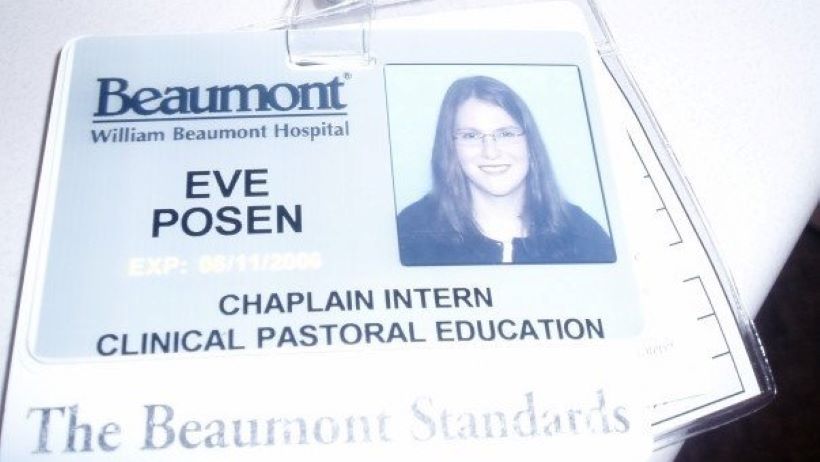


 Rabbi Eve Posen