 Rosh HaShanah sermon for Congregation Neveh Shalom
September 14, 2015
Now the real fun starts. We’re going to do some Rosh HaShanah math. Don’t worry, this is fun math. And that’s coming from me, for whom there is no more moronic oxymoron than “fun math.” And since it’s yuntif, I won’t ask you to show your work. Ready? Here we go.
The modern Egyptian village of Qantir is widely believed to be the location where Ramesses II built his great capital. The math hasn’t started yet, I’m just giving you some background. Of course we don’t know for sure that Ramesses II was the pharaoh we refer to as “Pharaoh,” but for the sake of Yule Brenner’s legacy, we’ll say he was.
Here’s where the math starts. Qantir is located about 280 miles from Mount Sinai. So allowing for some interpretive reasoning, we can guess that 280 miles is approximately the distance the Israelites traveled from receiving their freedom to receiving the Torah.
Keep that number in your head – 280 – while we move to the next number. On Shabbat mornings when services are in the sanctuary, the Torah generally follows the same path through the pews. You probably knew that. What you might not know is that the round-trip distance – in other words, the parade when we take the Torah out plus the parade when we return the Torah to the ark – is about 0.06 miles. That’s six hundredths of a mile. Now of course not every service is in the sanctuary, including this one, but if we imagine this is around the distance traveled each week, then after a year of Shabbatot, our Torahs have traveled just over 3 miles.
Do you see where this is going? If you started coming to shul as a baby and followed the Torah around the sanctuary each week, after 90 years of Shabbat services, you will have traveled the same distance the Israelites traveled when they originally received the Torah.
Like I said, I don’t do a lot of math. But I do love knowing how far I’ve walked, so my step-count is kind of the exception to the no-math rule. If you’ve spent any time with me this year, you know that a highlight of each Tuesday, my day off, is the two and a half hours I spend outside, rain or shine, pounding the pavement. I walk. I walk to clear my head, I walk to come up with great ideas, I walk to feel good. And for me, walking is also a solitary, reflective time. I often walk alone, and as strange as it may sound, I don’t listen to music or talk on the phone. It’s a time for me.
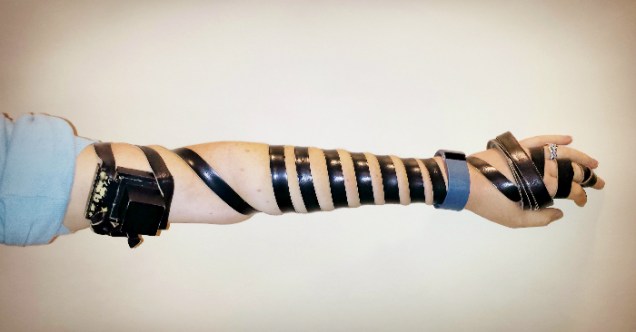
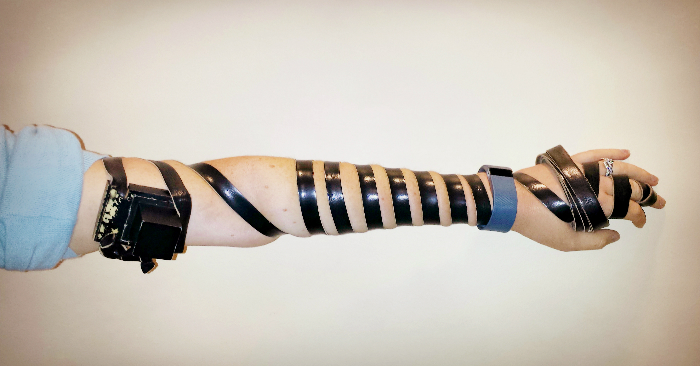
Show of Fitbits, how many people have some type of fitness tracking device? I bought my Fitbit Charge last December. This incredible little device sits on my wrist, and magically counts the steps that I take every day. Not only that, but if I sync it with my phone, I learn all sorts of information about how active I am in a day, how many calories I eat, how many calories I burn, how many flights of stairs I climb, and how fast I move. It can even track my sleep patterns. And when I hit my daily step goal, I feel a short little buzz against my wrist as a reward to keep me motivated.
A tiny little buzz for a job well done means a huge sense of accomplishment for the day. And let me tell you, I work for that little buzz. In fact, your very own Neveh Shalom staff can get pretty competitive when it comes to step-count. I won’t name names, but rest assured there is a healthy level of one-upmanship around here that only pushes us to walk more. The competition is paying off, because I can proudly say that since getting my Fitbit, I’ve lost 10 lbs.
All told, I have at least three motivators: the reward buzz when I reach my goal, the challenge to keep up with colleagues, and the knowledge that I’m a healthier, more fit person. I’m not being paid by Fitbit for this sermon – although if you know someone who knows someone, I’m open to that idea – these are all simply ways in which this little device on my wrist inspires me to be more active.
What inspires your action? Are you more inspired by others or does your “nudge” come from internal motivation? What is your little buzz on your wrist? At this time of reflection on the cusp of a new year, what will drive you to make it your best year?
Rosh HaShannah is the time when we are commanded to take stock in ourselves, to do a year-end review of what it is we’ve accomplished, identify where we feel we can do better, and then work towards making active change. This is a requirement of our holiday, to look back on the year. What did your year look like? Where do you hope to do better in the coming year? Most importantly, how will you measure your progress?
Perhaps what we need . . . is a “Jewish Fitbit!” We have all kinds of gadgets for measuring physical activity, productivity, and intellectual engagement, but we don’t have one that keeps us religiously motivated and spiritually active.
So what would a Jewish Fitbit look like? I need to know, because if I’m going to make my elevator pitch on Shark Tank, I have to get it just right. On my regular Fitbit, my progress is tracked in terms of steps, miles, calories, floors, active minutes, sleep, weight, and hydration. These are all measurable on the single device, and each one tells me about how hard I’m working, how fast I’m moving towards my goal, how I take care of myself physically and mentally, and so much more.
Steps
Let’s start with steps. My Fitbit measures each individual movement I make during the day. The steps all count towards a bigger goal of 10,000 steps for the day, but each individual step forward still takes me somewhere. On our Jewish Fitbit, perhaps this is the summation of each little thing we’ve done to make positive strides in the world. From the Exodus to the symbolic march of Dr. Abraham Joshua Heschel alongside Dr. Martin Luther King when he said, “I felt my feet were praying,” as Jews we are literally moved to make change. The actions in our world, the steps we take, are measured by the ways in which we work towards doing and bringing good into our world. At the end and beginning of the year, we must ask ourselves how we keep stepping forward in our prayer, in our relationships, and in our mitzvot.
Miles
When you’ve walked enough steps, you start counting up the miles. These miles add up; they’re cumulative. What I love about the mile count on my Fitbit is that every once in a while I get a badge telling me how far I’ve walked relative to other forms of travel. So far I’ve climbed the flight altitude of a hot air balloon, the length of the Tube in London, and the distance of the “march of the penguins,” just to name a few. Now you understand my fun math a little more.
Judaism gives badges for these types of milestones too. In our community our miles are the collective moments we share with one another. We wear proudly the badge of our first siddur, our first aliyah to the Torah, and later our wedding under the chupah.
calories
If a step-count or mileage goal seems a little out of reach, wait till you measure your calories. This is the real hard part. In terms of calories consumed, you could easily overdo it just within these synagogue walls. Between the challah, the tuna salad, and every last homemade dessert we pride ourselves on, there are plenty of calories to be had in our holy space. And for the calories burned, you don’t have to look any further than the many man-hours of volunteering mind and body that continue to power our community.
floors
What about floors climbed – how would that translate to our Jewish Fitbit? Climbing stairs is hard work, and Judaism is all about lifting up yourself and others. In our daily Amidah we traditionally climb 3 times – we raise up on our toes at “Kadosh, Kadosh, Kadosh,” “Holy, Holy, Holy” we proclaim as we are physically uplifted. But we also climb spiritually and emotionally. We climb as we lift and elevate our souls. Perhaps for you the stairs this year represent finding a way to lift up one another in cooperation, in justice, or in holiness.
active minutes
What are your active minutes? On the Fitbit this is the measurement of continuous movement, the solid cardio. Pirkei Avot teaches us we’re not obligated to complete the task, neither are we free to desist from it. And having a community ensures that we’re not in this alone. We cheer each other on, and we know that our goals are attainable when we feel supported. Just like it helps to have a workout buddy who is your accountability partner, what if you had a spiritual workout buddy? Someone to celebrate with during the best moments and someone to check in with during the questioning moments.
sleep
Sleep. For me it comes and goes. For Duncan, it’s possible just about anywhere. For Shiri it means a special ritual of bath-time, singing, and a bedtime Shema. This is the time we take to recoup, and it’s absolutely necessary in order to be healthy, in order to be productive. Where the Jewish Fitbit is concerned, Judaism also teaches us that making time for ourselves is essential. One of our core prayers, the V’ahavta, teaches that we should speak of God and speak of Torah when we lie down and when we rise up. Thus, we track our faith even in our subconscious states. In Parshat Vayeitzei in Bereishit, we see this illustrated quite vividly in Jacob’s dream of the angels ascending and descending. Faith awake, and faith asleep. As a side note, the angels are on a ladder as you’ll recall, so this example probably works for “floors climbed” too. Who knew there was so much fitness tracking in the Torah?
weight
My Fitbit helps me track my physical weight, but we carry a lot more around with us than that. We carry our memories and we carry our guilt. We carry things that we should probably work to let go of, and things that we can reflect on and hold in our hearts forever. We face a constant battle of what to keep and what to hold onto. Sometimes it feels like a yo-yo diet. During the year, our actions can weigh us down, and at Tashlich we finally symbolically let go of our sins. By literally shedding those carbs, those breadcrumbs, those extra pounds that hold us back, we’re able to start the year anew.
hydration
Water is essential for life. It keeps our internal bodily systems functioning, and it cleanses and refreshes. It also symbolically nourishes us. We refer to the waters of the mikvah as mayim chayim, “living waters.” These are waters that refresh, renew, and restore our bodies to a state of ritual purity. Interestingly, we often refer to Torah as both nourishment and renewal. The study of Torah can feed a soul, and like a shower after a long workout, learning Torah together with a community can refresh and renew your spirit.
So now that we have our Jewish parallels to the data we collect, now that we’ve used our Jewish Fitbit to keep track of these aspects of our Jewish living, what do we do with it? How do we analyze the results?
Similar to a fitness tracker, our liturgy has its own built-in procedural standard, a rubric for measuring understanding and growth. The Unetanetokef in Musaf serves as a rubric of sorts for our year, and we measure each of these counters – steps, stairs, sleep – according to Teshuvah, Tefillah, and Tzedakah. Teshuvah: what did we give back and how did we try to better ourselves? Tefillah: how did we interact with God? Tzedakah: in what ways did we grow our community and advocate for justice? This is how we look back at the year and actually see the effect we have during this limited time on our planet.
In a world of gadgets, measurable data, and competition, what would it look like to inspire, challenge, and nourish our own souls in this way?
The Jewish Fitbit, or the Jewbit, or the Mitzbit, whatever we’re going to call it – I’m taking suggestions, by the way – is the way in which we motivate ourselves to do more, be more, give more. This time of year is about accepting the responsibility to make positive change and identifying new goals we can set.
The metaphor of measuring our Jewish involvement isn’t supposed to make us feel guilty, but it is supposed to make us accountable to what it means to be a part of the community. The reward you get might not be a buzz on your wrist every day, but it might be the warm feeling you get when the synagogue building stops being a beautiful place to visit and starts being a home away from home. The reward you get might not be weight-loss, but it might be a healthier, more centered you. Your reward might not be overtaking the step-count of your coworker down the hall, but it might be turning acquaintances into lifelong friends.
Like the network of people who use the same device, we’re in this together. When you’re struggling during shloshim, that agonizingly long month after a loss, you have supporters to lift you up. When you cross the finish line of bat mitzvah, you have cheerleaders to sing and dance for your accomplishment. For every mile marker you cross, there will be someone crossing it with you, and there will be another journey to take. We are, after all, a people on the move. If the book of the Exodus teaches anything, it’s that there’s meaning in taking the long way, for ourselves and for each other. Our year is as much about the miles we’ve travelled in personal growth as it is about the number of milestones we accomplish together.