The building of the Mishkan was like a giant potluck . . . with a little less pasta salad. This too is Torah.
Jackpot – Parshat Ki Tissa 5776

The excitement over the recent $1.5 billion lottery jackpot now seems like a distant memory. I probably don’t need to confirm this for you, but sadly, I did not win. Still, in my fantasy scenario, the money would have been spent on paying off my rabbinical school debt, setting aside money for my children’s future, some charitable donations to help offset the cost of Jewish education in the community, and a little left over to enjoy as I travelled the world and pursued my passions. It was a nice dream, though since I never actually bought a lottery ticket, it remained just that, a dream.
The thought of coming into money, especially great windfalls like the lottery, lets us dream about all that we might be able to accomplish if only we had the financial means. However, studies show time and again that winners of large sums of money often find that the initial boost in happiness quickly wears off, and their overall lifetime happiness is in fact lower than it would have been otherwise. We dream big, but find the reality cannot be changed overnight.
This week we read parshat Ki Tissa from within the story of the Exodus. The Israelites are in the desert, they have received the 10 Commandments, and they are now set to continue on their journey, with Moshe and God leading the way. Moshe is on top of the mountain and he is delayed in coming down. The Israelites are worried, scared, and unsure of this God that they have yet to trust, so they gather their gold, make an idol, and turn their attention to something tangible.
The golden calf is often the center topic here, but there’s something else interesting about money, power, and faith that happens earlier. At the beginning of the parshah, Moshe takes a census of the people by asking the Israelites to each give a half shekel. He says “This is what everyone . . . shall pay.” Having the word “this” at the beginning suggests that Moshe was holding something up as an example, but was it actually money? An Eastern European commentary shares that God uses a flame in the shape of a half shekel to demonstrate the offering. The flame is symbolic because money is like fire: it can provide warmth and comfort or it can consume and destroy.
In parshat Ki Tissa, we see the golden calf as a moment of destruction of faith and dissolution of the community of trust established between God and the Israelite nation. It’s a fascinating juxtaposition to the half shekel given in support of the community. Clearly, money has the power to build up and tear down. I might still fantasize about being independently wealthy, but now I’m realizing it’s not so much a question of how the money would change me, but how I would remain me in spite of it.
Parenting by the Parshah – Ki Tissa
Even God has temper tantrums. In Ki Tissa, we see a role reversal with Moshe as the “parent” who has to mediate.
As a Seal Upon Your Heart – Parshat Tetzaveh 5776
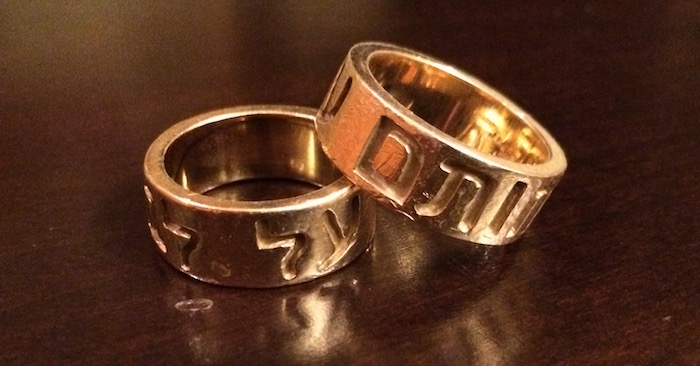
My wedding band is inscribed with the words “As a seal upon your heart” in Hebrew. Originally from Kohelet (Ecclesiastes), this verse on my finger serves as a daily reminder in several ways. When Duncan and I were ring shopping, I wanted the “plain gold band” we’d need for the ceremony to also be one that we both felt comfortable wearing every day. Even if it was simply solid gold, I wanted something that was both beautiful and meaningful. My mother shared with me that she and my father had this verse inscribed on the inside of their rings. It didn’t take much convincing to get Duncan on board, and now we each have a constant symbol of our connection to one another as well as the link to my parents and their love too.
The memories we carry are often attached to certain unforgettable details like a song playing at a specific moment or the smells of a certain location. This also happens with clothing and jewelry. Maybe you remember down to the last detail the outfit you were wearing when you brought your first child home from the hospital. Perhaps there’s a piece of jewelry passed down from generation to generation. The tallit you wear on Shabbat and the person it belonged to before you may hold a special place in your heart.
Parshat Tetzaveh, which we read this week, details the specific clothing items that a priest and those close to him are to wear. This is special attire that distinguishes them from others in their service to God. These clothes are meant to add an aura of holiness to the priests as they complete their sacred duties. Since these vestments and garments are to be used for such a unique purpose, God also gives a special instruction regarding who is to make them. After we receive these specifics, we learn about the details of what is on each garment.
Chapter 28, verse 29 teaches: “Aaron shall carry the names of the sons of Israel on the breast piece of decision over his heart, when he enters the sanctuary, for remembrance before the Lord at all times.” That is to say that in all of Aaron’s work, he is to carry the “seal” upon his heart of those who have come before him. The high priest, in his role, is beholden to the names, experiences, and fates of those who came before him. The Ba’al Shem Tov, a Chassidic master, shares “Remembering is the source of redemption, while forgetting leads to exile.” Our identities have been shaped by those who came before us not only in their actions, but in our memories of them.
While we may not have a high priest today, we too are linked to those came before us. Whether the memory is preserved in the use of your great-grandmother’s candlesticks on Shabbat or telling the same jokes each year at Pesach, the sharing of that past is what will ensure a future.
My wedding band reminds me of the strength and love of my parents’ marriage and of the dedication Duncan and I have to each other to maintain our own bond. May we all be blessed first with the sweetness of fond memories and second with the kavanah, the intention, to learn and grow from the lessons they teach.
Parenting by the Parshah – Tetzaveh
Your clothing can reveal a lot about where you work, the climate in which you live, and even your attitude on a particular day. And yes, this too is Torah.

