Monument To You – Parshat Vayishlach 5782

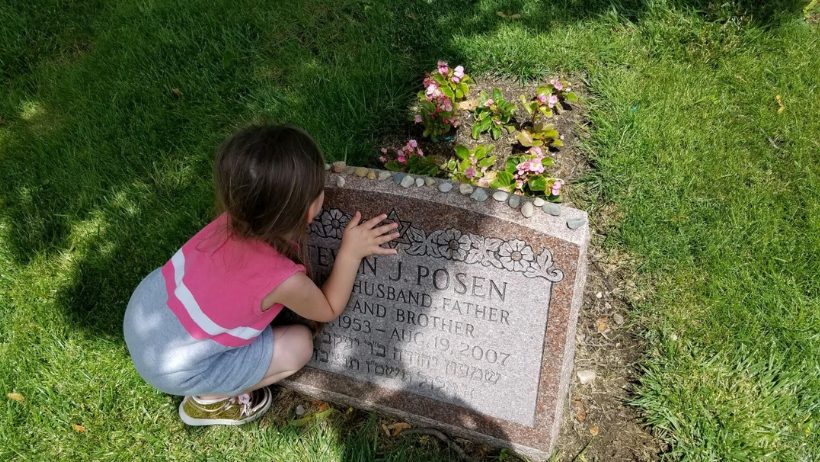
In my work as a rabbi I often have the honor of assisting families as they create the grave marker for their loved ones. In case you’re wondering, this is not something that’s taught in rabbinical school. This is an act that is unique to each family and, understandably, holds a lot of emotion. The creation of a marker stone is a finality in the process of loss and grief. Granite is final, the carving doesn’t change over time. This is the stone you’ll see every time you visit the cemetery.

These stones, though brief in their wording, often tell a story. We use descriptions both of character and relationships. Does the family prefer “beloved” or “loving”? How about “cherished”? Should we be generic in relationships and just say father, son, brother, grandfather? Or, should we use our personal terms of endearment like “Daddy” or “Zayde” or “Papa”? And what color should the marker be? Does it matter if the font is different from the other family members nearby or next to them? Should we put an image on it? Is it better to keep it simple? These are just a few of the many questions that go into the process of choosing this final marker for loved ones. It makes sense that there would be so many questions. After all, we get one shot to do this, and the honor and memory of our loved one is at stake. 

As we learn in this week’s Torah portion, Jews have been traditionally marking the resting places of family members since the time of the Torah. As an overview, our Torah portion this week, Parshat Vayishlach, reminds us of what it might be like to live fully as yourself, even as the world around you is changing. Jacob is preparing to meet his brother Esau after their fallout and struggles in his dream with the angel who changes Jacob’s name to Israel. The brothers meet and part in peace, and the story continues with the birth of more sons to Jacob and the different ways in which his children misbehave. 

In the middle of this section of text, Rachel dies in childbirth, and the Torah magnificently moves from death to life in the course of about three verses. Benjamin is born, but Rachel doesn’t survive, and as the clan is on the road, Rachel is buried along the way. In chapter 35, verse 20 we read, “Over her grave Jacob set up a pillar; it is the pillar at Rachel’s grave to this day. Israel journeyed on.” A simple, yet stunning tale of the burial of Rachel, Jacob’s beloved.

The Torah goes back and forth between calling Jacob by this name and using Israel, the one who wrestles with God. Interestingly, he is called both at the passing of his beloved wife. In this moment he is both the little boy who is born holding on to his brother, and the grown man wrestling with the reality of the world. It is somewhere between these roles where he sets the grave marker for his wife. 

Our markers are eternal, no matter how fleeting life is, and our portion suggests that this marker is one that is on her grave to this day. While we don’t read about the inscription upon the stone, we understand that Jacob knew that it was intended to forever symbolize his love for his wife.

Parshat Vayishlach is a reminder that there’s little that’s truly permanent, but establishing a permanent marker to know from where we’ve come and from who we’ve come is an essential part of our journey. The marker for Rachel happens in a blip in the Torah, just one verse. They didn’t agonize over the words, the color, the placement. Instead, the focus is on her legacy and the children who became leaders in our tradition. May we learn from Jacob how to both mark a moment and move forward, and may we do that knowing that while stone might last forever, our stories can outlast even the stone. 

Finding Home – Parshat Vayetzei 5782

I love finding family. For a bit of background, I grew up around lots of cousins on my mom’s side, including first, second, and third cousins. You could practically call it an entire family tree. We were so close that I never really distinguished between degrees of cousinhood; we were just cousins.

On my dad’s side, however, there were many cousins I never met. That’s because they were from a generation before me, since I have no first cousins on his side. This makes it all the more surprising and exciting that three times since I moved to Portland, I’ve had opportunities to connect with relatives. The first time happened when I accepted my position at Neveh Shalom. After the official announcement went out, I received an email from a cousin who lives nearby who was excited to hear I was coming “home.” (Hi, Ruby!) Then, a few years ago, I was officiating a wedding, and after the ceremony a guest came up to me and introduced herself as a cousin. She looked just like my sister, and we actually knew each other in passing when we were much younger. (Hi, Lindsey!). And most recently after our Covid-19 High Holiday services, I received an email from another cousin who just moved to Vancouver, WA and whose father actually delivered me when I was born. (Hi, Jeff!) That connection was made through watching our live streamed services. In each instance I was grateful for the moment of connection and the deep feelings of family bonds, despite reconnecting after a long time or for the very first time.

I’m not alone in this desire to be connected to family near and far. It’s actually expressed quite beautifully in this week’s Torah portion. Parshat Vayetzei begins with Jacob fleeing his home, on the run from his angry brother and the mess that has become of his family dynamic. Exhausted, he lies down and has this bizarre dream in which God comes and speaks to him. God gives Jacob marching orders, a legacy to hold and create, and a full sense of his mission in life. Much like his father Isaac, the journey is into the unknown. But unlike his grandfather, Abraham, Jacob finds family almost immediately. 

Jacob sees his cousin Rachel and once he sees her, he’s so overjoyed to recognize her, he embraces her with a kiss. While I didn’t kiss any of my cousins on the first meeting, I do relate to Jacob’s joy and jubilance at finding family in a new place when he’s feeling all alone. For Jacob, seeing Rachel was finding connection to his past and knowing that there was someone who was like him. That was enough for Jacob to feel at home, to feel safe after he’d run from his brother, and to feel like God was really with him.

When I’ve examined these verses with students, they’re usually quick to ask what it means in Jacob’s dream that God “will not leave you until I have done what I have promised you.” Perhaps one of the best lessons we learn from this parshah is that feeling a sense of home, of family, is a powerful way of feeling God’s presence. As we enter the darker part of our year, may we be embraced by light and warmth and that comfort of home whenever possible.

Inherited Problems – Parshat Toldot 5782

I try not to blame my parents for all my problems, but there are some that are totally their fault. Of course I’m talking about the problems that aren’t in their control either, the ones that are determined by genetics. It would be easy to blame them for all my neuroses and other issues too, but the truth is there’s a lot more nature involved than we like to assume. The place where they can’t escape blame (and neither can I for my kids) is my genetic makeup. I am prone to diabetes (I have a family history of it). I also inherited a history of heart disease, OCD, and stomach issues. I’m not trying to overshare personal health history in public; there are just certain things that each of us is genetically predisposed to have, and these are mine. Why couldn’t I have inherited a beach house instead?

And yet, I wouldn’t trade my family for the world. I inherited this (health issues and all) because of the lineage I come from, and that history and those people are incredibly special to me. They’ve always had my back, they hold me and support me through it all, and thanks to modern medicine, I know what’s coming so I can protect myself and work through it before it is an issue. 

This week we have a Torah portion that is fully focused on what we are born with and how generations move forward. This week we read Parshat Toldot, in which Isaac and Rebekah become parents. The pregnancy is not easy, and the twins are anything but calm. Jacob and Esau are very different, and each is feisty in his own way. Esau sells his birthright to Jacob for lentil stew, and Jacob tricks his father into getting the blessing his brother deserves. Esau finds out, and his outrage over the incident causes Jacob to flee for his life. The portion ends with Esau growing up and rebelling against the family in his choice of life partner.

In the moment Isaac and Rebekah know they’re going to be parents, Rebekah questions it all. She says as the next generation is fighting, forcefully, in her womb “If this is so, why do I exist?” Obviously she was uncomfortable. Obviously she didn’t feel like it was worth it to continue growing these humans if they were just going to cause problems. As we know, she did grow them, and they did cause problems.

Jacob and Esau had no conscious thought about fighting in the womb. They were born with the tendency to go against each other, fighting for attention. But that doesn’t mean Rebekah should have simply given up. Plenty of moments in life feel like an uphill battle. Try as I might to outsmart all the autoimmune diseases in my family, the likelihood I’ll have one is pretty high. That doesn’t give me an excuse to give up. At the same time, I recognize the place of privilege I come from to keep pushing forward, even when some struggles seem futile.

Even Rebekah, who is pregnant with the children promised by God, questions it. Why? To show us that it’s ok to be scared. What Parshat Toldot teaches us is to remember that our lives are not determined by what happens to us or what we’re born with, but by how we adapt and learn and use what we’ve been given.

Change My Mind – Parshat Chayei Sarah 5782

Has anyone ever offered to “pray for you” because they sincerely believed you were going to hell for being Jewish and not following their beliefs? It happened to me in Texas. Or maybe someone of another faith has come knocking on your door trying to spread the “good word”? It’s frustrating enough when someone insists that their way is the right way, but even more so when it’s about religion. I love Judaism (I’m a rabbi, after all), but that doesn’t mean I think Judaism is for everyone or that it’s the only right answer.

In 2017, comedian Ricky Gervais, famously an atheist, had a fascinating and friendly debate with devout Catholic Stephen Colbert on The Late Show. As a point to challenge Colbert’s belief in God, Gervais retorts, “So you believe in one God, I assume? Okay, but there are about 3,000 to choose from. Basically, you deny one less God than I do. You don’t believe in 2,999 gods. And I don’t believe in one more.”

In other words, who’s to say that they are absolutely right when it comes to religious belief? As a rule, Jews don’t proselytize. We don’t seek to convert others to Judaism. Like me, this is one of those Jewish facts you’ve probably known your whole life. This is why it puzzled me when, as a teenager, I saw representatives from the local Chabad standing on the sidewalk outside my public high school on Friday afternoons trying to teach the boys how to put on tefillin. I also clearly remember going up to them one week when I was feeling very brave, having my own tefillin with me, and showing them that I could do it too.

What was Chabad doing outside my public high school? They would argue that they weren’t proselytizing because, of course, they wouldn’t ask people of other faiths to put on tefillin; instead, they were trying to help other Jews fulfill the obligation. If that’s true, though, why stand outside the public high school? Why not stand outside a synagogue before daily minyan

Perhaps the answer is found in this week’s Torah portion. We read from Parshat Chayei Sarah, which makes the transition from one generation to the next. Beginning with Sarah’s death, we learn about Isaac and his courtship with Rebekkah, the list of Abraham’s descendants, and the death of Abraham and his burial at the cave of Machpelah. Through it all, the family continues to push their way from experiences of loss and grief into the next chapter of life.

As Abraham is trying to find land for burial and also a wife for Isaac, we read in chapter 24, verse 2: “Put your hand under my thigh and I will make you swear by the Lord, the God of heaven and the God of earth . . .” By using the phrase “the God of heaven and the God of earth,” our midrash suggests that Abraham was bringing awareness to the fact that God does not only rule in heaven, but also on earth. Throughout this passage he refers back to the fact that God rules both in heaven and on earth.

So what does this have to do with proselytizing or not proselytizing? Midrash teaches that Abraham was the first individual to recognize this and to try and teach it to others. However, Abraham didn’t go out looking for others to join him on his journey of following God. He didn’t go out and preach to everyone of God’s truth. Rather, he shared this special connection, this special teaching, with those in his circle whom he knew needed to hear it. He looked for others who might already share this belief and tried to bring them all together. For example, when he looked for a wife for Isaac, he wanted someone who already shared this belief in God to make their community that much stronger.

I don’t think either Ricky Gervais or Stephen Colbert were actually expecting the other person to completely change their viewpoint. Similarly, Chabad’s presence outside my high school wasn’t about converting anyone to something that they didn’t previously believe. While that public act might make some people uncomfortable, that public act also reminded the Jews who were there what it means to be Jewish and what it means to have community. Likewise, Abraham also wasn’t out to change people’s minds; he was hoping to bring people closer together in love and faith. May we work to live in a world where we’re not trying to change people’s beliefs to match our own, but instead, strengthening our own circles so that we all, in turn, strengthen each other.

Now See, Hear – Parshat Vayera 5782

One of the hardest parts in switching to what is now a commonplace Zoom lifestyle was not being able to really see people. Yes, we mostly had our cameras on during meetings and services, but only seeing someone from the neck up isn’t really seeing them. So much of what I use in conversation comes from watching body language, watching subtle movements and shifts in others, and being fully present with another person. I’m just as guilty as the next person of occasionally being “checked out” when a meeting is online. If I’m not on a walk, where there are fewer distractions, it’s much too easy to check and answer emails or help a kid with a project. I wanted to be fully focused, but sitting and staring at a screen all day long didn’t really allow me that focus I needed. So in other words, not being able to completely see people has also made it difficult for me to completely hear them.

I know I’m not alone in my inability to be fully focused, or fully listening, when something else is calling for my attention. One reason I know this is because it’s actually at the center of this week’s Torah portion. In this week’s parshah, Vayera, we learn a version of this lesson as well. Here’s the recap: Abraham and Sarah contemplate the son that will be born to them in their old age; Sodom and Gomorrah fall as Abraham bargains with God to save Lot’s life; and Isaac is born, causing a rift in Abraham’s house with Ishmael. Abraham moves forward in making a deal with King Avimelech, and we end with the Akeidah, the test of Abraham as God asks that he offer up his son, Isaac.

When Abraham and Isaac are on the walk to the mount for Abraham to sacrifice Isaac, there is stilted conversation. Isaac repeatedly asks questions based on his observations. “Where are we going?” “Where is the sacrifice?” And Abraham’s answer is consistently, “God will see to the sheep” and “He saw the place.” Whereas Isaac was taking in the world around him, likely because he was fully focused on the experience, Abraham’s focus was somewhere else, perhaps hoping and praying that God would intervene and call off this test. Abraham wasn’t watching his son to see how to really comfort him; instead, he was focused on God. 

This is not to say that as a monotheistic people we shouldn’t focus on God; rather, it’s a subtle reminder that Judaism, parenting, and life in general are about being present. After this incident, Abraham and Isaac don’t really speak to each other again, not that you can blame them. But I can’t help wondering if that would have been different if Abraham had been fully present with Isaac, listening to him, to really see him and to answer his questions, share wisdom, and let him know he was loved, despite this challenging ordeal. 

What I’ve learned about Zoom is I’m not able to be fully present unless I remove the distractions.  When we listen to each other, when we can really see each other, not just in a tiny window at the top of the screen while we mindlessly scroll Facebook or answer email, but in the full screen (large box, so to speak) that’s how we build relationships and move forward with one another. May we continue walking into 5782 with presence and focus on the things that matter.