Impossible Choices – Parshat Toldot 5784

I am a terrible decision-maker. In fact, for my birthday and Mother’s Day every year, the one gift that’s always on my list is making absolutely zero decisions the entire day. My indecisive nature comes partly from not wanting to miss out on something and partly because I’m always worried about making the “wrong” choice. When it comes to big decisions, I can usually feel it in my gut and I trust that space. However, when it comes to daily decision-making, I’d just rather not. Please, don’t ask me what I want for dinner!

There’s one area where I feel simultaneously the most confident and the most indecisive: parenting. Little decisions like what clothes we’ll purchase or when to say yes to dessert aren’t the ones that cause stress. It’s the decisions that shape my children’s lives that give me pause. And as a mother of two children, I make different decisions for each child based on who they are and what they need. That means that while one might be wearing shorts when it is 30 degrees outside, I will insist that the other wears a jacket and gloves. They just need different things. 

Rebekah, the mother of twins Jacob and Esau, teaches us the value of recognizing individual needs and talents in our children and making choices that support them. This week we read Parshat Toldot, in which Isaac and Rebekah become parents. The pregnancy is not easy, and the twins are anything but calm. Jacob and Esau are very different, and each is feisty in his own way. Esau sells his birthright to Jacob for lentil stew, and Jacob tricks his father into getting the blessing his brother deserves. Esau finds out, and his outrage over the incident causes Jacob to flee for his life. The portion ends with Esau growing up and rebelling against the family in his choice of life partner.

At the end of this Torah portion, the text appears to emphasize a fact that we already know – that Rebekah is the mother of both Jacob and Esau. Isn’t this obvious by now? Why would the text repeat this? It’s to reinforce the idea that while Rebekah might address the brothers’ needs in different ways, she loved them both. There are few “easy decisions” for mothers, especially Rebekah. She chose to send Jacob away in order to save his life, but also to save Esau from becoming a murderer. In other words, she may have favored Jacob for the blessing and seen his strength as a leader, but she protected both her sons. 

Sometimes in our lives, the hardest choices are the ones that require a bigger-picture mentality. And when emotion is involved, like the love of a mother, that makes it even harder. Parshat Toldot reminds us that for generations to continue after us, we can’t just consider the future, we must actively make decisions that keep the reality of that future alive.
To Offer a Blessing – Parshat Chayei Sarah 5784

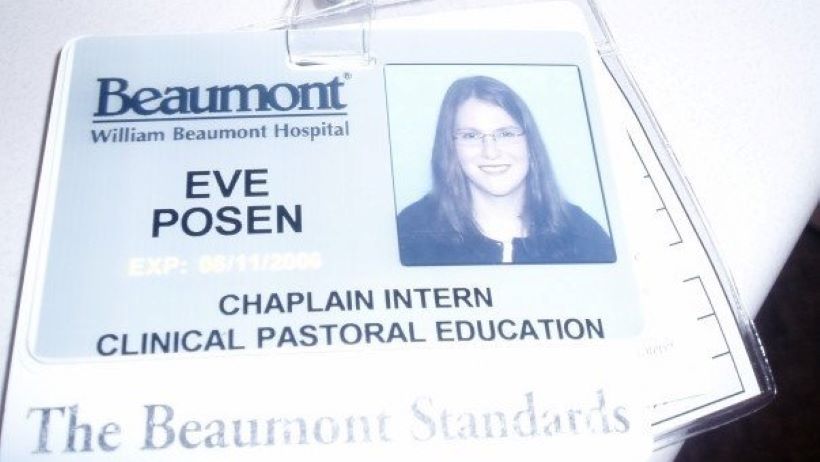
When I was in rabbinical school, I spent a summer doing an intensive unit of chaplaincy in a level-one trauma hospital in Michigan. Over that summer I learned about what it means to be with people in their highest of highs and lowest of lows, as well as how a multitude of religions approach healing and comfort. Our group of 10 clergy spanned six different faiths, and I was the only rabbi in the group. Every morning we would begin with a centering prayer, led by a different student. Some mornings we did meditation, others we studied text, and others we looked at liturgy. Then we’d break into our teams of two students each and go to our assigned floors and visit every patient.

It seemed almost every time we entered a room, someone asked the chaplain to pray for them. My chaplain partner Jen would then ask them what they’d like her to pray for, then they’d close their eyes and hold hands, and she’d offer an extemporaneous prayer. And I would stand there, terrified they’d ask me. I knew the Misheberach, the traditional prayer for healing in Judaism, but I had never been asked to offer a spontaneous prayer aloud. That summer, more than anything else, I learned the power of a unique, personal, unscripted blessing. 

Oddly, it took until graduate school for me to figure this out since the Torah is filled with extemporaneous prayers, including in our Torah portion this week. We read from Parshat Chayei Sarah, which makes the transition from one generation to the next. Beginning with Sarah’s death, we learn about Isaac and his courtship with Rebekah, the list of Abraham’s descendants, and the death of Abraham and his burial at the cave of Machpelah. Through it all, the family continues to carry themselves forward from experiences of loss and grief into the next chapters of life.

As Rebekah is preparing to go meet Isaac, her family asks her if she is willing to travel to meet him. When she agrees, they send her off with a blessing: “O Sister! May you grow into thousands of myriads; May your offspring seize the gates of their foes!” This wasn’t asked for or expected, it just happened. 

There’s a certain power in offering blessing one person to the other in moments of transition. While the siddur is a beautiful guide for the notion of prayer, the prayers are meant to be just that, a guide, not a set-in-stone limit to what we can offer. May we read this moment in the Torah as an invitation to open our hearts to others, to speak the words of our hearts, and to fully be present in everything we do.

To Be a Prophet – Parshat Vayera 5784

Like a lot of people, I have my superstitions. Mine don’t come in the form of black cats or broken mirrors, but more in the sense of not wanting to jinx myself. If you mention how well something is going, soon the opposite is certain to happen. Duncan knows that we never say things like, “Can you believe how well the kids are getting along right now?” because inevitably after we say that, the other shoe drops, and chaos ensues. Does that make me a prophet or a soothsayer? Not at all. Does it mean that perhaps I’m simply tuned in to the general ebb and flow of behavior? Maybe. It’s not that I can predict the future, it’s simply a bit of intuition mixed with experience. It’s not always correct, but when it comes true, however, it does sort of feel like a superpower.

Can one person really know the future? People make a living as psychics and fortune tellers to this day, long after prophets have had any sort of role in our culture or tradition. The Torah seems to mention fortune telling in various contexts as a normal thing. Let’s see if it shares any insight as to why. 

In this week’s parshah, Vayera, the idea of a prophet comes up. Here’s the recap: Abraham and Sarah contemplate the son that will be born to them in their old age; Sodom and Gomorrah fall as Abraham bargains with God to save Lot’s life; and Isaac is born, causing a rift in Abraham’s house with Ishmael. Abraham moves forward in making a deal with King Avimelech, and we end with the Akeidah, the test of Abraham as God asks that he offer up his son, Isaac.

As Abraham is growing in his own role as a leader in his family and in the greater world, he is seen making some unusual choices, like lying to Avimelech. On the other hand, he also makes some positive choices, engaging in dialogue with the neighboring nations. When they unravel the wife/sister lie, God admonishes Avimelech: “Therefore, let the man’s wife go for he is a prophet.” This is the first time the word prophet is used in the bible. A literal translation is “one who receives the divine call” or, “one who proclaims,” or “a spokesperson.” This leads us to the question, in which role is Abraham acting?

In this case, Abraham is something of a mix of these things, but mostly here to intercede on behalf of others. He is a spokesperson for the future on what will happen should Sarah not be allowed to return to him. Could Abraham really predict the future? Probably not. Nevertheless, as a prophet, or at the very least as a spokesperson who seems to have morals and values invested in him through his trust in God, it makes sense for Abraham to call for kindness and dignity as the path forward. With so much uncertainty and turmoil in the world, let us take this message to heart. While we can’t predict the future, perhaps we can use what we know from the past and present to steer ourselves toward the world we wish to build. 

Ability to Change – Parshat Lech Lecha 5784

There’s a persistent question that’s likely been on all of our minds for decades, but which has been particularly nagging over the past three weeks. Looking at the war in Israel and the antisemitism here and elsewhere, how often do you ask yourself if things will ever change? Even if (hopefully when) terrorist groups are taken down and eradicated, does antisemitism go away? Does anti-Israel sentiment go away? Is peace achieved? 

Lately, I’ve been wondering about the ability human beings have to change, to adapt, and to accept changes in others. There are the somewhat superficial changes, like the ease with which my kids can go from having a favorite food to absolutely despising that same food in the blink of an eye. Then there are the more significant, impactful changes, like the ways in which my personal theology, values, and style have shifted and morphed over the years. The arc of my life story is one that shows how very different the human being I am today is from the one I was thirty, twenty, or ten years ago. I’d venture to say that may be true for you as well, and it’s certainly true for the first patriarch in the Torah, Avram, as we read in this week’s parshah.

In Parshat Lech Lecha, we are finally introduced to Avram and Sarai – later Avraham and Sarah – who become the great patriarch and matriarch of the rest of our narrative. We learn that Avraham follows God with full intent, without questioning, and that Sarah goes with him, both of them acting through their faith in God and each other. The text from last week ends with the genealogy of the generations starting with Noah. Very little information is given about this time period other than these highlights: Avram and Sarai were married, Sarai could not have children, and Avram’s father took him and his family, including his grandson Lot, on a journey toward a new land. We also know that Terach, Avram’s father, was 205 when he died, and this time-based fact leaves a few unanswered questions. How old was Avram? Did they all go willingly? What were they doing in Haran? Was Avram happy there? Why did they leave?

You’ve probably heard the story from midrash (commentary on the Torah) that tells of Avram taking a stand against polytheism and smashing the idols his father made. But that story’s not in the text. All we know is that Avram went on a journey with his father and family, they stopped before they got the their final destination, and then his father died. The next line of the text is the beginning of Lech Lecha, where God is speaking directly to Avram and pushing him to go to the promised land, the land to which his father was en route. 

The first 75 or so years of Avram’s life are passed over without mention. The main parts of his story are shared when he begins to act on his own, with his own convictions and beliefs. Perhaps the midrash of smashing idols is so prevalent in our storytelling because it signifies the change that Avram wanted to make in his life, and it helps us reconcile the gap in the narrative and in Avram’s apparent frame of mind. One of the messages of Parshat Lech Lecha is that change is possible, and it can have enormous consequences, but it only happens when, individually, we decide the journey is worth it.

The Lion and the Lamb – Parshat Noach 5784

There’s a well-known fable about a frog and a scorpion. The scorpion wants to cross a river but cannot swim, so it asks a frog to carry it across. The frog hesitates, afraid that the scorpion might sting it, but the scorpion promises not to, pointing out that they would both drown if it killed the frog in the middle of crossing. The frog considers this argument sensible and agrees to transport the scorpion. Midway across the river, the scorpion stings the frog anyway, dooming them both. The dying frog asks the scorpion why it stung, despite knowing the consequence, to which the scorpion replies, “I am sorry, but I couldn’t resist the urge. It’s in my nature.” 

This parable is meant to teach that sometimes our instinctual or habitual ways win out, even when they’re not in our own best interest. The scorpion could not resist the urge to do what he always does, even if it meant that he would ultimately die along with the frog. At the same time, the frog, seemingly a natural helper, took a chance on the scorpion, knowing there was risk involved.

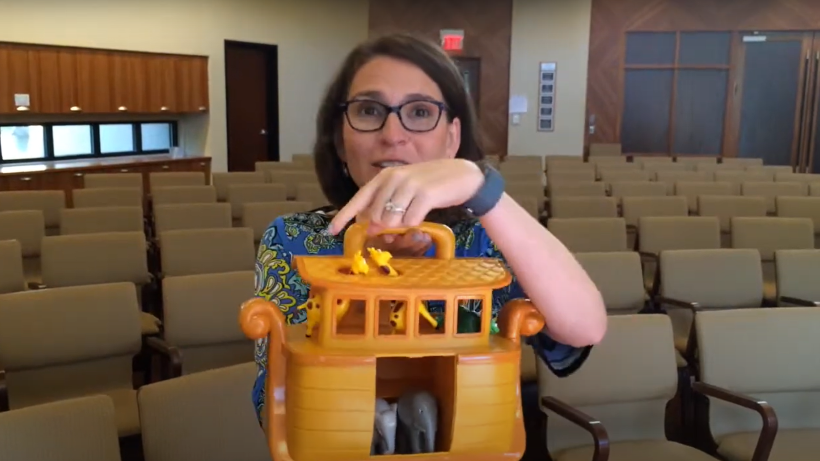
Whenever I hear this parable, I imagine what might have transpired on the ark that Noah built. After all, there were lambs and lions, scorpions and frogs, predators and prey, all crammed together. How could they coexist? 

This week we read that very story in Parshat Noach. As the second section of text in the entire Torah, this portion takes us through the story of the flood, including Noah building the ark, saving his family and the animals, sending out a dove, and God’s promise to never do this again. We learn of the generations of Noah and how humanity moved on to create the next piece of the narrative, the Tower of Bavel. After the Tower of Bavel, we see that the nations are scattered, and then the Torah quickly moves us through the 10 generations between Noah and Abraham, where the rest of our history as a people takes off.

So how did every type of animal live peacefully during their time on the ark? Our commentary suggests that these animals, unlike the society Noah was from, somehow recognized the dire situation and were able to put aside their natural enmity and cohabitate peacefully in the ark. It was only when the danger was over that they went back to their old habits. What do we make of this temporary change? Perhaps the pessimistic view focuses on the fact that the peacefulness they achieved was only temporary and that old habits and natural proclivities die hard. However, I choose the optimistic view, the one that focuses on the fact that change is possible, peace is attainable, and working together can make a difference, even if just for a short time.