For Heaven’s Sake – Parshat Korach 5775

Korach

Why do you do what it is you do?  Do you ever find yourself questioning the purpose behind everyday tasks?  Am I buying this bag of tortilla chips for nutritional reasons or simply to satisfy a craving?  Do I need another black skirt or do I simply like this one instead of another?  Am I getting into a fight with my husband because there’s an issue we need to resolve or just because I feel like arguing? There are certainly a multitude of reasons for each action we take.

The rabbis were aware of this as well. Not necessarily the tortilla chips, but the concept in general.  In the Mishnah, Perkei Avot, they teach:

יז כָּל מַחֲלוֹקֶת שֶׁהִיא לְשֵׁם שָׁמַיִם, סוֹפָהּ לְהִתְקַיֵּם. וְשֶׁאֵינָהּ לְשֵׁם שָׁמַיִם, אֵין סוֹפָהּ לְהִתְקַיֵּם. אֵיזוֹ הִיא מַחֲלוֹקֶת שֶׁהִיא לְשֵׁם שָׁמַיִם, זוֹ מַחֲלוֹקֶת הִלֵּל וְשַׁמַּאי. וְשֶׁאֵינָהּ לְשֵׁם שָׁמַיִם, זוֹ מַחֲלוֹקֶת קֹרַח וְכָל עֲדָתוֹ

“What is an example of a disagreement made for the Sake of Heaven? Such was the disagreement between Hillel and Shammai.  And what is an example of a disagreement not made for the Sake of Heaven? Such was the disagreement of Korach and all his company.”

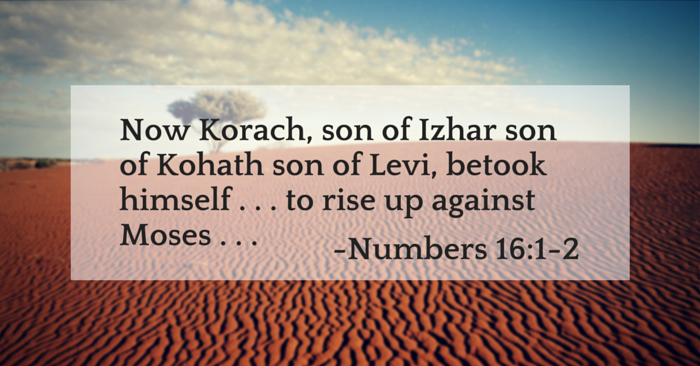
This teaching is relating to our parshah this week, Parshat Korach.  This narrative details the revolt of Korach and of Datan and Aviram.  Korach breaks apart the priesthood and prepares a revolt while Datan and Aviram, two other troublemakers, begin a revolt of their own.  Chaos breaks out in the camp, and those who don’t see a purpose to the fight pull away, which becomes a pretty smart idea as the earth opens up and swallows Korach and his followers.

Korach had decided that the entire notion of the priesthood, a specified leading class, was unnecessary since the Israelite nation as a whole is holy because of their work at Mt. Sinai.  Korach questions why Aaron and his lineage should have this special leadership role, and to be honest, it’s a good question.  The problem is that Korach doesn’t seem to want to hear any answers; he simply wants to start a fight.

Here’s where Korach was right: we are all holy, we are all a part of the nation.  But he was wrong to assume that everyone should be a priest.  Division of responsibility is how we form a cohesive and productive society.  If we’re all leaders, there is no one to follow.

Korach picked a fight because he could, but fighting simply because we can leads to chaos and destruction.  However, purposeful conversations, discussions, and even arguments have a place in pushing us to change our thinking and make better choices. These are the disagreements “for the sake of heaven.” Our Torah portion this week teaches us that we must think carefully and strategically about our actions, our desires, and our morals and move forward only when the fight is one that not only benefits us, but benefits the entirety of our community.


I Think I Can’t – Parshat Shlach Lecha 5775

I Think I Can't

Watching my daughter Shiri learn to walk was a little humorous and a little frustrating all at the same time. As she demonstrated when she started to crawl, she’s the kind of kid who waits to get really excited about something until she can master it. She took her first real steps without any help at fourteen and a half months. But as soon as we’d start to cheer her on, she’d lose her confidence and plop down and revert back to crawling. Walking was new and scary, but she was an expert at crawling, so the second she’d feel a wobble or a moment of imbalance, she’d simply give up. In her mind, this was a sign that she wasn’t ready yet.

It is human nature to be concerned about doing something “the right way.” Even if I’m trying something new, I want it to be perfect. But because change is difficult, it can be a long, hard path to full confidence.

So much of the struggle is mind over matter. Often what it comes down to is getting into the right mental space to create the confidence; adopting the right mindset is critical for completing a task.

Dr. Carol Dweck is a leading researcher at Stanford University in the field of motivation. Dr. Dweck studies the brain and our thought patterns and posits that there are two mindsets we all have: “Fixed” and “Growth.”

Fixed Mindset: A Fixed Mindset occurs when people believe that attributes such as intelligence are unchangeable. This mindset is based on the notion that talent alone creates success, and effort is a sign of weakness rather than a way to reach one’s fullest potential.

Growth Mindset: A Growth Mindset is one in which people believe that these attributes can be “grown” through learning. With this mindset, people believe that their abilities and talents can be developed over time. This view fosters a love for learning, a drive for growth, and the resilience essential for great achievement.

This week we read parshat Shlach Lecha. The parshah begins with Moshe sending 12 spies, one from each tribe, into the land of Cana’an to bring back an accounting of the land. The spies return with their report, and it’s discouraging. Two spies report back with a positive message, but the negativity of the other ten reports instills so much fear into the nation that they decide they do not want to make the journey into the promised land after all. This infuriates God, who then decrees that anyone who went out from Egypt at age 20 or older will not be allowed to enter the land of Cana’an. This generation will purposefully die out so that a new generation, unfettered by the destructive mindset of their predecessors, can start anew.

This is a crucial chapter in the narrative of the Israelites. At this point we’ve already heard their constant complaining about life being better in Egypt, but this complete lack of faith in themselves and in God is a considerable blow. The distinction couldn’t be clearer between the fixed mindset of slavery exhibited by most of the spies and the growth mindset of Joshua and Caleb, who do believe that they can conquer the land. The simple fact that they believe in themselves means they are more likely to try. For the rest of the spies in the fixed mindset, it’s a lack of faith in their own abilities and a fear of failure that holds them back.

We hear a lot about the concept of self worth, but we don’t tend to talk as much about self trust. This week, parshat Shlach Lecha reminds us that a growth mindset doesn’t ignore our current abilities; it simply allows us to trust our mental capacity. May we accept and rise to the challenges before us, confident that personal potential is the most incredible strength we possess.

Expecting Perfection – Parshat Beha’alotcha 5775

Expecting Perfection

Leaders are human, which means they have flaws. I think we can agree on this basic principle. But why do their flaws seem so much bigger? Political mistakes and indiscretions are headline news, and corporate CEOs have their every misstep dissected and commented on. Is it possible that we elect and promote people more flawed than we are? Or has their position of power affected their ability to judge circumstances and consequences?

These are both possibilities, but likelier still it’s our instant, digital world that has given us the ability to know everything about everyone which has altered our perspective. And because we hold our leaders to a higher standard, the lesser qualities are magnified much more than the greater qualities.

This week we read parshat Beha’alotcha, a turning point in our narrative.  This section of text begins with instruction for the purification of the Levites as they do their holy work in the Tabernacle. We read about the first Passover sacrifice in the wilderness and how to celebrate Passover if we miss it the first time around.  Then the text turns toward the Tabernacle, the Mishkan, and teaches us that God’s presence hovers over it in a cloud.  Finally, Moshe’s family – his father-in-law, wife, and children – return to join him and the rest of the Israelite nation on their journey through the wilderness.  It is in the return of his family to the camp that we learn about what unrealistic expectations have been levied against Moshe.

Chapter twelve begins with Miriam and Aaron gossiping about their brother.  “. . . he married a Cushite woman. They said, ‘Has the Lord spoken only through Moses? Has He not spoken through us as well?’  The Lord heard it.  Now Moses was a very humble man, more so than any other man on earth.”

There’s no question sibling rivalry goes back as far as the Torah.  Miriam and Aaron clearly don’t believe that Moshe married the “right” woman for him, and it sounds like they don’t believe he is worthy of being the leader. But why is this?  According to Rashi, Miriam isn’t necessarily upset about the type of woman that Moshe married, but in her eyes, he did not deliver as an appropriate husband.  Miriam is more upset that her brother put his leadership responsibilities above his family responsibilities.

In the line, “Moses was a very humble man, more so than any other man on early,” literally the words used are “the man Moses.”  Perhaps to emphasize that Moshe is only human.  Miriam and Aaron have expectations of their brother – someone who is holy, a leader, and a father – that simply aren’t attainable.  Even Moshe, the man who brought us out from Egypt with God and the man who stood up to Pharaoh, is imperfect; he is human.

Parshat Beha’alotcha reminds us that we are all human, we are all fallible, and we are all imperfect.  God brings a harsh punishment to Moshe’s siblings to make a statement about unrealistic expectations and the way they can bring down a community. Expectations of perfection leave you wide open for failure and frustration. This week we know that our job is to accept each other for who we are, flaws and all.

I Forgive Me – Parshat Naso 5775

I Forgive Me

When it comes to the art of asking for forgiveness, there’s nothing worse than a canned apology. You know the kind I’m talking about. A politician reading a few lines of carefully scripted empathy off a teleprompter or a business owner covering up for something that was “taken out of context.” The real problem with a fake “I’m sorry” is that even if it appeases those who were wronged, it carries no weight for the person apologizing. You see, when you’re to blame, the first person you must ask forgiveness from is yourself. Only then can you accept the feelings of guilt that help you to change.

As we read parshat Naso this week, we read about the Israelite society trying to move forward after leaving Egypt and the establishment of a successful community.  The narrative picks up with a second counting of the people; laws about how we are to treat one another and the property that we own; the blessing of the priests to the people; and the laws of the Nazir, detailing how we might dedicate ourselves directly to God.

Chapter 5, verse 7 focuses in on the notion of confession.  “He shall confess the wrong that he has done.”  While this sounds straightforward enough, the “confession” is loaded with ritual and with meaning. The Hebrew word used for confession is “hitvadu.”  This is in the reflexive form, which suggests that we must confess to ourselves the wrong that we have done.  Confessing to ourselves, and even forgiving ourselves, is essential in moving forward and growing as humans.

Too often as parents, children, siblings, and teachers, we only halfway apologize for our mistakes. We publicly ask for forgiveness, but we never truly move forward by personally taking ownership of those wrongdoings.  We give lip service to our wrongs, but don’t learn anything from them.  The text this week reminds us that in order to properly confess, and to properly forgive, we must forgive and believe it first ourselves.

One of the essential tools of the rabbinical trade is a thick skin.  This isn’t just because of the pastoral duties, which require a specific temperament. It’s also because as someone who must choose words carefully, I tend to be hardest on myself when my words fall short. Maybe I wasn’t able to respond to a question fast enough or I wasn’t able to be there physically when you needed me. I take these moments to heart and often hold onto them  longer than I should. You may have even forgiven me before I have forgiven myself.

Here’s my promise to you: I will work on forgiving myself if you promise to work on forgiving yourself too. After all, that’s precisely the point of including the concept of hitvadu in this community-building portion of the Torah. Confession is just one building block of a fruitful relationship, and it’s our relationships that create the society we want.

[photo credit: Sorry in Sydney, Australia -sky writing, National Apology Day , National Sorry Day 2015 “such unthinkable theft” via photopin (license)]

Piece By Piece – Parshat Bamidbar 5775

Piece By Piece

I am the first to admit that I have a touch of OCD. I can’t stand to see things unfinished. Parenthood has only exacerbated this affliction. Before I go to bed every night I have to make sure that Shiri’s toys are all put away, which means locating every ball and puzzle piece and making sure everything is assembled and in its proper place. Laundry time creates a similar anxiety. Missing socks are simply unacceptable; every sock should be in a pair. I have a tendency towards order instead of chaos, and I have a deep desire to make sure everything is accounted for and correctly placed. And yes, I have been known to tear the house apart looking for a small colored piece of plastic.

We often know our space by the way we set it up. Well all have routines, regardless of our level of obsession in sticking to them. You keep your books in a certain order or you sleep on the same side of the bed or you have a particular way you like to set up a new phone or computer. There is a calm and peacefulness to order, about which the Torah is acutely aware. This week we begin reading sefer Bamidbar, the fourth book of the Torah. Sefer Bamidbar begins with a census of the people and tells us more intimate details about the daily life of the Israelites as they camped out in the desert. Specifically in parshat Bamidbar we learn not only of the number of Israelites in the camp (603,550) but also of the main setup of the camp. Earlier in the Torah in parshat Yitro, we learn that the Israelites camped around Mount Sinai and the mountain that God had chosen was the center of their camp. In the middle of the camp is the Mishkan, the Tabernacle, where the stone tablets with the 10 Commandments are kept and where God dwells among the people.

Everything has its place, even in the ever-moving, nomadic camp of the Israelites. The census at the beginning of our parshah teaches that there were 603,550 Israelites in the camp. According to Levi Yitzchak of Berdichev, a Torah commentator, this is also the number of letters in the Torah. Yitzchak teaches that just as the absence of one letter renders a Torah scroll unfit for use, the loss of even one Jew prevents Israel from fulfilling its divine mission.

We all count; without any one of us, our community and our Jewish world are incomplete. Parshat Bamidbar teaches us not to count one another, but to count on one another in order to build a strong and sustaining community. Here at Neveh Shalom, whether you find your place on the finance committee or ritual committee, whether your place is teaching in our school or sitting in the pew on Shabbat, we are simply a better synagogue because your place is here with us.

[photo credit: Project 365 #86: 270311 On Good Form via photopin (license)]