
Hanukkah Is Fake News Too

hanukkah-is-fake-news.png

As we learned from the widespread propagation of “fake news” over the last several months, we believe what we want to believe. Fake news and sensationalized headlines are nothing new, but they rose to the forefront of our national dialogue during and immediately following the election.

What makes fake news so controversial is not that it exists. Anyone who has spent any time in a grocery store checkout line in the last 40-plus years has seen plenty of “published” fake news headlines. (Don’t you feel better knowing Elvis and JFK are alive and well in a bunker in Montana? I sure do.) What makes today’s fake news troubling is that social media, as pervasive as it is, is still a relatively new type of media. We’re still testing its limits and its trustworthiness.

Not only is fake news nothing new, so to speak, but the story of Hanukkah itself, which goes all the way back to 167 B.C.E., is fake news.

SPOILER ALERT: The rest of this article presents some information about Hanukkah that may be different than what you learned in Hebrew school or from singing “Hanukkah, Oh Hanukkah.” If you would like to continue living under this unspoiled illusion, you may want to skip to the final paragraph.

Most of us learned as children that the miracle of Hanukkah was that a little bit of oil lasted a full eight days, which is why we celebrate by lighting the chanukiah for eight nights. In reality, this headline that has been perpetuated since before “I Have a Little Dreidel” is one of the earliest fake news stories.

You see, while the Maccabees were fighting to save their society and their religion, they missed out on the fall celebration of Sukkot, an eight-day festival. So when the war ended and the Temple was rebuilt, it was the perfect time to “catch up” on the holiday they missed. Thus, they rededicated the Temple and celebrated for eight days. Hanukkah isn’t a miracle of oil, it’s just a late Sukkot.

But if you ask most people about the miracle of Hanukkah and why we light candles eight nights in a row, the only answer most people know is that the oil miraculously lasted that long. Why did we substitute the truth for something entirely made up? If we wanted to celebrate a miracle, wasn’t it a big enough miracle that the small band of Maccabees defeated the mighty Greek army?

One possible reason for the replacement story is that it’s not the simple truth; it’s provocative and inexplicable. Perhaps it is because in a time of darkness and destruction, the people needed to hold onto a miracle of light.

In the end, the “fake news” of Hanukkah was relatively harmless, and in fact quite the opposite. It created and sustained one of the most well-known Jewish stories within and outside of Judaism. But it also teaches us the power of our words and the power our convictions have over us. Confirmation of the opinions we hold, whether based in truth or not, makes us feel complete and safe. Although the consequences of fake news are not always as uplifting and miraculous as the new and improved story of Hanukkah, the reasons for fake news centuries ago and today are probably similar. We may not see as many miracles these days, but that doesn’t mean we aren’t looking.

Change of Perspective – Parshat Vayeshev 5777

change-of-perspective.jpg

Do you know that point at which you’ve read something so many times that it starts to lose its meaning? Maybe it’s something you yourself have written, and you’ve reached the saturation point when you need to hand it off to someone else to edit. Or perhaps it’s a subject line in your email inbox you’ve seen so many times that you know what the email is about without having to read it (and may not want to read it).

There’s a similar phenomenon that happens in our relationships. We become so accustomed to seeing certain people in certain places or acting in certain ways that even if they’ve changed, we don’t always notice. These patterns also present us with the opportunity to separate ourselves from that which is familiar and return later to see the content in a new way and to connect with it again.

This week we read Parshat Vayeshev. We find ourselves in the thick of the Joseph story. Joseph has two dreams that he shares with his brothers, both of which make them angry with him. The brothers go out to pasture, Joseph finds them, the brothers decide to sell him, and father Jacob mourns for his “favorite son.” After this the story takes a turn to focus on Joseph’s brother Judah and the betrayal of Tamar before turning back to Joseph’s life in Egypt, which ultimately lands him in jail.

In the moments that deal with the dreams, Joseph and his brothers are at odds. His brothers see him only through their jealous eyes. And Joseph only sees his brothers as mean, unhelpful, and exclusionary. Jacob, who perhaps has had enough of his sons not getting along, issues the following directive to Joseph: “Go and see how your brothers are and how the flocks are faring, and bring me back word.”

The term that Jacob uses to mean “How your brothers are” is shalom, peace. Literally, Jacob is asking Joseph to “See the shalom – the integrity and the peacefulness – of your brothers.” Jacob knows that his sons do not get along, yet perhaps he’s hoping that seeing his brothers in their element will give Joseph the opportunity to see that they aren’t all bad. Simchah Bunim, a late 18th century Polish commentator, interprets this line as, “You who complained about them and brought back bad reports, go and discover their admirable qualities.”

It is with fresh eyes that Jacob hopes Joseph will see his brothers. Fresh eyes to let go of the hurt and pain and a new light (in the field) that will show Jacob’s other sons as the kind and caring brothers they have the potential to be. Let us make it a goal, especially as we enter into a new secular year, to learn from this lesson and never miss an opportunity to use fresh eyes, open minds, and peaceful hearts.

Blow Me a Kiss – Parshat Vayishlach 5777

kissing-book.png

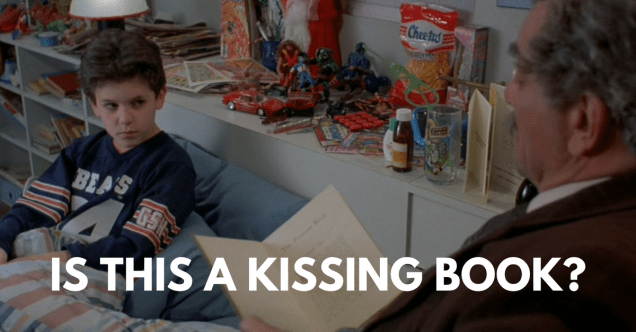
The Bible is a kissing book. Who knew? In fact, kissing in the Bible serves a significant purpose, and it’s not always a romantic one. This week’s parshah, Vayishlach, again shows us interaction between Jacob and his brother Esau. The last time these two were together, Esau didn’t seem too attached to his birthright blessing until it had been given to Jacob, and Jacob didn’t care much about his brother’s right to the blessing until his brother threatened to kill him. Now, twenty years or so later, we find the brothers on a path to meet again. Both are now married and fathers of large clans, and both have large flocks with them.

When the brothers are reunited there is a scene that, on the surface, appears to be a straightforward reconciliation between two estranged brothers. They hug, they kiss, they move on. But anyone who is familiar with sibling relationships knows that this is no ordinary reconciliation. After all, Esau is usually looking out for himself and no one else, and his actions are almost always motivated by hatred. To see him kiss and hug his brother as only a close family member would feels foreign based on previous passages in the Torah.

We often express ourselves more through body language and actions than through words, and a kiss is one of the most intimate forms of expression. But this simple gesture can mean a lot of things. Of course there’s the passion and excitement of a first kiss or the tender kiss from parent to child, but we also use the term metaphorically. “The kiss of death.” “Kiss and tell.”

Shiri loves to give silly kisses. At bedtime we used to go through at least a dozen different silly kisses before she’d finally agree to go to her crib. There was the tiny kiss, the baby kiss, the monster kiss, the pineapple kiss (not even the silliest one, believe me). Each one had some different noise or expression that went with it, and you can bet Shiri would let me know if I did the expression wrong.

Clearly kisses can mean a variety of things, so what did the kiss between Jacob and Esau mean? Was it simply an act of fraternal love, or was it shallow and conciliatory and just for show? Certainly this is one of those Torah portions that asks us to draw our own conclusions. Kisses from mother to daughter, from spouse to spouse, and from sibling to sibling are all very different, even without the baggage that Jacob and Esau brought to their reunion. So perhaps the meaning, like the gesture itself, is to remain between two people and two people alone.


Good luck will rub off when I shake hands with you. Or blow me a kiss, and that’s lucky too. –“Chim Chim Cheree” from Mary Poppins.

Comfort Zone – Parshat Vayetzei 5777

comfort-zone.jpg

Each of our children has a soft fleecy lovey. The three-month-old isn’t quite old enough to fully appreciate its magical comforting powers, but it means quite a bit to his older sister. Her lovey is her regular bedtime companion. In addition, when my daughter is sad or scared, she’ll ask for her lovey. Or when she’s especially tired or grumpy, holding lovey to her face makes her calm and peaceful.

We also have very particular rules about lovey’s location to minimize the risk of losing this special item. Rather than attempt to transport lovey all over the place, some advanced parental preparation meant lovey was always where my daughter needed it. Comfort was never too far away.

In a certain way, this seemingly stationary – yet always available – nature is not unlike God’s presence in the Torah, especially for Jacob. This week we read from parshat Vayetzei, one of the turning points and most famous parts of our text. The text picks up with Jacob on his journey away from his parents’ house to meet his cousin, Lavan, and the strange dreams and encounters he has with godly creatures along the way. He ends up falling in love with Rachel, works for her hand in marriage, but is tricked into marrying Rachel’s older sister Leah. Fast forward a few more years of work, and the prize of having Rachel as his wife is realized. The text continues with the birth of Jacob’s large family and his journey away from his father-in-law Lavan to a new home.

As Jacob runs away from his house, he has a dream. God appears to him. Jacob was likely frightened; after all, he was alone in an unknown place, in an unknown time, not sure of what would happen next. And in his moment of need, comfort arrives: “I am the Lord your God and I will be with you to protect you,” God says. Knowing from this point on he would never be alone, Jacob is able to move forward with confidence, understanding that there would always be a protector with him. In that moment, God was Jacob’s community. The place might have been new and different, but the comfort was familiar.

The need for protection doesn’t go away as we age; it is simply solved in different ways. The common thread is the comfort of consistency. It won’t always be a lovey. It may not always be God. But the knowledge that it’s not you alone against the world is one of the most valuable takeaways from our parshah and a core message of Judaism.

Stop It: 4 Ways to Break the Pattern – Parshat Toldot 5777

break-the-pattern.png

Bad eating habits, destructive relationships, poor time management – how do we get into these cycles, and more importantly, how can we get out of them? Idioms like “Fool me once . . . ” and “If at first you don’t succeed . . .” are supposed to spur us into action to break these patterns. However, as much as these theories of progress are meant to teach us to learn from our mistakes, it’s not always that easy.

The Torah is full of examples of the same situation occurring over and over again, and those involved never seem to learn their lesson. Our parshah this week, parshat Toldot, is no exception to this common theme. The text begins with Isaac and Rebecca learning about the birth of their twins, followed later by Esau selling his birthright to Jacob and the sibling issues that follow.

In the middle we learn about what happens to Isaac as he re-inhabits a land where his father had been before. As Isaac is in Gerar, he follows the exact same pattern of his father. In chapter 26 we learn that Isaac lies to Avimelech about his wife being his sister, just as his father had done. Then we learn that his reward is bountiful crops. Finally, we discover that after the Philistines had stopped up all the wells that Abraham had dug, Isaac digs them again. And not only that, but he renames them with the exact same name. Like father, like son, Isaac follows in Abraham’s footsteps, which lead him to the same less-than-favorable results: children who quarrel, land too vast to deal with, upset kings, and the need to dig more wells.

Too often we do what we do simply because the comfort of familiarity outweighs the discomfort of the results. We follow a well-worn path, even if it might mean making the same mistakes that our parents or previous generations made. Perhaps parshat Toldot is here to teach us about the consequences of the paths we walk, but if you’re like me and always appreciate a more concrete plan of action, here are four suggestions for breaking the cycle.

Do something you’ve never done

Even if it’s unrelated to the habit or pattern you’re trying to break, a totally new experience can do wonders. It can distract you, lift your spirits, and possibly even change your outlook. Most importantly, it proves to yourself that you’re capable of change.

Write about it

Compiling your thoughts is a great way to remember positive experiences and reexamine negative ones. Journaling can be very therapeutic, but even if you don’t keep a daily diary, try making an outline or summary of the particular issue you’re facing. It may help you take a step back to look at things more objectively. If it helps, you could even try a symbolic gesture like tearing it up afterward.

Identify your triggers

In this week’s Torah portion, we notice a familiar pattern, but we don’t really get into what may have caused the pattern in the first place. Figuring out what triggers your behavior might be the most powerful weapon you have in fighting that behavior. Does stress lead to poor food choices? Does a fear of failure subconsciously cause procrastination? Work on the catalyst first, and the issue might just take care of itself.

Tell a friend

You’re not alone, and the sooner you realize that, the better. Whether you attend a group therapy session or simply talk through your troubles with someone you trust, a sympathetic ear is a game changer.

There is inherent hope in a negative pattern. Why? Because to recognize a pattern means you acknowledge its existence and thus stand a chance of addressing it. Take that chance.