The Power of Pause

There is something profoundly humbling about pausing before a meal to say a blessing. Whether seated at a Shabbat table or unwrapping a snack on a busy afternoon, the simple words “Baruch atah… borei p’ri ha’adamah” remind us that what we consume is not simply the work of our own hands, but part of a sacred partnership with the earth and with God. This week’s double portion, Behar-Bechukotai, invites us to expand that moment of gratitude into a vision of justice, rest, and renewal for the entire society.

In Parshat Behar, we’re introduced to the Shmita year—the sabbatical year—when the land is allowed to rest every seven years, and the Yovel—the jubilee year—after seven cycles of Shmita, when debts are forgiven, slaves are freed, and ancestral land is returned to its original family. These systems are not just about agriculture; they are about economic fairness, social equality, and creating a rhythm of pause and repair. 

Parshat Bechukotai continues by describing the blessings that come with following God’s statutes and the consequences if we turn away. Among the blessings are abundant harvests, peace in the land, and the assurance that God’s presence dwells among the people.

The blessing over the fruits of the earth—borei p’ri ha’adamah—captures the heart of these portions. We acknowledge that the land’s produce is not solely ours to command; it is a gift. When we say Birkat HaMazon after eating, we express gratitude not only for the food on our plates but also for the land of Israel, its covenantal promise, and the divine presence that sustains life. It’s easy to forget the source of our abundance, yet these blessings pull us back into relationship with the earth, with each other, and with God.

Behar and Bechukotai challenge us to ask: How can we build lives and communities that make space for rest, release, and fairness? Shmita and Yovel remind us that none of us truly “owns” the land, our wealth, or even our time; they are entrusted to us, and we are called to steward them with care. As we move through the week, may we find ways to practice release: letting go of control, forgiving debts, sharing resources, and allowing ourselves moments of true rest. 

Counting Up

Every year between Passover and Shavuot, we count the days. While this act is based on a Torah commandment, it can often take on an additional meaning. There are years when that count leads directly to the last day of school, and other years when it might lead to a birthday of a loved one. In 2010, the year I was ordained, the count led directly to my rabbinic ordination, with the ceremony taking place the day before Shavuot. 

Parshat Emor covers a wide range of topics, but a large section focuses on the festivals of the Jewish year — Shabbat, Pesach, Shavuot, Rosh Hashanah, Yom Kippur, and Sukkot. It is here that the Torah lays out not only when we celebrate these holidays, but also why: to sanctify time, to remember our story, and to reconnect to God and one another. Among these mitzvot, we find the commandment of Sefirat HaOmer, the counting of the Omer — a mitzvah we’re engaged in right now, between Pesach and Shavuot.

Each night during this seven-week period, we say the blessing:

Baruch atah Adonai, Eloheinu melech ha’olam, asher kid’shanu b’mitzvotav v’tzivanu al sefirat ha’omer.

“Blessed are you, God, sovereign of the world, who has sanctified us with your mitzvot and commanded us regarding the counting of the Omer.”

This blessing teaches us something profound: the act of counting — something so simple, so ordinary — becomes holy when we do it with intention and blessing. It’s not about reaching day 49 as fast as we can. It’s about noticing each day as it comes, pausing, reflecting, and marking time with purpose. Through this small nightly ritual, we remember that holiness doesn’t always require grand gestures — sometimes it’s found in small, mindful acts repeated with care.

This week’s parshah, Emor, invites us to reflect on the power of sacred time and sacred action. When days blur together and we often rush from task to task, Emor reminds us that time is not just something we pass through — it’s something we can elevate.

Emor challenges us to look at the mitzvot in our lives — not only the big holidays or life-cycle moments, but the everyday acts of kindness, justice, and mindfulness. Can we bless these ordinary acts with intention? Can we find the sacred in a conversation with a friend, a meal with family, or even just a deep breath before the next busy day begins?

Sacred Boundaries, Sacred Commitments

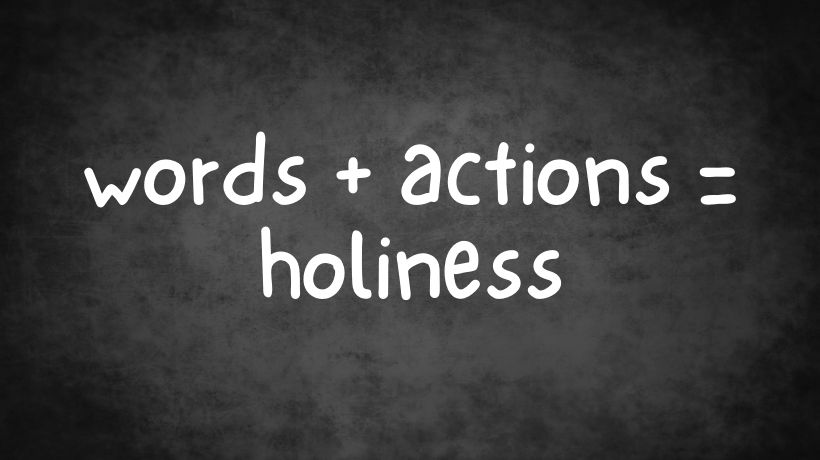
In our tradition, holiness isn’t something that floats above us in the heavens—it’s rooted in the way we live our lives, especially in our most intimate relationships. Parshat Acharei Mot, one of two parshiyot in this week’s double portion, challenges us to consider what it means to live a life of holiness not just through prayer and ritual, but through how we love, commit, and connect. In a culture that often celebrates freedom without boundaries, this parshah reminds us that some of the most powerful forms of holiness come not from saying “yes,” but from knowing when and how to say “no.”

Acharei Mot begins with the Yom Kippur service, detailing how the High Priest is to enter the Holy of Holies and seek atonement for the people. But the second half shifts dramatically into a list of arayot—forbidden sexual relationships. These laws are blunt and specific, outlining which relationships are prohibited, including those involving close kin, adultery, and other behaviors seen as destructive to the moral fabric of society.

While these verses may feel uncomfortable to read or discuss, especially in modern times, they close with a crucial teaching: “You shall keep my statutes . . . and live by them—va’chai bahem.” (Leviticus 18:5) These mitzvot are not meant to shame or repress, but to uphold life, community, and sacred trust.

There has never been more openness around sexuality and relationships than there is now. Much of that progress has been positive—celebrating love, expanding rights, and affirming dignity for all people. But in a world that often blurs the line between freedom and permissiveness, Acharei Mot reminds us that not all expressions of love are ethical or holy. The Torah’s sexual ethics are rooted in the belief that intimacy carries power—and with power comes responsibility.

There is no blessing for “not doing” something wrong—but there is a blessing for doing something right. At a Jewish wedding, we recite the sheva berachot, and one of those seven blessings thanks God for sanctifying us through mitzvot and commanding us concerning forbidden relationships:

Asher kid’shanu b’mitzvotav v’tzivanu al ha’arayot . . . 

It’s a striking moment: at the height of joy and intimacy, we recall the boundaries that protect the sanctity of the union. Judaism doesn’t just bless love—it blesses committed, ethical, sacred love.

This week, take time to reflect on the relationships in your life—romantic, familial, communal. Are they built on mutual respect and holiness? Do they honor boundaries, consent, and care? Consider how you might bring more intentionality to the way you show love, build trust, and uphold sacred commitments. Holiness isn’t only about what we avoid—it’s about what we build.

Healing Words and Healing Actions

“Sticks and stones may break my bones, but words will never hurt me.” We know this isn’t true. Words can wound deeply—and also heal. In this week’s double portion, Tazria-Metzora, the Torah offers a layered exploration of both the power of words and the potential for healing, inviting us to reflect on speech, gratitude, and the journeys—physical and spiritual—we take toward wholeness.

Parshat Tazria opens with a woman’s recovery after childbirth, detailing a ritual of purification and offerings. In ancient times, childbirth was not only spiritually significant, but perilous. The Torah’s acknowledgment of that danger—followed by the mother’s eventual reintegration into communal and spiritual life—echoes a profound truth: survival itself is sacred. Today, when a parent safely delivers a child, we still carry this awareness. It’s reflected in the blessing of Birkat HaGomel, recited by those who emerge from danger: “Blessed are you . . . who bestows goodness upon the undeserving and has granted me all good.” It’s a powerful reminder that recovery calls not only for relief, but for gratitude.

Later, the parshah transitions into a discussion of tzara’at, a skin affliction often interpreted by the rabbis as a spiritual consequence of lashon hara—harmful speech. This theme continues into Parshat Metzora, where the afflicted person undergoes not only physical inspection and quarantine, but ultimately, a ritual of release and renewal. A live bird is set free, symbolizing reintegration and new beginnings. Like the mother after childbirth, the metzora is welcomed back into community—restored, renewed.

Though tzara’at may no longer appear on our skin, its lessons linger. Harmful speech still isolates. Gossip still wounds. But just as the body can heal, so too can relationships, when we take responsibility and seek repair. And just as we recite Birkat HaGomel for physical healing, perhaps we might imagine a blessing for the restoration of our words—when our speech turns from tearing down to building up.

Our siddur offers us such a model. Each morning, we begin Pesukei d’Zimra with Baruch She’amar—“Blessed is the One who spoke, and the world came into being.” God’s speech is not destructive, but creative. It builds worlds. If we are made in the divine image, then our words, too, can create. They can comfort, connect, and bless.

So this week, what if we treated our words and our health as equally sacred? What if we offered gratitude not only for physical healing, but for the chance to speak kindly, to start fresh, to repair what was broken? In doing so, we echo both Birkat HaGomel and Baruch She’amar—giving thanks for survival, and honoring the creative holiness within every word.

May our speech be life-giving, our gratitude expansive, and our healing—physical and spiritual—a source of blessing for ourselves and others.

The Sacred Art of Discernment

It’s a fast-paced world, where information is abundant and opinions are often polarized, and the ability to discern truth from falsehood, wisdom from folly, and right from wrong has never been more critical. As we navigate the complexities of our time, as usual, we turn to Torah for guidance. 

Parshat Shemini recounts the dramatic events of the eighth day of the Mishkan’s inauguration. The day begins with joy and divine presence, as Aharon and his sons bring offerings, and fire descends from heaven to consume those offerings. However, this moment of holiness is abruptly interrupted by the tragic deaths of Nadav and Avihu, who bring an unauthorized fire before God. Their fate serves as a stark lesson on the boundaries of sacred service.

Later in the parshah, the Torah outlines the dietary laws of kashrut, specifying which animals are permitted for consumption and which are not. The section concludes with the commandment to be holy and distinguish between the pure and impure, reinforcing the idea that holiness requires conscious, thoughtful choices.

The Torah states: “To distinguish between the impure and the pure, and between the living things that may be eaten and the living things that may not be eaten.” (Leviticus 11:47) This verse reminds us that holiness is not accidental—it’s a product of intentional discernment. Just as the Israelites were instructed to differentiate between permitted and forbidden foods, we are tasked with making ethical, spiritual, and moral distinctions in our daily lives.

Parshat Shemini, with its focus on distinguishing between the pure and the impure, teaches the importance of discernment in our lives. This theme is beautifully encapsulated in the blessing:

Baruch atah Adonai, Eloheinu melech ha’olam, hanoten l’anu binah l’havdil bein hatamei v’hatahor.

“Blessed are you, Adonai our God, sovereign of the universe, who grants us understanding to distinguish between the impure and the pure.”

The blessing hanoten l’anu binah l’havdil bein hatamei v’hatahor reflects this sacred responsibility. It acknowledges that discernment isn’t merely an intellectual exercise but a divine gift. We ask God for the wisdom to see clearly, to separate the essential from the superficial, and to make choices that align with our values.

At this moment in time, when we’re bombarded daily with competing narratives, when justice and truth both feel elusive, we must embrace the responsibility of discernment. Let us commit to seeking clarity in our decisions, ensuring that our actions reflect holiness and integrity. May we use the skill and blessing of discernment wisely, for the betterment of ourselves and the world around us.