Do It Or Else – Parshat Yitro 5776

Do It Or Else

Raising my “threenager” (though she won’t be three until September, I’m pretty sure this term applies), I am constantly straddling the line between coercion and freedom of choice. In some circumstances it’s totally acceptable for my daughter to have the final say. Does it really make a difference if she wears the purple socks or the rainbow socks to shul? No, not as long as she’s wearing socks.

Of course there are times when Mommy has to put her foot down. As parents, we have to have our bottom lines. I’ve made peace with this, and I don’t mind standing firm on an issue that’s for my child’s own good. Rather, it’s the persuasion game that I don’t care for. We each develop our own bag of tricks (and threats) to use in cases when you need your child to do something you know she doesn’t want to do. I can tell myself a thousand times that I have her best interests at heart, but I often end up feeling guilty when I’ve tricked or threatened my toddler into following the rules.

Our Torah portion this week, parshat Yitro, paints a familiar picture of God as the parent. The text begins with the Israelites arriving at Mount Sinai and the preparations for the presenting and accepting of the commandments. As a side note, this event is sometimes called a “theophany,” which is a term of Greek origin to describe a manifestation of God. Following this momentous event, the Israelites are able to move on in their journey in the desert, now in possession of the laws meant to help them build a healthy society.

Chapter 19, verses 7-8 read: “Moses came and summoned the elders of the people and put before them all that the Lord had commanded him. All the people answered as one, saying, ‘All that the Lord has spoken we will do!’ And Moses brought back the people’s word to the Lord.” It sounds simple enough; Moses as the messenger shares God’s word with the people and they agree to follow it. But hidden in this simple encounter lies an unusual occurrence: the people all answered as one. Is it possible that the hundreds of thousands of Israelites standing at the bottom of the mountain all opened their mouths at the same time without arguing and agreed, together as a people? That seems more than a bit unusual.

The Talmud explains this phenomenon as God compelling them to answer by lifting the mountain over their heads, threatening to crush them with it unless they accept the Torah. That sounds to me like anything but free will. Another tradition likens this moment to God suspending the mountain not as a threat to crush the people, but to create a huppah, a wedding canopy, so that God and the Israelite nation are joined together in the covenant. While these two interpretations of God’s intent are polar opposites, it makes complete sense that an event of this magnitude would mix both joy and fear, the extremes which are illustrated.

Let us extend this idea further. Being a part of the Jewish community and living a Jewish life means that we have moments of intense joy and intense sadness. With as many life cycle events and holidays as we have, it comes with the territory. In either case these moments compel us to stick together and to speak as one. Furthermore, you may want to follow a strict Pesach kashrut practice, but decide on a less traditional Shabbat observance if that works for your family. If we’re always building, learning, and growing together as a people, the color of your socks – so to speak – is up to you.

Thirsty For More – Parshat Beshalach 5776

Thirsty For More

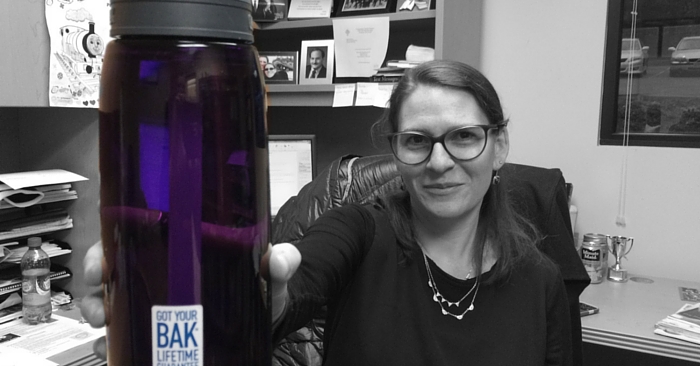
If you see me on a regular basis, you’ve seen the purple CamelBak water bottle that I carry everywhere. It may surprise you to learn that for most of my life I hated (I mean really HATED) drinking plain water.  There was nothing fun or flavorful about it, and it was a huge chore to force down anything other than Diet Coke.  At age twenty-five I decided it was time to take control of my weight, my health, and my future, so I started drinking water.

I didn’t quit the colors and flavors cold turkey of course. First it was flavored, carbonated water, then it was diluted flavored water, then just carbonated water. Finally, I could stomach plain old water. My water bottle became like an appendage, and I felt totally lost without it by my side. At a certain point, I started to crave water so much that I was drinking up to four liters a day. That ended soon after I started teaching and had long stretches in the classroom. However, to this day I can’t go more than twenty minutes without craving a delicious gulp of room-temperature water from my little personal reservoir.

Water is a life force and a life-sustaining force.  From the moment of our conception, we are immersed, and we use water throughout our lives to clean, purify, hydrate, and refresh. I’ve written before about the use and symbolism of water in the Torah. Parshat Beshalach, which we read this Shabbat, is perhaps more associated with water than any other parshah because it contains the crossing of Yam Suph. After the children of Israel leave Egypt, they journey with Moses through the wilderness until they reach the bank of the Sea of Reeds, stranded between the body of water and their pursuers, the Egyptians. After the Israelites safely cross to dry land, the water, which parted to save their lives, closes in on the Egyptians.

Not long after this water-based miracle, the Israelites complain about their water supply and the taste of it. The Israelites clearly know they need water to survive, and yet they don’t seem to have a grasp on the type or how much they might need. We learn in chapter 15 that the Israelites traveled three days in the wilderness and found no water. Even if my CamelBak wasn’t a constant companion, three days would still be too long to go without water. Our sages delve deeper into this particular span of time and ask, why is three days so notable? They teach that water in the Torah is actually a symbol of Torah itself, and just as the body cannot go three days without water, the soul cannot go three days without some life-sustaining contact with Torah. Interestingly, this is also the reason why we never go more than three days in a row without reading Torah.

What is the life-sustaining force in this metaphor for you? What is the thing you need a regular supply of to refresh and revitalize your spirit? Whether it’s learning, running, cooking, or making music, the Israelites’ journey in the wilderness reminds us to partake every day of the things that nourish our souls as well as our bodies.

Leftovers – Parshat Bo 5776

Leftovers

As an executive chef, my Uncle Larry gets culinary inspiration from a variety of places, including my Nana’s recipe box.  Of course in order to use family recipes for commercial purposes, he has had to make some serious measurement conversions. This means that when I want to make one of Nana’s famously delicious family recipes at home, Uncle Larry sends it to me with instructions like: “Divide by 40 to get a reasonable size recipe.” Somehow I still always end up with enough food to feed an army.

Maybe it’s the stereotypical Jewish mother in me that’s to blame, but whenever we host a dinner or event, I stress over having enough food. “I’ll just make one more side dish to go along with the other four, just to be safe,” I’ll rationalize. Inevitably, we have leftovers for days.  

Oddly enough, there are leftovers in the Torah. It makes sense when you think about it. When you’re feeding an entire Israelite nation, there’s no way to anticipate the precise needs of every meal. Our parshah this week, parshat Bo, is notable for containing the commandment to observe Passover, but it also contains helpful hints about what to do with seder meal leftovers. The narrative picks up with the final plagues that God is sending to Egypt and continues with the holiday of Passover, teaching the Israelites what it means to build a community, beginning with the first laws of their calendar. The text ends with arguably one of the most important commandments we have – that of telling the story of the Exodus in every generation.  

In Exodus chapter 12, God gives the commandments for the Passover sacrifice, specifying that each family is to sacrifice their own lamb. But in verse 4 God states, “But if the household is too small for a lamb, let him share one with a neighbor who dwells nearby, in proportion to the number of persons: you shall contribute for the lamb according to what each household will eat.” The Torah teaches that Passover, like a great number of our Jewish traditions, is a family celebration. Specifically, it is meant to be celebrated communally, not in isolation. An abundance of food is simply another reason to share the celebration.

According to Samson Raphael Hirsch, the paschal sacrifice teaches that we are to “let those whose households are too small to absorb all the blessings that God has given them seek out their neighbors and share the bounty with them.” It is our responsibility to sustain others in our community with our “leftovers.”

Nowhere is there a better reminder that we celebrate best when we celebrate together. Every time I make one of Nana’s recipes (thanks to Uncle Larry’s assistance), it takes me back to the big dinners I remember with family and friends. These shared experiences are just as much a part of living Judaism as anything else. By the way, does anyone need two kugels and a challah?