The Apology that Limped

This is the d’var Torah I delivered at Congregation Neveh Shalom on December 5, 2025.


There are few Torah scenes as emotionally charged, or as painfully relatable, as the reunion between Jacob and Esau in Parashat Vayishlach. It’s the kind of moment that makes you want to reach for popcorn and tissues.

Remember: the last time these brothers saw each other, Jacob was running for his life after stealing Esau’s blessing. Not exactly an argument about whose turn it was to unload the dishwasher. Decades pass. Jacob builds a family. Esau builds an army—at least, that’s how it looks when he approaches with 400 men.

The night before they meet, Jacob is left alone and wrestles with a mysterious figure until daybreak. He emerges with a limp and a blessing, but also with a new name: Yisrael. The one who wrestles. It’s as if Torah is telling us: “Before you face the person you hurt or who hurt you, you must first wrestle with yourself.”

Then dawn comes. Jacob limps forward. Esau runs toward him. And instead of revenge, Esau throws his arms around Jacob’s neck and weeps.

Here’s the part I find so moving: Esau does not give a polished apology. There’s no “I’ve been doing a lot of reflection, and I want to own my part in this conflict.” There’s no mutual processing with a box of tissues and a feelings wheel. There’s just an embrace. A gesture that says, “I missed you,” even if he never says the words “I’m sorry.”

And Jacob, who has every reason to be cautious, receives it. He allows that imperfect gesture to open the door to reconciliation, even if their paths ultimately diverge again.

So often we wait for the perfect apology, the one that hits all the right notes, includes footnotes and a bibliography, and arrives with a gift basket. But most human apologies are like Jacob’s limp: awkward, incomplete, evidence of a wound that’s still healing.

Vayishlach reminds us that apologizing requires courage, but so does accepting an apology that isn’t everything we hoped for. We mend relationships not because they’re perfect, but because we choose to step toward each other anyway.

May we learn to offer apologies that are brave, to receive apologies with generosity, and to trust that even imperfect steps can lead us toward wholeness.
Pillar of Memory

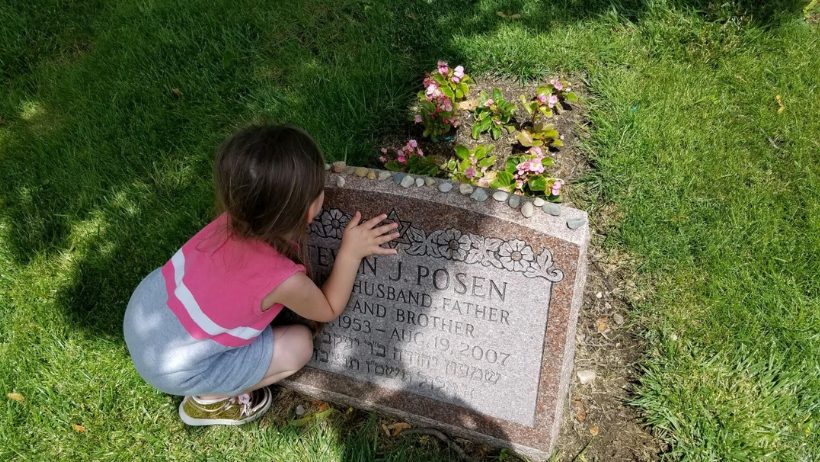
I have long found the cemetery to be a peaceful place. That could sound morbid to some, but the cemetery is often a place where I feel grounded and at peace. It might be because the cemetery in Michigan where my family members are buried is beautiful and peaceful. But in general, I’ve found cemeteries to offer a similar feeling of sacred connection to the earth and to the stories they tell. 

When you walk through a cemetery, you’re likely to see the story of a community. Family trees drawn by names and dates on the gravestones. Stones that imply a permanence of the life story, that our loved ones existed and their stories will be remembered because there is a lasting marker of their lives. Stone is changed by water and wind, but remains nonetheless.  

Our Torah portion this week, Parshat Vayishlach, is marked by the death of Rachel after the birth of Benjamin. “Over her grave Jacob set up a pillar; it is the pillar at Rachel’s grave to this day.” This verse is the core text for the Jewish custom to mark the grave with a monument. As the Torah stands strong throughout the test of time, so too the honoring of a life will be remembered by the placing of a headstone or marker.

Interestingly, for all of the occasions for blessings we have, there is no traditional blessing recited at an unveiling. Instead, the rabbis remind us of the blessing of life, the blessings we have when we come together, when we preserve memory, and when we tell our stories.  

Call Me Maybe – Parshat Vayishlach 5784

As technology continues to grow, shift, and change, so do the ways in which we connect with one another and the ways we’re able to communicate. With so many message format options, sometimes I wonder if it might be better to send a carrier pigeon, just to do something unique that would get the message seen amidst the overload of emails, texts, chats, messages, and other apps we use. These days, the format is everything. You can often tell the importance of a matter by what form it arrives in. If you receive a piece of certified mail, you know that’s important, whereas a text message is the more casual end of the spectrum, and a hand-written thank-you note is somewhere in between (and a nice surprise). Rarely do I pick up the phone when I have a quick question for someone when I can simply text them and get an immediate reply, especially while I’m trying to accomplish five other tasks simultaneously. 

Believe it or not, the Torah also teaches us about the decorum of sending a message and the different media we should use. This week’s parshah, Vayishlach, brings the twin brothers together again. The last time these two were together, Esau didn’t care much for his birthright blessing until it had been given to Jacob, and Jacob didn’t care much about his brother’s right to the blessing until his brother threatened to kill him. Now, 20 years or so later, we find the brothers on a path to meet again. Both are now married and are fathers of large clans, and both have large flocks with them.

Throughout this narrative, there are multiple messages sent. If we go back to the beginning of Jacob’s lineage, we see God giving a message to Abraham in the form of a ram stuck in a thicket so that Isaac is not sacrificed. Jacob is often sent messages from God via dreams. Then, there are messages sent via gifts from Jacob to his brother before they reunite. Finally, there’s the person-to-person message interaction announcing that their mother’s nurse has died, which implies that their mother Rebekah has died as well. 

Although the types of messages in the Torah are different than those of today, you can imagine what ancient messages might have looked like with today’s technology. Perhaps the visual cue of the ram in a thicket would come as an animated GIF on Abraham’s iPhone. Maybe Noah would have been alerted about the flood with an emergency broadcast system notification. 

From the Pony Express to FaceTime to physical face-to-face interactions, humans have always found ways to communicate and ways to show how serious a message is. For each of these moments in the Torah and beyond, the ways in which we communicate remind us how we strive for connection, especially when we’re apart. So . . . write, text, message, email, or maybe even call. Interacting is the important part. 

Feeling Small – Parshat Vayishlach 5783

When have you felt small? A few years ago I was at a Rabbinical Assembly convention where the CEO asked this question. It just so happened I’d been next to the six-foot-plus-tall Rabbi Steven Rein just minutes earlier, so I didn’t have to think too hard. And immediately after that, we were invited into a tight circle for a singing exercise, and I felt small again because of the sound that enveloped us.

When have you felt small? Take a minute to think about it.

This week’s parshah, Vayishlach, brings the twin brothers together again. The last time these two were together, Esau didn’t care much for his birthright blessing until it had been given to Jacob, and Jacob didn’t care much about his brother’s right to the blessing until his brother threatened to kill him.  Now, 20 years or so later, we find the brothers on a path to meet again.  Both are now married and are fathers of large clans, and have large flocks with them.

As Jacob prepares to reconnect with his brother, he again has a dream. This time he dreams in chapter 32, verse 11: “Katonti mikol hachasidim.” It’s often translated as “I am unworthy of all the kindness that you have so steadfastly shown your servant” But a literal translation would be “I am small compared to the kindness.”

In addition, the use of messengers between the brothers is a helpful reminder of the messages we might be sending to others through our actions and attitudes. Strife is often the result of one person or group of people seeing themselves as big, or bigger than others. On the other hand, when we feel small we often don’t stand up for ourselves, and we allow others to take more than their allotted space. There’s a balance between self-confidence and self-depreciation. 

Preparing to go into this moment with his brother, Jacob in his dream state recognizes the need to find his own humility. It’s a valuable lesson both brothers learn. You don’t have to make someone else feel small in order to build yourself up.

Monument To You – Parshat Vayishlach 5782

In my work as a rabbi I often have the honor of assisting families as they create the grave marker for their loved ones. In case you’re wondering, this is not something that’s taught in rabbinical school. This is an act that is unique to each family and, understandably, holds a lot of emotion. The creation of a marker stone is a finality in the process of loss and grief. Granite is final, the carving doesn’t change over time. This is the stone you’ll see every time you visit the cemetery.

These stones, though brief in their wording, often tell a story. We use descriptions both of character and relationships. Does the family prefer “beloved” or “loving”? How about “cherished”? Should we be generic in relationships and just say father, son, brother, grandfather? Or, should we use our personal terms of endearment like “Daddy” or “Zayde” or “Papa”? And what color should the marker be? Does it matter if the font is different from the other family members nearby or next to them? Should we put an image on it? Is it better to keep it simple? These are just a few of the many questions that go into the process of choosing this final marker for loved ones. It makes sense that there would be so many questions. After all, we get one shot to do this, and the honor and memory of our loved one is at stake. 

As we learn in this week’s Torah portion, Jews have been traditionally marking the resting places of family members since the time of the Torah. As an overview, our Torah portion this week, Parshat Vayishlach, reminds us of what it might be like to live fully as yourself, even as the world around you is changing. Jacob is preparing to meet his brother Esau after their fallout and struggles in his dream with the angel who changes Jacob’s name to Israel. The brothers meet and part in peace, and the story continues with the birth of more sons to Jacob and the different ways in which his children misbehave. 

In the middle of this section of text, Rachel dies in childbirth, and the Torah magnificently moves from death to life in the course of about three verses. Benjamin is born, but Rachel doesn’t survive, and as the clan is on the road, Rachel is buried along the way. In chapter 35, verse 20 we read, “Over her grave Jacob set up a pillar; it is the pillar at Rachel’s grave to this day. Israel journeyed on.” A simple, yet stunning tale of the burial of Rachel, Jacob’s beloved.

The Torah goes back and forth between calling Jacob by this name and using Israel, the one who wrestles with God. Interestingly, he is called both at the passing of his beloved wife. In this moment he is both the little boy who is born holding on to his brother, and the grown man wrestling with the reality of the world. It is somewhere between these roles where he sets the grave marker for his wife. 

Our markers are eternal, no matter how fleeting life is, and our portion suggests that this marker is one that is on her grave to this day. While we don’t read about the inscription upon the stone, we understand that Jacob knew that it was intended to forever symbolize his love for his wife.

Parshat Vayishlach is a reminder that there’s little that’s truly permanent, but establishing a permanent marker to know from where we’ve come and from who we’ve come is an essential part of our journey. The marker for Rachel happens in a blip in the Torah, just one verse. They didn’t agonize over the words, the color, the placement. Instead, the focus is on her legacy and the children who became leaders in our tradition. May we learn from Jacob how to both mark a moment and move forward, and may we do that knowing that while stone might last forever, our stories can outlast even the stone.