A Blessing for Reconciliation

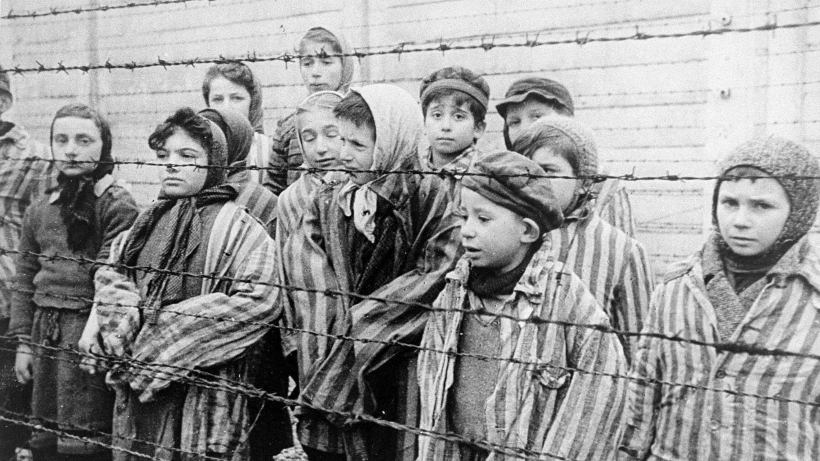
Eva Mozes Kor and her twin sister Miriam Mozes (far right in knitted hats) at the liberation of Auschwitz.

Forgiveness isn’t often controversial, but for Eva Mozes Kor, it was. In 2015, at the trial of former Auschwitz guard Oskar Groening, Holocaust survivor Kor publicly forgave 93-year-old Groening, a former SS officer who was facing accusations of accessory to 300,000 murders. This act of forgiveness was widely criticized by Kor’s co-plaintiffs, who questioned her decision to be a plaintiff at all. But whether you feel what Kor did was right or wrong, it certainly speaks to the very human need to reconcile our feelings. Toward the end of her life, Eva Kor felt that the hate she was holding was more painful to her than to the Nazis at whom that hate was directed. She would go on to write, “I didn’t forgive the Nazis because they deserve it. They don’t. I forgave them because I deserve it.”

Parshat Vayigash, this week’s Torah portion, shows us behavioral changes that lead to what was perhaps a very unlikely reconciliation, considering everything that has transpired in Jacob’s family. In the parshah, Joseph’s brother Yehudah (Judah) tries to redeem himself by asking to be imprisoned instead of Benjamin, and Joseph reveals himself to his brothers and heroically invites the whole family to Egypt to save them from starvation in Israel. In addition, Joseph and his father Jacob are reunited, and Joseph is able to finally reveal his newfound position of power.

This emotional reunion of Joseph with his brothers is the definition of forgiveness. This moment of healing their fractured relationship also reflects the rebuilding of shalom bayit, literally “peace in the home.” This Jewish value originally referred to marital relationships, but now often includes the whole family unit. Reconciliation isn’t necessarily easy; it requires intense work on all sides. But maintaining shalom bayit creates an environment where kindness, patience, and understanding thrive. A home that embodies this value is a microcosm of a peaceful society. Families filled with love and harmony contribute the same to their communities.

If you’ve recently reconciled with someone or are working to repair a relationship, what better way to mark the moment than to pause and offer a blessing to honor and sanctify this essential human act:  

Blessed are You, Adonai, our God, Sovereign of the Universe, who brings peace among siblings and teaches us to seek forgiveness and understanding.


When Humanity Breaks the Cycle – Parshat Vayigash 5784

Having just returned from a trip to Israel where I viewed some of the unspeakable devastation from the terror attacks on October 7 and heard from survivors and families of hostages, I cannot wrap my mind around the perspective that Israel should simply back down altogether. Those calling for a “ceasefire” are suggesting that Israel should not defend itself against acts of terror. What other country would face this type of backlash? Am I horrified at the number of civilian casualties on both sides? Yes, of course I am. It would go against every fiber of my being not to be outraged on behalf of innocent life cut short. But as much as social media would have you believe that this is a black-and-white issue with no room for gray, the relationship between Israel and Palestine has always been anything but. Action (and inaction) on both sides will always carry consequences, and that’s a lesson we learn in the Torah too.

Parshat Vayigash, this week’s Torah portion, reminds us of how the changes we make can have far-reaching implications. In the parshah, Joseph’s brother Yehudah (Judah) tries to redeem himself by asking to be imprisoned instead of Benjamin, and Joseph reveals himself to his brothers and heroically invites the whole family to Egypt to save them from the starvation facing Israel. In addition, Joseph and his father Jacob are reunited, and Joseph can finally reveal his newfound position of power.

Throughout this Torah portion, we see Joseph and his brothers rework their relationships with one another. From the trickery to the embrace, from Joseph being alone in Egypt, to him being surrounded by family. How the tables have turned! The last time Joseph and his brothers were all together they were bullying him, putting him down, and keeping him away because of his arrogance. Now, he’s the one with the power in their relationship. The brothers eventually find a way to live in harmony with one another, a seemingly happy ending.

The same cannot be said of the relationship between the Israelites and Egyptians. Part of Joseph’s plan, in order to feed all the Egyptians, is to make them into serfs for Pharoah. Pharaoh now owned the land, the food, and the people, all because of Joseph’s doing. Needless to say, the Egyptians weren’t thrilled with this outcome and held Joseph singlehandedly responsible for their servitude. 

Move forward to the next book of the Torah, and you’ll see that they take their revenge and enslave the Israelites. Why? Well, in this section of our Torah, we see that every behavior has an impact. Every action has a reaction. While Joesph’s brothers learn their lesson for mistreating Joseph, Joseph ends up mistreating others. Breaking a cycle of mistreatment will never be a one-sided endeavor. It will always be one of those “we turn our keys at the same time” ordeals. For now, we will work toward the day when humanity on all sides is reason enough to break the cycle.

In the Still of the Night – Parshat Vayigash 5783

Recently I’ve become somewhat of a restless sleeper. Falling asleep is not my problem, though. I’m pretty skilled at that part. It’s staying asleep that’s a struggle for me, especially following a particularly deep sleep early on in the night. Usually, by about 3:00 a.m. my mind starts to race, and my sleep goes from fluid to restless. It’s as if my brain thinks the best time to have an epiphany or take stock of my life is sometime in the wee hours, when all I really want to do is sleep. It has gotten to the point where I keep paper next to the bed so I can write down everything that comes out, not necessarily to save my thoughts, but to help them escape my brain so I can catch a few more hours of sleep.

But why do these deep thoughts strike when I’m not able to fully process them? Of course I don’t remember or understand half of what I write down in my sleepy haze, but I do know that for some people, the best ideas come at odd times, like in the shower, during a commute, or, like me, at 3:00 a.m. Perhaps it’s something about the calm darkness of night that offers a nice blank canvas for thoughts. This is often a place where epiphanies or trains of thought can occur. And apparently, our forefather Jacob and I have this in common.

Parshat Vayigash, this week’s Torah portion, reminds us of the different ways in which we see behavioral changes. In the parshah, Joseph’s brother Yehudah (Judah) tries to redeem himself by asking to be imprisoned instead of Benjamin, and Joseph reveals himself to his brothers and heroically invites the whole family to Egypt to save them from starvation in Israel. In addition, Joseph and his father Jacob are reunited, and Joseph is able to finally reveal his newfound position of power.

The entirety of Jacob’s story is lifted through the power of dreams. From the angels on the ladder when he runs away from home, to the messenger he wrestles, to even raising a son who is a dreamer himself, Jacob is the only forefather to whom God only speaks through dreams.

This week’s parshah is no different. Jacob was nervous about the trip to Egypt, including what it would be like to travel and to see his beloved Joseph once more. In a restless sleep, God reassures Jacob that it will all be fine. Why is it only under the cover of night when God speaks to Jacob? It could be because that’s when we let our guard down. That’s when we’re vulnerable enough to show our true intentions or spirit. As we end another secular year, may we take this lesson of vulnerability and openness into our waking lives too, so that we’re better able to welcome our truest selves.

Trading Up – Parshat Vayigash 5782

Why do children take advantage of each other? I’ve watched my children do this so many times. One has a toy the other one wants, and so the bribing and bargaining begins. They’re wiser now that they’re older, so it isn’t as easy for the younger one to be taken advantage of. To be fair to them, equitable trades become much more complex as you grow up. Gone are the days of “I’ll be your best friend” if such and such, and very real is the need for tangible results from our bartering and bargaining.

Perhaps there’s something inherent in our nature about trying to get the best deal or the most value. We see it as early as Jacob and Esau. Jacob wants the birthright, Esau wants food, a “fair” trade is made, and off they go with their lives. Except, that particular trade was anything but equal. It’s a theme we’re quite familiar with, and in this week’s Torah portion, we see a prime example of the dark side of wanting it all.

Moving on to Jacob’s sons, Parshat Vayigash reminds us of the different ways in which we see behavioral changes. In the parshah, Joseph’s brother Yehudah (Judah) tries to redeem himself by asking to be imprisoned instead of Benjamin, and Joseph reveals himself to his brothers and heroically invites the whole family to Egypt to save them from starvation in Israel. In addition, Joseph and his father Jacob are reunited, and Joseph is able to finally reveal his newfound position of power.

When it comes to Joseph overseeing the distribution of food in Egypt, we focus more on his dealings with his brothers, but this week’s portion reveals another side of his cunning (and problematic) leadership. The Egyptians, who had worked together to store food, are still hungry because the government had taken hold of the stores of food, and the citizens needed to pay or barter to take a share of it.

In chapter 47, verse 19 of Genesis, we read of the Egyptians coming to Joseph without anything left to trade. They’ve given all their livestock and fields as consignment to the leadership. They’re starving, and with nothing left to give, they offer up themselves in servitude, and Joseph accepts this offer. For me, this was a horrifying discovery. Joseph, the dreamer, the leader, allowed people to sell themselves for food? Didn’t he learn from what his brothers did to him? How could he be guilty of the same action?

Rest assured, the rabbis of old were bothered by this as well, and as a result, we have biblical laws requiring us to help the poor so that they should not have to sell themselves into slavery to repay a dept. Ours is not to own or outdo another. Our job is to respect and lift up one another.

Joseph could have kept control over a scarce resource without forcing people to sell themselves to survive, but he failed to strike that balance. Vayigash means “and he met.” But it wasn’t only his brothers whom he met. Joseph met himself at a crossroads, faced with deciding between a path of power and control over his brothers and the rest of the country, and a path to meet his brothers halfway. The lesson to take away is that perspective is everything; when we can approach any discussion, deal, or decision from the other party’s view, that’s what true humanity is about.

Old Fights – Parshat Vayigash 5781

Like most siblings, my sister and I have our fights. We’re seven years apart, which for us meant we were raised in very different realities because of my parents’ career situations at those different times. We were raised by the same loving parents and in the same home, but because of the age difference, and because we’re simply different people of course, we often have different versions of what happened in our family, or at least how we remember life together. One thing we’ve come to agree on is that the past is the past, and however we remember it, we can’t change it. We can only accept it and move forward.

Our parshah this week reminds us of this same idea. Parshat Vayigash, our Torah portion for this week, is the continuation of the saga between Joseph and his brothers. Judah, one of the primary perpetrators of the evil against Joseph, stands up for his brothers and requests to be imprisoned rather than Benjamin. Later, Joseph reveals himself to his brothers, and his brothers tell their father Jacob that Joseph is still alive. Then the 70 members of Jacob’s people follow him down to Egypt, and the family is reunited. 

What is so relatable about this is that as the brothers are turning to go back to their father, Joseph bids them adieu, saying: “Do not be quarrelsome on the way.” Joseph knows his brothers all too well, especially their family dynamics. He’s warning them that resorting to the same blame game they played after they sold him off to the Egyptians would only be replaying and rehashing the past. Instead, Joseph is urging his brothers to remember that the past is the past, and it cannot be undone. 

In other words, there is nothing to be gained from fighting old fights. The best way to move forward is to connect to what is happening now and to change what you have control over. Joseph could have easily taken a kind of revenge by letting his brothers continue to fight with each other as payback for the way they treated him. Ultimately, though, Joseph knew in the grand scheme of things his family would be healthier and much better off if they let go of the past and focused on how to change themselves for the future. 

While we’re all physically apart from each other, it’s easy to forget that we all have to live with each other in every sense of space. Portlanders share one city. Oregonians share one state. Humankind shares just one planet. Vayigash means “and he drew near,” and the parshah reminds us to draw near to each other and meet each other in the here and now.