The Cost of Silence

This is the d’var Torah I delivered at Congregation Neveh Shalom on November 8, 2025.


There’s a moment many of us know well: that split second when we notice something isn’t right, when our gut says, “Say something…do something,” and yet our fear whispers back, “Maybe stay quiet.” We replay this moment in schools, workplaces, at family tables, and in our communities. And Parshat Vayera meets us right at that crossroads between comfort and courage.

Vayera is filled with holy disruption. Moments when our ancestors must choose whether to speak up, act decisively, or stay silent. When God tells Abraham that Sodom and Gomorrah will be destroyed, Abraham could nod silently in agreement. Instead, he steps forward with one of the Torah’s boldest challenges: “Ha’af tispheh tzaddik im rasha?” “Will You sweep away the innocent along with the guilty?” (Gen. 18:23). Abraham argues with God. He advocates for people he doesn’t know. His bravery is not in physical action, but in raising his voice for justice.

A few verses later, we meet a very different scene, one that is far more painful. Abraham and Sarah send Hagar and Ishmael into the wilderness. This time, Abraham is silent. The Torah tells us he is distressed, but he does not protest, negotiate, or advocate for their safety. Silence, too, becomes a choice, one with consequences.

And then, perhaps the most wrenching test: the binding of Isaac. We notice again that Abraham does not speak—not to Sarah, not to God, not to Isaac until the very last moment. Commentators wrestle with this silence. Was it faith? Was it fear? Was it a missed opportunity for the courageous conversation God might have wanted from him?

Vayera holds up a mirror: We all have moments of Abraham’s courage and moments of Abraham’s silence. Our task is to learn when to embody which.

Speaking up requires vulnerability. It risks relationships, comfort, and certainty. But silence carries its own cost, especially when others depend on our voice.

As Jews, we inherit Abraham’s sacred responsibility to challenge, to advocate, to question power, and to protect the vulnerable. Brave choices are not always dramatic; sometimes they sound like, “I’m uncomfortable with that language,” “I need to tell you how this impacts me,” or “This isn’t who we are.”

This week, may we cultivate the courage to use our voices with compassion and conviction. May we choose to speak, even when our voice trembles, and stand up for what is just, kind, and true.

Bless Those in Need of Healing

I’ve written before about my time in rabbinical school when I did a summer unit of Clinical Pastoral Education. Over that summer I worked 40-hour weeks in a level one trauma hospital. Each day I would do rounds of my assigned units and offer to pray for each patient. From what I observed, my colleagues of other faiths were easily able to access extemporaneous prayer, partly because they weren’t relying on a specific prayer for healing as we have in Judaism. However, I was regularly drawn to the words of our prayer for healing, the Misheberach L’cholim. These Hebrew words literally translate to: “To the one who blesses the sick.” 

It’s in this week’s parshah when the first blessing of the ill is offered, and we actually see several variations. This blessing in Parshat Vayera doesn’t look quite like it does today. In the Torah, the messengers of God come to visit Abraham as he’s healing from his circumcision. They model what it looks like to visit the sick. Following this experience we see Abraham bargain with God on behalf of the people of Sodom and Gemorrah; begging for an injunction to save their lives is also a prayer for healing. The text ends with Hagar begging for sustenance, its own form of healing, as she and Ishmael are banished from Abraham’s house, and then finally Abraham’s proclamation of presence at the binding of Isaac. 

Together these segments of text teach us that part of our work in community is to be in the blessing process with each other. We can show up so those in need of healing are not alone. We can pray, and we can also offer resources. We can send meals or participate in a Meal Train. Each of these acts and more are a part of the blessing of healing the sick. 

For more:

The Story Behind Debbie Friedman’s Beloved ‘Mi Sheberach’ Melody

Jewish Prayer for the Sick: Mi Sheberach

To Be a Prophet – Parshat Vayera 5784

Like a lot of people, I have my superstitions. Mine don’t come in the form of black cats or broken mirrors, but more in the sense of not wanting to jinx myself. If you mention how well something is going, soon the opposite is certain to happen. Duncan knows that we never say things like, “Can you believe how well the kids are getting along right now?” because inevitably after we say that, the other shoe drops, and chaos ensues. Does that make me a prophet or a soothsayer? Not at all. Does it mean that perhaps I’m simply tuned in to the general ebb and flow of behavior? Maybe. It’s not that I can predict the future, it’s simply a bit of intuition mixed with experience. It’s not always correct, but when it comes true, however, it does sort of feel like a superpower.

Can one person really know the future? People make a living as psychics and fortune tellers to this day, long after prophets have had any sort of role in our culture or tradition. The Torah seems to mention fortune telling in various contexts as a normal thing. Let’s see if it shares any insight as to why. 

In this week’s parshah, Vayera, the idea of a prophet comes up. Here’s the recap: Abraham and Sarah contemplate the son that will be born to them in their old age; Sodom and Gomorrah fall as Abraham bargains with God to save Lot’s life; and Isaac is born, causing a rift in Abraham’s house with Ishmael. Abraham moves forward in making a deal with King Avimelech, and we end with the Akeidah, the test of Abraham as God asks that he offer up his son, Isaac.

As Abraham is growing in his own role as a leader in his family and in the greater world, he is seen making some unusual choices, like lying to Avimelech. On the other hand, he also makes some positive choices, engaging in dialogue with the neighboring nations. When they unravel the wife/sister lie, God admonishes Avimelech: “Therefore, let the man’s wife go for he is a prophet.” This is the first time the word prophet is used in the bible. A literal translation is “one who receives the divine call” or, “one who proclaims,” or “a spokesperson.” This leads us to the question, in which role is Abraham acting?

In this case, Abraham is something of a mix of these things, but mostly here to intercede on behalf of others. He is a spokesperson for the future on what will happen should Sarah not be allowed to return to him. Could Abraham really predict the future? Probably not. Nevertheless, as a prophet, or at the very least as a spokesperson who seems to have morals and values invested in him through his trust in God, it makes sense for Abraham to call for kindness and dignity as the path forward. With so much uncertainty and turmoil in the world, let us take this message to heart. While we can’t predict the future, perhaps we can use what we know from the past and present to steer ourselves toward the world we wish to build. 

Hold My Hand – Parshat Vayera 5783

Over the past two-plus years, as Covid turned our world upside down, we’ve all felt the loss of what was our normal. Not being about to be physically present for holidays was hard, masks were uncomfortable, but so important. We went through the peaks and valleys of fear to relative calm and back to fear again as variants and surges came and went.

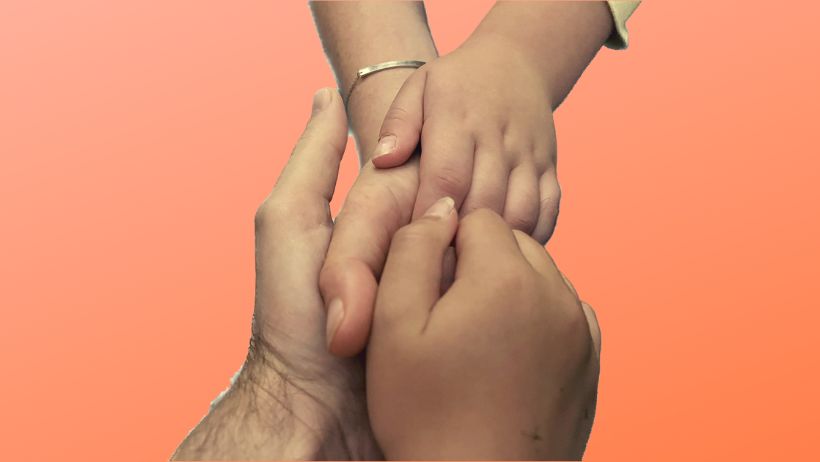
One of the lasting effects of Covid is how we handle physical touch. We’re now hyper-aware of every physical interaction. Whether it’s avoiding a handshake when meeting someone new or the awkward hug while holding your breath, for someone like me who’s used to giving a big hug or a gentle arm squeeze when I’m comforting someone, the early phases of the pandemic were especially hard. It’s only now as we’re understanding more and living with our adjusted reality that I realize how much meaning holding hands can have in our lives.

From skin-to-skin contact for newborns, to adult health benefits like slowing the heartbeat, lowering blood pressure, and triggering the release of oxytocin, the positive effects of touch have been proven time and again. Studies using PET scans have even shown that just holding a person’s hand helps the brain’s response to stress.

Hagar, Sarah’s maidservant and Ishamel’s mother, teaches us this lesson as well in the Torah this week. In this week’s parshah, Vayera, Abraham and Sarah contemplate the son that will be born to them in their old age; Sodom and Gomorrah fall as Abraham bargains with God to save Lot’s life; and Isaac is born, causing a rift in Abraham’s house with Ishmael. Abraham moves forward in making a deal with King Avimelech, and we end with the Akeidah, the test of Abraham as God asks that he offer up his son, Isaac.

When Sarah can no longer handle having Hagar and Ishmael in their home, she sends them into the wilderness. Hagar is alone with her child, feeling vulnerable and a bit scared. In chapter 21, verse 18, God instructs Hagar, “Come, lift up the boy and hold him by the hand.” Though they’re isolated from their community, God reminds Hagar that they have each other in this powerful moment of human touch. 

The exact translation of the Hebrew is closer to “make your hand strong in his.” When we hold each other, when we lift each other, we are stronger. As we’ve all learned over these last years, a simple high five or a gentle arm touch brings strength and connection. The name of our Torah portion this week, Vayera, means “and he saw.” Perhaps this is a reminder that really seeing each other is more than a visual cue. The real value of human connection is to see when someone is in need. 

Now See, Hear – Parshat Vayera 5782

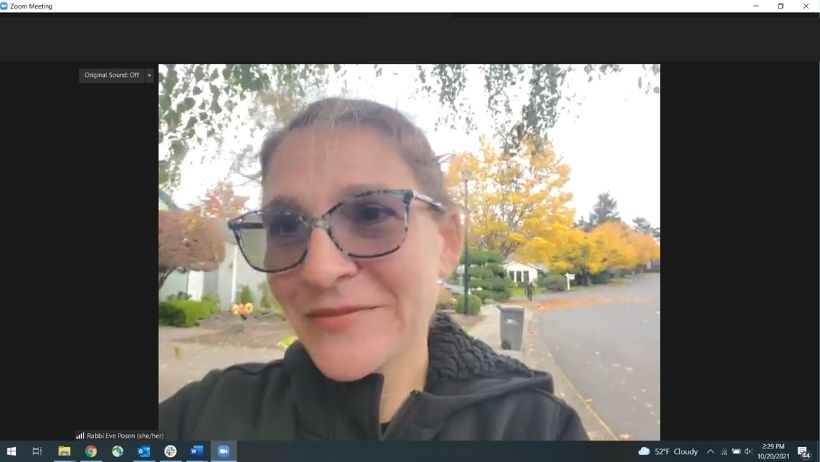
One of the hardest parts in switching to what is now a commonplace Zoom lifestyle was not being able to really see people. Yes, we mostly had our cameras on during meetings and services, but only seeing someone from the neck up isn’t really seeing them. So much of what I use in conversation comes from watching body language, watching subtle movements and shifts in others, and being fully present with another person. I’m just as guilty as the next person of occasionally being “checked out” when a meeting is online. If I’m not on a walk, where there are fewer distractions, it’s much too easy to check and answer emails or help a kid with a project. I wanted to be fully focused, but sitting and staring at a screen all day long didn’t really allow me that focus I needed. So in other words, not being able to completely see people has also made it difficult for me to completely hear them.

I know I’m not alone in my inability to be fully focused, or fully listening, when something else is calling for my attention. One reason I know this is because it’s actually at the center of this week’s Torah portion. In this week’s parshah, Vayera, we learn a version of this lesson as well. Here’s the recap: Abraham and Sarah contemplate the son that will be born to them in their old age; Sodom and Gomorrah fall as Abraham bargains with God to save Lot’s life; and Isaac is born, causing a rift in Abraham’s house with Ishmael. Abraham moves forward in making a deal with King Avimelech, and we end with the Akeidah, the test of Abraham as God asks that he offer up his son, Isaac.

When Abraham and Isaac are on the walk to the mount for Abraham to sacrifice Isaac, there is stilted conversation. Isaac repeatedly asks questions based on his observations. “Where are we going?” “Where is the sacrifice?” And Abraham’s answer is consistently, “God will see to the sheep” and “He saw the place.” Whereas Isaac was taking in the world around him, likely because he was fully focused on the experience, Abraham’s focus was somewhere else, perhaps hoping and praying that God would intervene and call off this test. Abraham wasn’t watching his son to see how to really comfort him; instead, he was focused on God. 

This is not to say that as a monotheistic people we shouldn’t focus on God; rather, it’s a subtle reminder that Judaism, parenting, and life in general are about being present. After this incident, Abraham and Isaac don’t really speak to each other again, not that you can blame them. But I can’t help wondering if that would have been different if Abraham had been fully present with Isaac, listening to him, to really see him and to answer his questions, share wisdom, and let him know he was loved, despite this challenging ordeal. 

What I’ve learned about Zoom is I’m not able to be fully present unless I remove the distractions.  When we listen to each other, when we can really see each other, not just in a tiny window at the top of the screen while we mindlessly scroll Facebook or answer email, but in the full screen (large box, so to speak) that’s how we build relationships and move forward with one another. May we continue walking into 5782 with presence and focus on the things that matter.