As a Seal Upon Your Heart – Parshat Tetzaveh 5776

Seal Upon Your Heart

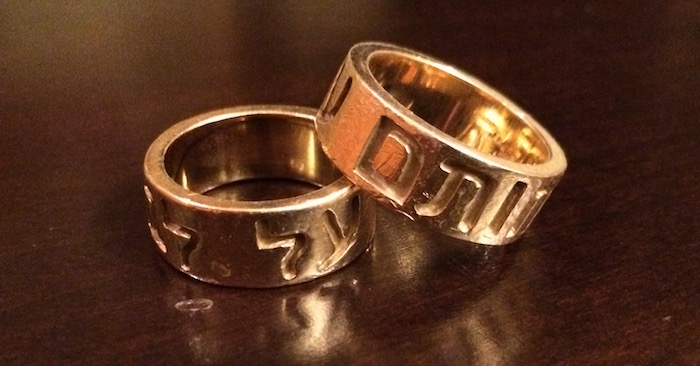
My wedding band is inscribed with the words “As a seal upon your heart” in Hebrew. Originally from Kohelet (Ecclesiastes), this verse on my finger serves as a daily reminder in several ways. When Duncan and I were ring shopping, I wanted the “plain gold band” we’d need for the ceremony to also be one that we both felt comfortable wearing every day. Even if it was simply solid gold, I wanted something that was both beautiful and meaningful. My mother shared with me that she and my father had this verse inscribed on the inside of their rings. It didn’t take much convincing to get Duncan on board, and now we each have a constant symbol of our connection to one another as well as the link to my parents and their love too.

The memories we carry are often attached to certain unforgettable details like a song playing at a specific moment or the smells of a certain location. This also happens with clothing and jewelry. Maybe you remember down to the last detail the outfit you were wearing when you brought your first child home from the hospital. Perhaps there’s a piece of jewelry passed down from generation to generation. The tallit you wear on Shabbat and the person it belonged to before you may hold a special place in your heart.

Parshat Tetzaveh, which we read this week, details the specific clothing items that a priest and those close to him are to wear. This is special attire that distinguishes them from others in their service to God. These clothes are meant to add an aura of holiness to the priests as they complete their sacred duties. Since these vestments and garments are to be used for such a unique purpose, God also gives a special instruction regarding who is to make them. After we receive these specifics, we learn about the details of what is on each garment.

Chapter 28, verse 29 teaches: “Aaron shall carry the names of the sons of Israel on the breast piece of decision over his heart, when he enters the sanctuary, for remembrance before the Lord at all times.” That is to say that in all of Aaron’s work, he is to carry the “seal” upon his heart of those who have come before him. The high priest, in his role, is beholden to the names, experiences, and fates of those who came before him. The Ba’al Shem Tov, a Chassidic master, shares “Remembering is the source of redemption, while forgetting leads to exile.” Our identities have been shaped by those who came before us not only in their actions, but in our memories of them.

While we may not have a high priest today, we too are linked to those came before us. Whether the memory is preserved in the use of your great-grandmother’s candlesticks on Shabbat or telling the same jokes each year at Pesach, the sharing of that past is what will ensure a future.

My wedding band reminds me of the strength and love of my parents’ marriage and of the dedication Duncan and I have to each other to maintain our own bond. May we all be blessed first with the sweetness of fond memories and second with the kavanah, the intention, to learn and grow from the lessons they teach.

Now Boarding – Parshat Tetzaveh 5775

now-boarding

You may have noticed I like travel analogies. The reason is simple – I love flying. There is still something magical to me about getting on an airplane and being whisked away to a new place, even if that place is really cold or even if it’s for business instead of vacation. I get excited about travel.   When I was younger and I traveled with my father, I felt special because we had a “World Perks” card and could get into the secret club. That made travel even more special. Even the little things like having a lower group number so I could get on the plane earlier were huge in my eyes.

These days I don’t travel a ton or have a perks card, and therefore I have no special reward status. Everyone gets to board the plane before I do. I’m not “priority access,” and I don’t have platinum, gold, silver, bronze, or even aluminum status with any airline. I am simply a traveler. I can’t even board early because I’m traveling with a small child. The single reason I wanted children was to be able to board the plane early, and now the airlines have taken that away from me too. Ok, maybe not the single reason.

I am simply a passenger, coach class.

In parshat Tetzaveh, the Torah portion we read this week, God gives the commandments for what clothing the priests will wear, how they should be fashioned, and the materials that should be used in their fashioning. The priests are set to wear special clothing that distinguishes them from others in the service of God. These clothes are meant to add an aura of holiness to the priests as they complete their work. Since these vestments and garments are to be used for such a unique purpose, God gives a special instruction regarding who is to make them. Aside from this section on apparel, the parshah is mostly centered around the role of the priest.

The Israelite nation stems from the twelve tribes of the twelve sons of Jacob. The ones who are considered to be Priests, Kohanim, come from Aaron, the Levites come from the tribe of Levi, and everyone else is an Israelite. The Kohanim are those that have the honor in our parshah. They wear special clothes, perform sacred rituals, and are leaders in a general sense. The Levites help the Kohanim. They too have special roles in order to make sure the ritual rites are performed. The Israelites are simply congregants, members. Even today, Kohanim traditionally receive the first aliyah to the Torah and Levites receive the second, and only after this do the Israelites have an honor.

This process might have felt exclusionary, especially if you consider that a hereditary priestly class could easily include any unworthy children of a Kohen and exclude those who would actually want to serve. At the same time, there are advantages. It meant that the priesthood was free of outsiders who might use it for personal advantage, and it allowed – and still allows – for a legacy of ritual to be passed on from birth. This hierarchy is one of the few ways in which we’ve held onto the traditions of our past and preserved them.

Not everyone can be a Kohen. Think about it. If everyone were a Kohen, then no one would be a Kohen, just as we can’t all have platinum status, because then we’d have to come up with an entirely new way to board the plane. But the fact is today your status as a Kohen, Levite, or Israelite doesn’t limit how much you can give of yourself as part of our Jewish community. We can all learn, lead, pray, and support; those are the true perks.