Healing Words and Healing Actions

“Sticks and stones may break my bones, but words will never hurt me.” We know this isn’t true. Words can wound deeply—and also heal. In this week’s double portion, Tazria-Metzora, the Torah offers a layered exploration of both the power of words and the potential for healing, inviting us to reflect on speech, gratitude, and the journeys—physical and spiritual—we take toward wholeness.

Parshat Tazria opens with a woman’s recovery after childbirth, detailing a ritual of purification and offerings. In ancient times, childbirth was not only spiritually significant, but perilous. The Torah’s acknowledgment of that danger—followed by the mother’s eventual reintegration into communal and spiritual life—echoes a profound truth: survival itself is sacred. Today, when a parent safely delivers a child, we still carry this awareness. It’s reflected in the blessing of Birkat HaGomel, recited by those who emerge from danger: “Blessed are you . . . who bestows goodness upon the undeserving and has granted me all good.” It’s a powerful reminder that recovery calls not only for relief, but for gratitude.

Later, the parshah transitions into a discussion of tzara’at, a skin affliction often interpreted by the rabbis as a spiritual consequence of lashon hara—harmful speech. This theme continues into Parshat Metzora, where the afflicted person undergoes not only physical inspection and quarantine, but ultimately, a ritual of release and renewal. A live bird is set free, symbolizing reintegration and new beginnings. Like the mother after childbirth, the metzora is welcomed back into community—restored, renewed.

Though tzara’at may no longer appear on our skin, its lessons linger. Harmful speech still isolates. Gossip still wounds. But just as the body can heal, so too can relationships, when we take responsibility and seek repair. And just as we recite Birkat HaGomel for physical healing, perhaps we might imagine a blessing for the restoration of our words—when our speech turns from tearing down to building up.

Our siddur offers us such a model. Each morning, we begin Pesukei d’Zimra with Baruch She’amar—“Blessed is the One who spoke, and the world came into being.” God’s speech is not destructive, but creative. It builds worlds. If we are made in the divine image, then our words, too, can create. They can comfort, connect, and bless.

So this week, what if we treated our words and our health as equally sacred? What if we offered gratitude not only for physical healing, but for the chance to speak kindly, to start fresh, to repair what was broken? In doing so, we echo both Birkat HaGomel and Baruch She’amar—giving thanks for survival, and honoring the creative holiness within every word.

May our speech be life-giving, our gratitude expansive, and our healing—physical and spiritual—a source of blessing for ourselves and others.

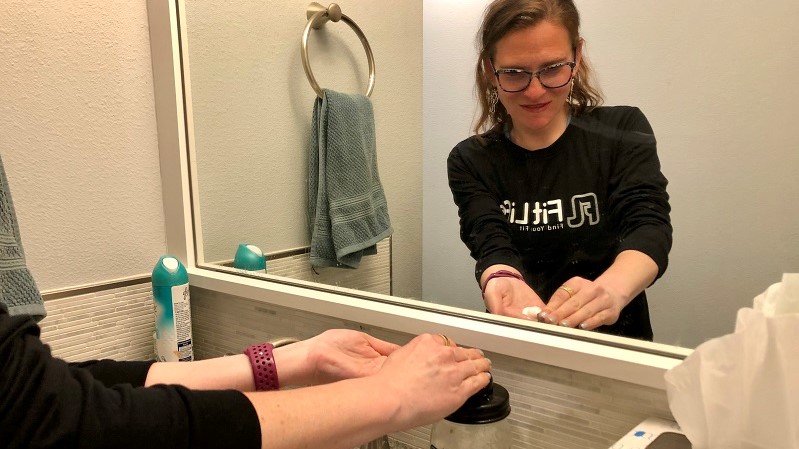
Uncommon Cold – Parshat Tazria-Metzora 5783

How many of you have had the experience over the last four years of looking at someone who was coughing or sneezing (or had any signs at all of being under the weather) and pulled back just a little because “Oh no, Covid”? How many times did you have to excuse your seasonal allergies so that you weren’t shunned for “Covid-like symptoms?”

In a pre-Covid world, we might have assumed the best, if you can call a cold or allergies “the best.” In our post-Covid world, we have to do extra work to decipher what’s a cold, what’s the flu, what’s allergies, and what’s a potentially life-threatening virus we can spread to others. That’s not to say these other illnesses can’t be deadly or highly contagious, but simply that we have a whole new understanding of how to recognize and classify symptoms.

The truth is, our Torah has been guiding us on quarantining and recognizing ailments since the very beginning, and it kicks off in this week’s double Torah portion of Tazria-Metzora. The text of these parshiyot tell us of the laws for the purification of our homes and our bodies after disease or death has occurred. The laws remind us that our bodies and our places of residence need to be treated with the utmost respect. We also have the obligation to help one another maintain healthy lifestyles and support one another when we find ourselves with impurities. 

It’s interesting, in our modern, post-Covid world, to read laws about how we purify ourselves (sanitizer, anyone?) and about quarantines well before modern medicine and our current support systems were in place. What it comes down to is the human connection we feel when we care for one another. Illness doesn’t mean that you’re somehow morally flawed; it means that we have work to do to bring healing. As we read this week’s double portion, we’re reminded just how important it is to be both aware of our own bodies and respectful enough of others to keep our fellow community members safe. 

Staying Strong – Parshat Tazria-Metzora 5781

I’m sure you’ve heard the message in one form or another: just because you’re vaccinated does not necessarily make it safe to return to life as we knew it in 2019. As we work toward what’s been referred to as herd immunity, more spikes in infections would reverse the progress we’ve made. That means the safest course of action for the time being is doing the things we’ve been doing for the past year, like keeping our gatherings small and with the same people, wearing masks, and washing our hands. 

As Jews, this is familiar territory. We are acutely aware of what comes in contact with our bodies, from the laws of kashrut to ritual hand washing to visits to the mikveh to the burial process, just to name a few. Jewish ritual practice brings an awareness of our physical selves, the world that surrounds us, and the connection between the two.  The book of Vayikra, which contains so many laws about food and daily activity and also sacrifices, serves as a bridge between physical and spiritual. Specifically our double Torah portion this week, Tazria-Metzora, is the essence of this connection. 

The text of these parshiyot tell us of the laws for the purification of our homes and our bodies after disease or death has occurred. The laws remind us that our bodies and our places of residence need to be treated with utmost respect. We also have the obligation to help one another maintain healthy lifestyles and to support one another when we find ourselves with impurities. While our human nature tends to lean towards picking ourselves apart based on what we wish we could change, the Torah reminds us that what might be seen as an “impurity” in our eyes is seen as a “tabernacle,” a holy space, by God.

The parshah we read last week, Shemini, lists in great detail the food that is permitted to enter our bodies and how that food can make us ritually impure. The text this week discusses how the things that come out of our bodies can do the same thing with regard to infections, and other ailments. Being attune to our bodies means focusing on what we put into it, how our body reacts, and how we care for it. In a similar way, in Metzora we read about how buildings can become impure too based on what we do or put inside them. 

These sections of text remind us of the intimate connection between our actions and our health, a reminder that’s all the more important to take with us as we head into another new stage of coping and living.

The Torah Says Stay Home – Parshat Tazria Metzora 5780

torah-says-stay-home.jpg

This novel coronavirus has completely changed our rules of acceptable interaction. However, even before the outbreak, there were certain procedures in place for how to handle illness and bodily fluids in public. For example, there are rules about when children can attend school. If you have to wipe your nose more than five times in five minutes, or your snot from said nose is an alarming color, you are to stay home from school. Then there are the other ailments, which I won’t mention here because even seeing the words cause me to break out in itchy paranoia. Of course these precautions are mostly for the benefit of the teachers and other students. In general, public health and safety is at the center of so many policies regarding our places of work and education, and even more so now. These concerns also happen to be front and center in the Torah too. 

Our combined Torah portion this week, Parshiyot Tazria and Metzora, remind us of the healing properties of water as well. The text of these parshiyot tells us of the laws for the purification of both our homes and our bodies after disease or death has occurred, and the laws remind us that our bodies and our places of residence need to be treated with respect. We also have an obligation to help each other maintain healthy living and to support one another when we find impurities.

In all of this text, the Torah is focused on both what is best for the community at large, and what is best for the person with the ailment. Two full sections of text focus on cleaning and healing, separating and rejoining, and caring for and letting go of various ailments and bodily issues. The Torah even has a prescription for how we’re supposed to disinfect after an illness. Sound familiar? 

So why are there such detailed procedures laid out? Because everyone gets sick at one point or another. Everyone goes through some type of ailment. There’s a reason the common cold is called “common.” This universality means we need to learn how to care for ourselves and each other. It is a Torah mandate to stay away if you’re contagious and also a Torah mandate to care for others when they are sick.

As a working parent (in a two-working-parent household), I admit I try to push the limits a little when my own kids are sick, simply because the change in routine by having them home is difficult. However, I understand that the rules are there to keep us all safe and healthy. These two portions, Tazria and Metzora, are about our ability to help others heal and protect others from illness. And above all, it’s because you would want others to do the same for you. 

Pure and Simple – Parshat Tazria Metzora 5778

pure-and-simple.png

As you may recall when I spoke about the subject of water on Yom Kippur, I am a terrible swimmer. Nevertheless, there is something magical about water, and being near a body of water has always been a calming force in my life. For almost my entire life I have lived within a quick drive of the lakes in Michigan or the coast in California and Oregon, and it somehow soothes me to know that I can be near the water in a matter of hours. And although Texas has the Gulf of Mexico, being mostly land locked in Dallas never felt quite right. I missed the soft waves on the shore of the lake, the open expanse of an ocean, and the calming feeling of that ebb and flow with no end or beginning.

Although I’m not usually actively thinking about it, it’s also likely my strong feelings about water are due in part to the sense of purity and cleansing it provides. It both hydrates and cleans my body, and that relationship to water is one that’s fundamental to human existence. Our combined Torah portion this week, Parshiyot Tazria and Metzora, remind us of the healing properties of water as well. The text of these parshiyot tells us of the laws for the purification of both our homes and our bodies after disease or death has occurred, and the laws remind us that our bodies and our places of residence need to be treated with respect. We also have an obligation to help each other maintain healthy living and to support one another when we find impurities.

In chapter 14, verse 9 of Leviticus, we learn about the purification of the leper; we read that he should “bathe his body in water; then he shall be pure.” This is not referring to just any ordinary bath. This is a symbol of rebirth and recreation. The Seifer HaHinnukh teaches that the experience of illness and recovery has made the leper a new person. In other words, someone who now looks at life differently. While it is ultimately the experience that changes a person, the water symbolizes that moment of change. As infants we are born out of water. When we enter a new life phase, including converting to Judaism, we visit the mikvah. In fact, our entire world was created only as it emerged out of a giant body of water.

As the spring begins to give way to the first signs of summer, may we find refreshment in all that we do and take as many opportunities as possible to enjoy all the peaceful reassurance and calm our beautiful Pacific Northwest has to offer.

As a final note, I encourage you to visit our beautiful community mikvah located on the Mittleman Jewish Community Center campus. It’s closer than the ocean and cleaner and calmer than the river. We have been blessed as a community through the support of the Oregon Board of Rabbis and Jewish Federation to sustain a beautiful, tranquil place to refresh and transform ourselves.