This is the sermon I delivered at Congregation Neveh Shalom on Rosh Hashanah day, 2025. For more on Dr. Lisa Miller’s book The Awakened Brain, visit: https://www.lisamillerphd.com
I want to pose a question you may have never been asked. When was the last time you let awe interrupt you? These are the Days of Awe after all, so what is this “awe” we’re talking about? The kind I mean doesn’t have to be earth-shattering; it just has to wake you up from wherever your mind is.
Here’s an example to get you thinking. This summer I found myself on a walk. That’s not the awe-inspiring part. None of you should be surprised that I relish my walks. It was my typical mode: headphones in, multitasking between an audiobook and thoughts of work – in this case it was this very sermon that needed writing. Before it had even really registered with me, I was passing a toddler in a stroller who was pointing to the sky and shouting, “Moon! Moon!” Her eyes sparkled with awe, not only at the idea that the moon could be visible during the day, but in the childlike wonderment that our planet has a moon at all.
I looked up. There it was—a full, glowing moon still visible in the early morning sky. And I realized: I hadn’t noticed it at all. I was too busy being productive. That little girl saw something bigger, something sacred. She was awake to wonder, and I was just trying to get through my day.
That moment stayed with me. It reminded me that being awake—truly awake—is more than just getting up in the morning. It’s about how we show up to our lives. That’s what the sound of the shofar does, and that’s what Rosh Hashanah itself is about: awakening to our truest selves, our relationships, and the sacred pulse that beats behind it all.
What prompted this connection for me and led to this sermon was Dr. Lisa Miller’s powerful book The Awakened Brain, in which she explores how awakening isn’t just a spiritual metaphor—it’s a biological and psychological necessity. She identifies three types of awakening that help us live richer, more meaningful lives: Personal Awakening, Relational Awakening, and Transcendent Awakening. And on this Rosh Hashanah, as we begin 5786, these three awakenings offer a roadmap for how we might renew our lives.
Dr. Miller’s first kind of awakening is Personal Awakening, the internal shift that comes when we confront challenge, loss, or profound insight and begin to see ourselves differently.
We all have these moments. They often come when life throws something unexpected our way—a diagnosis, a breakup, a loss, a new career. In a flash, the world feels unfamiliar. But it’s in those cold-water-on-your-face instances that we’re invited to truly wake up.
The shofar we hear today is the ancient sound of that personal awakening. Maimonides wrote that the shofar calls to us: “Awaken, you sleepers, from your sleep, and you slumberers from your slumber! Examine your deeds and return in repentance.” We don’t call it the “gentle nudge” of the shofar. We call it the “blast” of the shofar! It’s a divine alarm clock.
Dr. Miller calls these moments of personal awakening “the doorways to transformation.” Her neuroscience research shows that people who embrace these turning points with open eyes and hearts, rather than retreating into fear or denial, actually rewire their brains for greater resilience and emotional health.
And wouldn’t you know, Judaism teaches the same thing: that teshuvah—return—is not about guilt. It’s about growth. When we reflect deeply on our lives, we can return to who we were always meant to be.
So I ask: What is your shofar blast this year? What is asking you to wake up?
Maybe it’s a health scare, although I hope it isn’t. Or a job transition. Or the dream you’ve delayed. Maybe it’s a loneliness you’ve managed to push down and cover up that suddenly finds itself staring you in the face. Listen closely. The sound is there. This year, don’t hit snooze. Let yourself be jolted awake.
The second kind of awakening Dr. Miller explores is Relational Awakening, the understanding that we individuals are hardwired to connect. That our healing, our hope, and our humanity depend on each other.
We learned this the hard way during the pandemic, when distance became our new normal. We longed for hugs, for shared meals, for singing side-by-side. And even now, years later, many of us are still finding our way back into community.
There’s plenty in our Jewish tradition that can be done solo or as a family unit in the privacy of your home. But Rosh Hashanah is a communal holiday for a reason. We pray Avinu Malkeinu—Our Parent, Our Sovereign. We gather as a people, not just as individuals. Even the most personal of prayers are recited in the plural, because our tradition knows something Dr. Miller confirms: we are not meant to go it alone.
Her research shows that people with strong relational networks—family, chosen family, spiritual community—are more resilient in the face of life’s challenges. They’re more grounded, and yet also more hopeful. Why? Because being seen and known and loved heals us.
This is the heartbeat of synagogue life. I hope you’re not tired of hearing this, because I’m never going to stop preaching that we are more than a building to house services. We are the Meal Train you sign up for after someone has surgery. We are the embrace when you see someone who has just started saying Kaddish after they’ve lost someone close to them. We are the joyful chaos of kids running through the halls. We are every time you say “Shabbat shalom” because it doesn’t just mean “Shabbat shalom,” it means, “I see you. You matter.”
But this kind of awakening takes a little more effort than the first kind. It means showing up for each other. Not perfectly, just honestly. It means reaching out when you’d rather stay in. Forgiving when you’d rather forget. Saying yes when it feels easier to say no.
This year, I challenge you: reawaken your relationships. It’s easy for the rabbi to stand up here and invite you to attend services more often. I’m here anyway. No, what I’m really asking of all of us is to say hello to someone you don’t yet know. Invite someone new to your table. Open your sukkah. Rebuild the sacred web that holds us together, because if you’ve been anywhere near the news or social media recently, you know we need it.
The final awakening Dr. Miller describes is Transcendent Awakening—when we realize we are part of something greater than ourselves. This is the dimension of the spiritual, the sacred, the holy.
I know that not everyone here in the room uses the word “God” comfortably. Some of us picture a divine being. Others connect through nature, music, or quiet moments of reflection. But I’d guess all of us, at some point, have felt awe, whether it’s watching a newborn open their eyes, hearing the final blast of the shofar, or just gazing at the moon during the daytime.
That’s transcendence. That’s what awakens your spirit.
Rosh Hashanah means that kind of awakening. We call it Hayom Harat Olam—today the world is born. We remember that we are part of something vast and mysterious. We relinquish the illusion that we control everything and lean into trust and humility.
The Unetaneh Tokef prayer stirs us: “Who shall live and who shall die?” These words are hard. They’re real. They ask us to take stock of what we can and cannot control. But they don’t leave us in despair, they do the opposite. They offer us a roadmap: teshuvah, tefillah, and tzedakah—returning, praying, and acting with justice—can transform our destiny.
Guess what Dr. Miller’s research shows about people who cultivate a sense of the sacred through prayer, gratitude, and awe. It’s not that they need to cut down on sodium. It’s that they live with more meaning and less fear. They have what she calls “an awakened brain”—a mind attuned to love, beauty, and hope.
This year, how might you cultivate transcendence? Light candles. Say Modeh Ani in the morning. Say thank you. Start small, and let awe interrupt you. Let holiness sneak in.
Now that we’ve talked about what my hope for your Rosh Hashanah awakening is, I feel I should also mention what it isn’t. It isn’t about striving for perfection. And it isn’t about some universal awakening that applies to everyone. It’s yours.
This is your invitation:
- First, wake up to your own life. Listen for the shofar calling you back to your truest self.
- Second, wake up to each other. Reach out, reconnect, rebuild what has been broken.
- Third, wake up to the sacred. Let yourself be awed. Let yourself be moved.
Dr. Miller says it plainly: “Spiritual awareness is not an add-on. It is foundational to our well-being.”
And Judaism says: You were made for this kind of awakening. You were created b’tzelem Elohim, in the image of God. You are worthy. You are needed. You are part of something beautiful and enduring.
This year, may we not sleepwalk through our days. May we wake up—in body, mind, heart, and soul. Shanah tovah u’metukah. May it be a sweet, sacred, and awakened new year for us all.
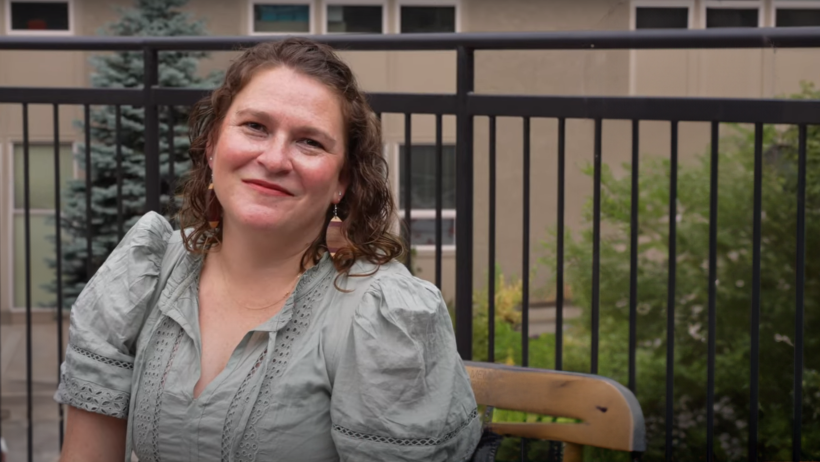
 Rabbi Eve Posen