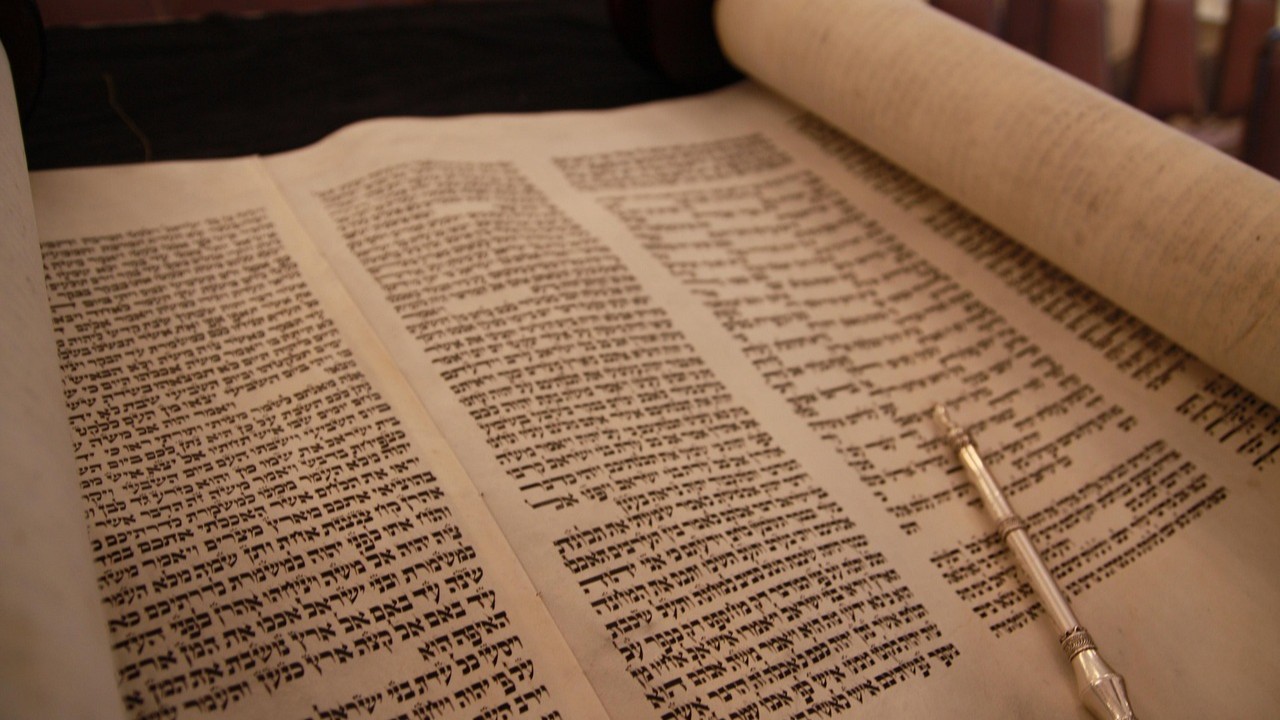
The Source of Wisdom

The study of Torah is such a fundamental part of Judaism that there’s not just a blessing for the act of Torah study, there’s a blessing for encountering someone whose life is shaped and guided by Torah study. Whether it’s a scholarly figure with critical insight or a community elder whose wisdom is drawn from years of learning and living the law, our tradition teaches us to pause and offer a blessing. In doing so, we acknowledge that the wisdom before us is not theirs alone, but a spark of the divine shared with us through them.

Parshat Ha’azinu offers us a similar encounter. This parshah is often called the “Song of Moses.” Nearing the end of his life, Moses does not simply offer final instructions or laws. Instead, he sings. His words cascade as poetry: heaven and earth are summoned as witnesses, history is remembered, and God’s faithfulness is proclaimed. The tone is at once stern and tender, filled with warning and with hope.

What makes this song extraordinary is that it distills the essence of Torah into music and memory. Moses, the greatest of teachers, transforms his final teaching into a form that will live on beyond him. It is as though he becomes the embodiment of the blessing we say upon seeing someone distinguished in Torah study: he channels God’s wisdom, not for himself, but for the people who will carry it forward.

When we hear Ha’azinu, we are invited to see Moses not only as a leader or lawgiver but as a vessel of divine wisdom. And we, in turn, are called to recognize that Torah wisdom is not locked away in the past. It can appear in a teacher who explains a verse in a new light, in a friend whose insight guides us through a hard choice, or in a child who asks a question that reframes everything we thought we knew. Each of these moments is worthy of blessing, for each reveals God’s wisdom refracted through human lives.

The charge for us is clear: to cultivate the eyes and the humility to see divine wisdom when it appears in scholars, in neighbors, and even in ourselves. And when we do, may we always respond with gratitude, blessing both the opportunity to learn and the source of our learning. 

Finding Meaning – Parshat Ha’azinu 5783

I write this d’var Torah acknowledging that with its completion, I have written a d’var Torah every week for 12 years straight. That’s a lot of digging in, finding meaning, extrapolating relevance and, lest I forget, editing by my amazing editor, my Rabbi Consort, Duncan Gilman. I’m often asked about my process for writing these weekly columns, and it’s a little embarrassing to reveal that I write them a year ahead of time. That way, I’m never without something to say, and I always have at least a basic structure to work from, should the world go awry, which it almost always does.

As I’ve written about so many weekly portions, and they’ve all appeared in print, it also means I have to check to make sure I’m not repeating myself. Usually, it’s easy enough to take the same topic and explain it in a different way, but sometimes I’m at a loss. Occasionally I only want to talk about one specific moment in the Torah portion, and while repetition isn’t necessarily bad, it feels risky to repeat myself on my blog and the Neveh Shalom website.

The good news for me is that this week’s Torah portion has a reminder about finding connection to its own words, and it’s helpful advice to live by too. This week we read the penultimate Torah portion, Parshat Ha’azinu, which has the special honor of being the last section of Torah read on Shabbat morning. Parshat Ha’azinu is a poem which warns against the negative behavior of the Israelites and explains the blessings that will befall them with the good behavior they are certainly capable of. The text ends with Moses ascending the mountain into the clouds as he takes his leave of the Israelite nation. This parshah is the link between generations, between new and old leadership, and between living on earth (in the land of Israel), and living with God (on top of the mountain in the heavens).  

At a point in this week’s Torah portion, Moses shares that the Torah is “not an empty thing from you.” That is to say, if the Torah is lacking in meaning, it’s not because the meaning isn’t there, but because you might not have found the connection yet. It is simultaneously the worst advice I want to hear on days when I struggle with what to make of our tradition, and at the same time, the most helpful reminder that there are always moments, words, sounds, phrases that will have meaning for me. 

I find it fascinating that towards the end of the entire Torah we get this reminder to look closer, deeper, broader into the text to find meaning. The answer is it’s always there, we just have to open our hearts and minds to find it. As someone who writes every week, I often struggle with this, and yet Moses and God are right – the knowledge is there, I just need to open myself to hold a new perspective.

Ha’azinu translates to “and we listened.” May we open our ears to listen to one another, our hearts to hear anew, our minds to connect to something new and meaningful for us in the new year.

From a Distance – Parshat Ha’azinu 5782

Until the vaccine became widely distributed, it felt like we were living life from a distance. We got to know new neighbors on our street from a distance. We made people smile with window art from a distance. The kids even maintained their friendships from a distance using Zoom and Google Classroom. They were taught and entertained, and they learned to mute and unmute themselves (if only they could do that in real life too). However, we quickly found out some things just aren’t the same from a distance. As part of my job as a rabbi, making physical contact with mourners and holding them in their time of need was one of those things. For the kids, going to the playground behind our house (because what fun was it to just stare at the playground equipment) was one of those things.  

This week we read the penultimate Torah portion, Parshat Ha’azinu, which has the special honor of being the last section of Torah read on a Shabbat morning. Parshat Ha’azinu is a poem which warns of the negative behavior of the Israelites and explains the blessings that will befall them with the good behavior they are capable of. The text ends with Moses ascending the mountain into the clouds as he takes his leave of the Israelite nation. This parshah is the link between generations, between new and old leadership, and between living on earth (in the land of Israel), and living with God (on top of the mountain in the heavens).  

This section of text ends with Moses standing on the mountain and God reminding him, “You may view the land from a distance, but you shall not enter it, the land that I am giving to the Israelite people.” In essence, Moses is much like my children during our “stay home, stay safe” order. He is standing on the edge of the playground, the place he wants to go the most, and being told he can look but not touch. But it’s in this very moment that Moses shows his leadership. He doesn’t go into the land. He doesn’t have a tantrum. He turns to the people in the next and final section of the Torah and simply offers up blessings.

Why did Moses need to see the Promised Land at all? We’re told it was a different generation that entered anyway, so wouldn’t it have made more sense and been much easier for Moses if he had died before being able to see what he was missing? Sometimes I can’t even have certain foods in the house because even just seeing them in the pantry is too much of a temptation. I can’t imagine what it must have felt like to be Moses and not be able to go into the Promised Land after all this time leading the people there.

Being a leader sometimes means making difficult decisions even when easy decisions are staring you in the face. It means taking a step back and putting some distance between you and something you want deeply because it will benefit the greater good. I’m certain it wasn’t easy for him, but Moses trusted in God and modeled the behavior of what it means to move forward. We won’t be able to fully enjoy the world we leave for our grandchildren and our great-grandchildren either, but it’s our responsibility to lead them to it and leave it in their hands.

I’m Listening – Parshat Ha’azinu 5781

Last year for Purim, the Foundation School (our synagogue preschool) teachers got together to discuss what theme we would use to tell the Purim story this year. What came up over and over again was the idea of how we listen to one another. King Achashverosh has the opportunity to listen to Vashti when she shares her wishes, but he doesn’t open his ears. Later, the king listens to Haman when he shouldn’t have, another poor choice. Finally he makes a better choice listening to Esther, as she tries to save the Jewish people. In the telling of the story, we use catch phrases the kids can shout out when they hear a character’s name. It’s not just booing for Haman, it’s also cheering or describing the others. When we asked our students to share a phrase for King Achashverosh’s name, they suggested “I’m listening.” 

How often do you say the words “I’m listening” to someone else? And how often do you actually listen and hear exactly what that person is trying to convey? Now more than ever, we’re relying on what we hear from others. We don’t currently have the benefit of live gestures or physical contact to convey what we mean.

This week we read Parshat Ha’azinu, the penultimate parshah in the Torah, and one which reminds us of the importance of actually listening to one another. This portion includes Moshe’s final poem to the Israelites; in it, he reminds the people of God’s grace, compassion, and loving leadership, while at the same time criticizing the Israelites for their lack of faith and understanding. In this poem we read: 

Remember the days of old

Consider the years of ages past

Ask your father, he will inform you

Your elders, they will tell you.

As Moshe is nearing his final farewell to the people, he implores them to ask their elders to clarify laws and to share their stories. The text begins with the words “Give ear, O heavens, let me speak; Let the earth hear the words I utter!” As the Israelite nation is moving into their own land, out of the adolescence of wandering in the desert, Moses pleads that God should listen to him, that the people should listen to him, and that ears and hearts be opened to really hearing one another. 

In essence, as his final wish, Moses simply wants to be listened to. Isn’t that what we’re all seeking? We all want the reassurance of knowing our voices are being heard. May the gift of listening – both giving and receiving – be something we take with us into the new year.

Listen To Me – Parshat Ha’azinu 5780

listen-to-me.jpg

I find that my least successful moments in life are when I’m too emotionally worked up to consider my words thoughtfully, and instead I scream, yell, cry, or just whine. I should actually heed the words I use with my children: “I can understand you much better when you’re calm.” Listening can’t be forced. Trying to force someone to listen to you is like trying to force someone to love you. It just doesn’t work that way.

Throughout the Torah, God is giving rules and asking the Israelites, or Abraham, or Isaac, or Jacob, or Moses to listen as they navigate the nation through the journey of life. This week we read the penultimate Torah portion, Parshat Ha’azinu, which has the special honor of being the last section of Torah read on Shabbat morning. Parshat Ha’azinu is a poem which warns of the negative behavior of the Israelites and explains the blessings that will befall them with the good behavior they are capable of. The text ends with Moses ascending the mountain into the clouds as he takes his leave of the Israelite nation. The parshah is the link between generations, between new and old leadership, and between living on earth (in the land of Israel), and living with God (on top of the mountain in the heavens).  

The text begins, “Give ear, O heavens, let me speak.” If you imagine the scene, it’s Moses’s final moment with the people. He’s sharing his vision with them and his faith in God. The people, knowing how close they might be to entering the Promised Land, are likely boisterous, loud, dancing, screaming, excited for the moment. And there’s Moses at the top of the mountain, shouting “LISTEN, LISTEN!” Getting all those people to quiet down could not have been easy.

Ha’azinu begs of us not just to listen to ourselves and to others, but to listen even when we’re irrational. And what an appropriate message near the end of the Torah: this part of the story is over, so were you listening? Were you paying attention? And how will you be a better listener the next time around?