Searching for More When You Need Less – Parshat BeShalach 5772

There’s no doubt about it – transitions can be scary.  A new job means new coworkers and an unfamiliar commute.  Transitioning from single life to married life brings questions like how to share a bathroom, who will do the dishes, when will I have private time.  The transition from lower school to middle school finds our students with all sorts of new anxieties about daily life, workload, and friendships, even when they’re already comfortable with the building and the teachers. 
In Sefer Shemot, the Book of Exodus, the Israelites are in constant transition: from slavery to freedom, from civilization to the desert, from known to the unknown.  In Parshat Beshalach, the Torah portion this week, we find the Israelites on their journey out of Egypt and ready to move on to the next phase in their live.  They have put an enormous amount of faith in God, a force they have yet to truly encounter as a community. 
The fear of the unknown is powerful within the Israelites, and as the journey continues, their fragility and tentativeness come to a head.  As the Israelites are camped out, Pharaoh’s army starts to approach.  Because the people are afraid that they will be captured again, they complain to Moses in chapter 14 verses 11-12 that they would have been better off staying in Egypt.  Even though we sing at Pesach every year, Dayeinu, freedom would have been enough; the Israelites have no sense of security yet. 
When Moses responds with faith, believing that God will protect them, the Israelites seem satiated for the time being.  They acknowledge they have been saved, but are still fragile.  But security isn’t the only human need.  As they journey on, they are thirsty and can only remember the sweet waters in Egypt, the plentiful liquid nourishment.  They complain again and finally receive water, but as I’m sure you can guess, quenching their thirst isn’t the end of the story.  The people feel the pangs of hunger, and they cry out that they require food and to know where their next meal will come from. 
As the people learn to embrace freedom, they also learn that part of freedom is the responsibility to speak up if your needs aren’t being met.  Abraham Maslow, a 20th century psychologist, suggests that individuals can only become self actualized if they have all their other levels of basic needs met.  This begins with physiological needs.  A basic sense that there will be food, water, shelter, and sleep.  The second level that must be fulfilled is that of safety – safety of body, resources, family, health, and property.  The hierarchy goes on to discuss belonging, esteem, and then finally self actualization.  These first two levels of the hierarchy must be met in order to move forward.  It makes sense that the Israelites complained at first.  Their basic needs and safety were not being met, and they didn’t know if they would survive.
But the grass is always greener.  Once these needs were met, the Israelites did not stop complaining and got stuck in the mindset of wanting more.  Water and mana were no longer enough.  They wanted meat, and they wanted more water, better water.  We can certainly relate.  Your laptop is barely a few months old, but that new model is so tempting.  And what’s wrong with buying just one more outfit while it’s in style? 
It comes as no surprise to any parent that has lived through a large transition like a move or a small one like switching to Daylight Saving Time that transitions show us the need for routine, schedule and security.  When the Israelites first left Egypt, they wanted to go back out of fear of the unknown, and it took renewing that sense of self and sense of place for them to put their trust in Moses and in God. 
The Israelites went through several phases of transition, and the story of the Exodus presents us with a choice for how we deal with our own transitions.  We can work to find ourselves by trusting in ourselves and in God, or we can continually find something that we feel is lacking, something that holds us back, or something that could always be better.  The question is how will you spend your journey? 
ללמוד  To Learn: ללמד  To Teach: One of the first things we learn about the Israelites’ journey is that God is going to take them on the long road out of Egypt rather than the most direct way. Why does God make this decision?
לשמור  To Keep:  לעשות  To Do:  Chapter 16, verse 23 teaches us that the Israelites needed to put food aside on Friday to eat during Shabbat.  The idea of setting aside food for Shabbat, or tzedakahbefore Shabbat reminds us that we have a responsibility to take care of ourselves and others at all times.  As a family, try to remember each Shabbat to set aside some time, money or necessities to be donated to help others. 
Are We There Yet? – Parshat BeShalach 5771

This past summer, my husband and I made the trek driving from Los Angeles to Dallas in preparation for my work here at Levine Academy.  We got in the car early Monday morning with our TripTik in hand, counting down the maps and miles.  The drive east out of California was beautiful:  the magnificent scenery of the desert, the grandeur of the mountains, until we reached . . . boredom.  Then I think back to the fifth grade trip I took earlier this school year to Sky Ranch.  In comparison, that drive was only about 2 hours, but 20 minutes in I heard the all-too-familiar question, “Are we there yet?” 
It is only natural when we’re on a journey, whether or not the destination is determined, to want to know when the next rest stop or the end point is coming.   This week’s Torah portion, parshat Beshalach, finds us at the beginning of a journey which will last 40 years for the Israelites as they travel away from Egypt.  Of course even when walking, the entire trip does not need 40 years, but God, as the driver, makes a few executive decisions.  After all, it is important on a road trip to carefully map out your rest stops, tourist attractions, and any construction along the way.  God knew the passengers well and how easily they were scared, so perhaps taking short cuts through the warring lands was not in their best interest.  Instead, God the navigator decides to take the long way.  While not as direct, God hoped this path would lead the Israelites to strengthen themselves individually and as a community along the way. 
But like all groups of travelers whose trips seem to drag on forever when the scenery is boring or when construction adds an hour or two, the Israelites complain over and over and over again.  The whiny, bored chant of “Are we there yet?” begins to weave its way through the Israelite nation.  The people left Egypt where they had food, water, shelter, and work to journey in the wilderness without any clue as to what would happen next.  They haven’t yet felt the freedom of the wilderness or experienced the manna, the dew-like, magical food from God.  The people are terrified and fragile, and they complain incessantly throughout this journey. 
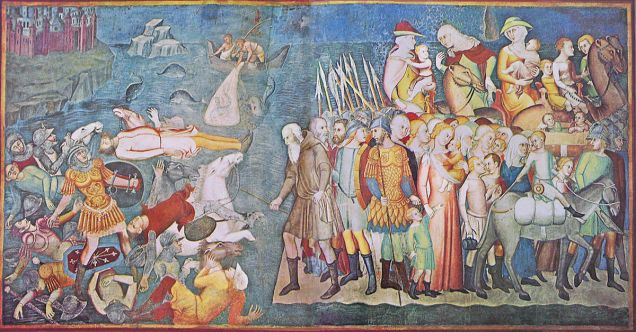
Then suddenly in chapter 15, as the Israelites are in the throes of one of their kvetching rants and wishing to go back, God surprises them.  God parts the sea and the people move through to safety.  And for the first time in their existence since Egypt, the first time for them as a whole, they see the miracle of God, they see the sea split and their lives saved.  In this moment, the whining, the nervous frustration, and the fear seem to melt away as they sing “Ozi V’zimrat Ya, Vayehi Li Lishuah.”  Adonai is my strength and my song, He will be for me deliverance.
While this is only a momentary pause for celebration in the Israelites’ arduous journey, the change from “are we there yet” to a song of praise is rather refreshing.  Like the Israelites, we often get caught up in asking, “are we there yet.”  We’re easily pulled into the mentality of needing to know and not able to recognize the moments of strength, beauty, and good in our world.  When we go on our individual journeys, we may not see the sea split per se, but we have the ability and even the obligation to call out in song, and just for one moment allow the “are we there yet” to be “wow, I’m here.”
Family Discussion Questions:
  1. Our ‘ethical covenant’ reminds us that we have an obligation towards creating holiness in our world.  As a family, how can you remember to stop and say “I’m Here”?  what effect to you think this act might have on our society?
  2. The Israelites called out Ozi V’zimrat Ya, what is your song?

On the Brink – Pesach 5768

on-the-brink-pesach.JPG

Here is the d’var Torah I gave on Friday night at my shul in Farmington Hills, MI. 

Picture this: you’re tired, your feet hurt from standing, walking, waiting. You rushed to get all the cooking done, exhaustion begins to take over, the journey is beginning. For some of you, this might sound like I’m talking about last Friday as you rushed to finish up the preparation for Passover. As tradition has it, tonight, the end of the sixth, beginning of the seventh day of Pesach is the time when the Israelites crossed the Red Sea. After years of hard labor in Egypt, 6 days of walking, they finally reached the point of transition. A plethora of possibilities are before the Israelites, but this is only the beginning.

Tomorrow we read from Parshat Beshalach, the splitting of the Sea of Reeds. This parshah comes on the brink of freedom and the edge of slavery. The Israelites, on their journey, have the ultimate GPS system, a pillar of fire at night and a cloud by day. Through these symbols, God is visibly present for the Israelites, to lead them on their journey.

As the Israelites travel, moving farther away from slavery and closer to freedom, they arrive at the Sea of Reeds, their first obstacle of freedom. If they turn around, the Egyptians, who are in hot pursuit, will capture them and they will return to slavery. If they attempt to cross the sea, they might drown. They stand, awaiting transition, paused in a moment of decision. What to do? The Midrash tells us that Nachshon Ben Ami-Nadav takes a risk, he steps into the water, moves forward, and just as the waters’ depths are nearly over his head, the sea parts, and dry land appears for the Israelites to cross.

Seeing this miracle, the Israelites begin to sing, the Song of the Sea, praising God as their strength, their warrior, the ultimate being.

עָזִּי וְזִמְרָת יָהּ וַיְהִי־לִי לִישׁוּעָה

“The Lord is my strength and song, He has become my salvation.”

What respect and awe the Israelites exhibit to God in this song! They are grateful, amazed, dancing, and singing. And yet, they cross the sea, arrive safely, having seen the Egyptians swallowed up by the waters, and they begin to complain.They want food, water. They want to go back to Egypt, where life wasn’t so hard, where food was easy to come by. Sound familiar? How many of us are waiting anxiously for the end of Passover, for that piece of bread? How many of us complained about the cleaning the preparation?

In Parshat Beshalach, the Israelites experience a continuum of emotions; fear, gratitude, excitement, disappointment, awe, dread, discomfort, and joy. It is a lot to take in for a people so new to freedom. Parshat Beshalach is about finding the balance between these emotions on our journey throughout life.

We stand here, on the brink of our own transition. We’ve cleaned out the chametz, cleaned out the clutter and dirt of our homes. We’ve made it 6 days out on the journey. Passover stands on the balance of rebirth and renewal, will we go back to our old ways, or will we take the leap of Nachshon Ben Ami Nadav? Will we follow the pillar of fire, the light of Torah as we embark on our journey towards Shavuot and Matan Torah? We’ve come far on the journey, 6 days done, we’ve almost made it across the point of no return. Here we stand at the edge of Passover, we’ve done the hard work, how will we emerge?

As Passover comes to an end, as we cross the Sea of Reeds and embrace the freedom that comes with it, may we experience this transition, as not, running way from what was, but running towards what will be. May we be blessed on this journey with foresight. As we enter this Shabbat of transition, may we find ourselves surrounded by the warmth of the pillar of Fire that is Torah, may we be blessed with the strength to follow the sometimes challenging path that leads towards the future.

Shabbat shalom!