Traveling with Blessing

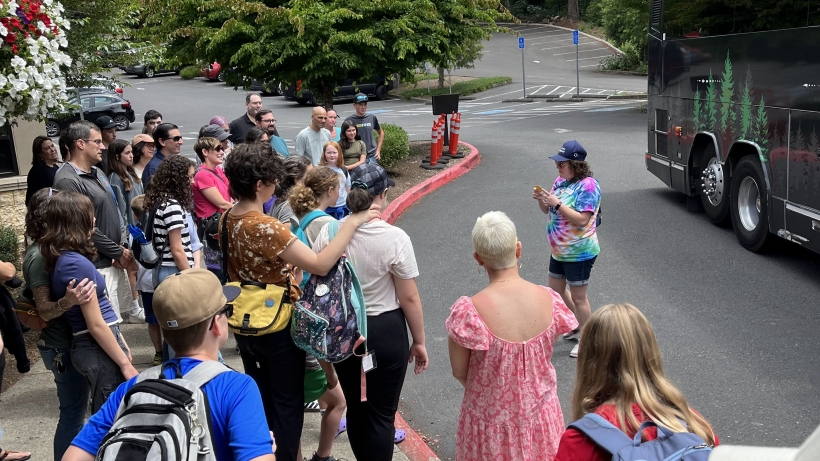
As a rabbi, I have many opportunities to offer blessings. One of my favorites is just after loading a bus on its way to camp or a youth group event and reciting a blessing for the travelers before sending them on their way. No matter the trip, traveling always comes with a certain amount of uncertainty. Whether we’re embarking on a family road trip, sending a child off to camp, or even just navigating the busy demands of our daily lives, there’s always that flicker of anxiety: Will we be safe? Will we arrive well? Jewish tradition meets that uncertainty with ritual — particularly with blessing. One of the most beautiful examples of this appears in Parshat Beha’alotcha, reminding us that journeys are not only physical but also spiritual, and that we are never truly traveling alone.

Parshat Beha’alotcha is rich with movement and transition. The parshah opens with the commandment to Aaron to light the menorah and quickly moves into organizing the Levites for service in the Mishkan. But a pivotal moment comes when the Israelites set out from Mount Sinai, their first major journey since receiving the Torah. To mark this moment, we read:

Vayehi binsoa ha’aron vayomer Moshe, kumah Adonai v’yafutzu oyvecha…

“When the Ark would set out, Moses would say: ‘Arise, Adonai, and let your enemies be scattered…’” (Numbers 10:35).

This verse is so significant that it’s set off in the Torah scroll by two inverted letter nuns, framing it almost like parentheses — or perhaps like wings of protection — around the words. Moses’s words over the Ark are among our earliest Jewish travel prayers. They are echoed in Tefilat Haderech, our traditional “Traveler’s Prayer,” which we say before setting out on a journey, asking God to guide us in peace and protect us from danger. But the connection goes deeper: the Ark itself was more than just a physical object being carried — it was a symbol of divine presence, Torah, and purpose, traveling with the people.

We often think about protection as something external: a seatbelt, a map, a vaccine, an insurance policy. But Moses teaches that spiritual protection comes when we consciously invite God — and the values of Torah — into our journeys. The act of blessing transforms our travels from mere movement to meaningful passage. It reminds us that no matter where we go, we carry a sacred purpose with us.

We can cultivate the practice of offering a blessing — whether through formal words like Tefilat Haderech or simply a moment of gratitude or intention. Our lives are full of movement, but Beha’alotcha reminds us that we are never just traveling — we are journeying with blessing. May we go forward like the Ark, carrying the presence of holiness with us, and may all our paths be made safe and meaningful.

Head in the Clouds – Parshat Beha’alotcha 5784

Do you ever see shapes in the clouds? Despite the persistent gray for a significant portion of the year, the Pacific Northwest has an incredible variety of weather conditions, including cloud formations. We often see the vibrant colors of the trees against a gloomy (or my favorite, “doomy”) background. Some days there’s so much fog we can barely see ahead of us, but other days the clouds are moving quite quickly as though on a mission to get somewhere before we make it to our own destination. 

It’s easy to get lost in sky-gazing. Watching clouds puts me at peace. Finding shapes and watching their movements grounds me between the heavens and the earth. Having your “head in the clouds” is usually associated with the impractical or unimportant, but to me, it’s those contemplative moments of feeling at one with nature that are more important now than ever. This concept of cloud-watching, in a literal sense, is central to our Torah reading this week as well. 

Our parshah this week, Beha’alotcha, lands us with Aaron and Moses as they get into the daily requirements of their jobs. This section of the text begins with instructions for the purification of the Levites as they do their holy work in the Tabernacle. We read about the first Passover sacrifice in the wilderness and how to make up the celebration of Passover if we somehow miss the holiday. Finally, Moses’s family – his father-in-law, wife, and children – return to join him and the rest of the Israelite nation on their journey through the wilderness.

The magic in Beha’alotekha comes as the order to march is given. When the Torah talks of the Tabernacle, the Mishkan, it teaches us that God’s presence hovers over it in a cloud. The narrative suggests that the cloud symbolizes God ascending and descending upon the camp, and this cloud would determine the movement of the march as well as when and where to make and break camp. Cloud up, time to move; cloud down, time to rest. 

If it feels like a struggle to find God today, you’re not alone. However, I’d argue that even if we’re not necessarily on the move like the Israelites, couldn’t the clouds still serve the purpose they did in the Torah? Their ever-changing shapes remind us to look up and pay attention to the world and to nature. Their movement across the sky reminds us to be open to change. Their rain and fog and mist remind us of our water cycle and connect us to our past and future. These are perhaps a few ways we can still be aware of God’s presence.

Welcome to the Positivity – Parshat Beha’alotcha 5783

There are certain moments of childhood that I will never forget. Many of them are positive, built on love and joyful celebration. Of course there are a few (and thankfully only a few) that I will never forget because of the yucky, negative feeling I had in that moment. I distinctly remember a moment when my piano teacher pulled my ponytail to make me sit up straighter, which is probably the reason I stopped learning piano. I remember the first time I got a bad burn from having my fingers too close to a fire. I’m sure you have your list as well. While the negative memories are filled with interactions that felt bad or shameful, the positive memories from throughout my life left me with amazing sensory moments. The smells, the feelings, they all bring back a sense of love and connection, especially when it comes to distinctly Jewish memories. Those Jewish memories are why I became a rabbi, because being in shul and “doing Jewish” offered a sense of peace, beauty, and wholeness.

As I walk into my tenth High Holidays this fall at Neveh Shalom, you probably know by now that one of my main goals in my rabbinate is instilling a love of Judaism built on everyone feeling safe, joyful, and welcomed in our community, and that starts with our youngest congregants, because that’s when those positive (or negative) memories are made. If you’ve seen the carts of fidget toys or noticed a child playing with Wikki Stix, stickers, or puzzles, it’s with this purpose in mind. There are more ways to keep children engaged in services than just scolding them for being noisy. They’re the future leaders of our Jewish community, and they should remember the positive feelings they had being part of it. And this doesn’t stop at children; it’s equally important to make adults feel loved and welcomed, whether that means changing the wording and pacing of prayers and announcements, or creating new programs or connective opportunities so that no one feels left out. But why is this so critical? One answer is in this week’s Torah portion.

Our parshah this week, Beha’alotcha, lands us with Aaron and Moses as they get into their daily requirements of their jobs. This section of text begins with instructions for the purification of the Levites in their holy work in the Tabernacle. We read about the first Passover sacrifice in the wilderness and how to celebrate Passover if we miss it the first time around. Then the text turns toward the Tabernacle itself, the Mishkan, and teaches us that God’s presence hovers over it in a cloud. Finally, Moses’s family – his father-in-law, wife, and children – return to join him and the rest of the Israelite nation on their journey through the wilderness.

In chapter 8, verse 19 we’re in the midst of the work Aaron and his sons should do for the priesthood and the Israelites. God instructs Aaron to perform the service for the Israelites at the Tent of Meeting, among the people, so that the Israelites, who are not usually permitted to be in the holy space, can feel connection without facing a plague for violating the rules. One medieval commentator suggests that this verse offers the message: “May all their visits to the sanctuary be for reasons of joy and not calamity. May all their memories of these visits be pleasant ones.”

Amen! Our work here is to support a positive, welcoming, loving environment where all who enter feel they belong. My fellow clergy and I may sound like broken records on this subject, but it’s some of the most important work we do. It’s how we make those positive memories happen and pave the way for an active, engaged, dedicated new generation.

Memory For All Time – Parshat Beha’alotcha

As we continue to weather the Covid years, I’ve found myself wondering which of the lessons I’ve learned will stick with me. Will I carry with me the lessons of resiliency or will the need to have a completely stocked pantry be what sticks? Will I return to the comfort of rigid planning, or can I carry with me a more go-with-the-flow attitude I’ve had to adopt? And, how will I keep myself from forgetting? 

During the early stages of the pandemic, I was quite mesmerized by historical fiction about the 1918 pandemic, which brought a certain comfort knowing that even as awful as it was then, I was born into a world where the nasty scars from it have all but disappeared. I also read it to get a glimpse into what might become part of our everyday lives in the wake of a societal rebirth.

Habits are often formed in response to specific circumstances, but then change as the world around us changes. If I want to hold on to any of the good habits I’ve developed throughout these years, I’ll need to do some active work to keep them alive. This is a lesson as old as Torah.

Our parshah this week, Beha’alotcha, lands us with Aaron and Moses as they get into the daily requirements of their jobs. This section of text begins with instructions for the purification of the Levites as they do their holy work in the Tabernacle. We read about the first Passover sacrifice in the wilderness and how to celebrate Passover if we miss it the first time around. Then the text turns toward the Tabernacle, the Mishkan, and teaches us that God’s presence hovers over it in a cloud. Finally, Moses’s family – his father-in-law, wife, and children – return to join him and the rest of the Israelite nation on their journey through the wilderness.

At this moment, the Israelites have left Egypt and the story of Passover is both fresh in their minds and a world away in this first new moon of the second year following the Exodus. God notes this moment and then instructs Moses and the nation on how to reenact the story of the Exodus so that they would not forget. Keep in mind, the nation is still in the desert. They’re a mere 12 months removed from slavery, and yet that story, the miracle of crossing the sea and the wonderment of God, might no longer be fresh in their minds. Therefore they must review the story before it is too distant a memory to really be carried on.

If you try to glean something from an experience after the experience is over, you might miss quite a bit. At this point we’re not quite out of the pandemic, but hopefully far from the height of it. This is the time to remember the lessons we’ve learned. This is the time to make some habits permanent. 

Out of Love – Parshat Beha’alotcha 5781

It’s human nature to interact differently with different people. Chances are we’re going to be more tolerant of certain behaviors in some people and less in others. For example, if you cut me off on the highway, and then slow down in front of me, I might react somewhere between perturbed and enraged because I won’t have the context to understand you or your actions. On the other hand, if we know each other, and I know you’ve had a bad day, I’m likely to be more forgiving if you seem rude or checked out. This works in other ways too. While I might not think twice about reprimanding my children for a certain behavior we’ve talked about over and over again, I probably wouldn’t have the same reaction toward someone else’s child. So if the action is the same or similar, why is my reaction different?

The answer, simply, is love. In relationships with friends and loved ones, there’s a history and familiarity that comes with the territory. I’ll describe what this is like for me with my kids, but even for those of you who aren’t parents, you can probably relate in the way you treat your partner, parent, loved ones, or even pets. 

Neither of my children slept through the night until well after they turned two years old. As frustrating as that was, and despite all our sleepless nights, I still love them. And like many children, mine are mostly great listeners at school and pay attention when others talk, but for me, their ears tune me out and can’t hear a simple direction. Often aggravating, but yes, I still love them. We tolerate and accept things in different ways because we love each other; that’s what a family does. 

From this week’s Torah portion (and elsewhere in the Torah) we understand this to be part of our relationship with God too. Our parshah this week, Beha’alotcha, lands us with Aaron and Moses as they get into the daily requirements of their jobs. This section of text begins with instructions for the purification of the Levites as they do their holy work in the Tabernacle. We read about the first Passover sacrifice in the wilderness and how to celebrate Passover if we miss it the first time around. Then the text turns toward the Tabernacle, the Mishkan, and teaches us that God’s presence hovers over it in a cloud. Finally, Moses’s family – his father-in-law, wife, and children – return to join him and the rest of the Israelite nation on their journey through the wilderness.

As the Israelites are leaving Egypt and on this long journey, they complain. A lot. Moses gets to the end of his rope and finally goes to God and lets it all out. “Why did you do this to me?” he screams at God in chapter 11, verse 11 of Numbers. He goes on to complain that God made him take them out, and now God expects him to “carry them in my bosom like a nurse carries an infant.”

It’s an odd expression, but Ha-Emek Davar, a 19th century Russian commentator on Torah, suggests “even if the infant hits the nurse or soils her clothing, she does not reject the child.” Moses is essentially asking God, “They’re screaming at me, and hurting me, and breaking me, and I still have to love them?” God’s answer is an emphatic “Yes!” Yes, we have to love our family (in this case our people), and when those we love struggle, it is our job to support them. Yes, you need to show them unending love and encouragement, even when you feel beat down.

I began by admitting that we naturally alter our reactions and behavior depending on who we’re engaging with, but Parshat Beha’alotcha teaches us that our work as citizens of the world is to extend generosity, love, and compassion everywhere, especially when there is struggle or strife. You would want the same extended to you.