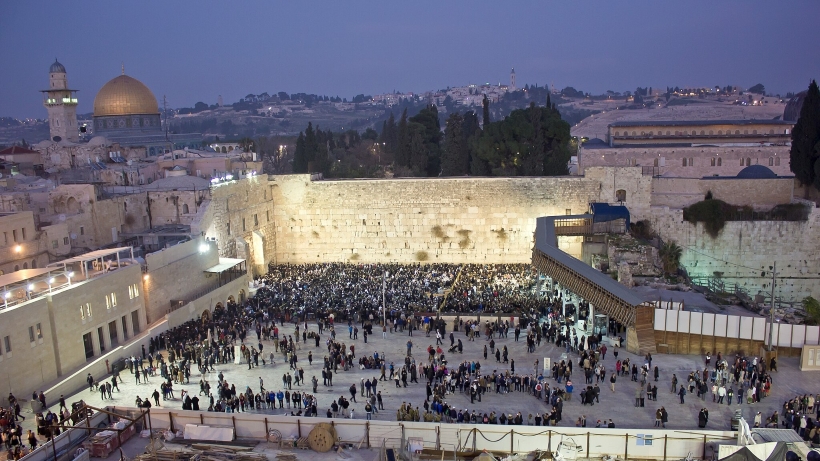
A Minyan and Then Some

There’s a special electricity in the air when a large Jewish gathering comes together — whether it’s the Kotel packed on a festival, a concert hall filled for a Jewish music event, or even a massive Zoom screen of tiny Jewish faces during the pandemic. In the Talmud (Berakhot 58a), we’re taught that upon seeing 600,000 Jews gathered together, we recite the blessing: Baruch… chacham ha-razim — “Blessed is the wise one who knows all secrets.” This rare blessing invites us to reflect on the power of community, diversity, and the holiness that emerges when individuals stand together.

This week, in Parshat Bamidbar, we open the fourth book of the Torah — the Book of Numbers — with the dramatic moment of the census. God commands Moses to count the Israelite men of military age, tribe by tribe. The tally comes to 603,550, just over the threshold associated with the chacham ha-razim blessing. But this census isn’t just about numbers; it’s about identity and belonging. Each person is counted l’mishpachotam u’l’veit avotam — by their families and their ancestral houses. The parshah also describes the arrangement of the tribes around the Mishkan and assigns specific roles to the Levites, underscoring that every individual and every tribe has a unique place and purpose.

The blessing chacham ha-razim expresses awe at the idea that God knows the inner workings, thoughts, and uniqueness of each person in a vast crowd. The sages teach that just as no two faces are alike, no two minds or souls are alike. It’s easy to look at a massive crowd and see only sameness, but God sees the secrets within — the hopes, struggles, dreams, and doubts that make each person irreplaceable.

The census in Bamidbar is not a cold bureaucratic exercise; it’s an act of love. As Rashi comments, God counts the people because God treasures them, just as someone counts their precious jewels. When we stand in community, whether in the desert, in synagogue, or even virtually, we remind ourselves that we are more than a number — we are part of a tapestry of souls, each known and cherished by God.

This Shabbat, as we read Bamidbar, I invite us to pause and look around at our own community with the eyes of chacham ha-razim. Can we see beyond the surface to recognize the unique stories, struggles, and gifts of each person around us? Can we cherish the differences that strengthen the whole? Even when we gather in numbers far fewer than 600,000, we have the opportunity to bless the divine wisdom that makes each human being a secret worth knowing.


It’s An Honor – Parshat Bamidbar 5784

When I was ordained, I found out some interesting news. After 25 years in the rabbinate, you could receive an honorary doctorate. Why? Because that long in the field allows for a certain level of expertise and dedication of service. I also view this opportunity as a reminder that as a leader, I’m always learning and growing in my position. The day I was ordained was also the day when I realized how very little I knew about being a rabbi. It felt akin to the day our firstborn child came into the world, and we realized we had no clue what to do next.

In so many aspects of our lives, we’re able to grow, change, and even learn and adapt on the fly. In some cases, there might be a title (including an honorary one) that goes along with it, but that honorific comes from putting in the time, the work, and the connection to make it so. 

As we begin the fourth book of the Torah with this week’s portion of the same name, Bamidbar, the Israelites are well-established on their desert journey, and the groundwork for the structure of their future has been laid. Army leaders are appointed to lead alongside Moses and Aaron, a census is taken of the people, and we learn that the camps are situated in a specific order, each with a flag in the center that tells us which tribe is there. The time spent in Egypt is a distant memory at this point.

As the Levites take on their new positions and Moses and Aaron continue to grow as leaders, we learn about the various chief officers and what their jobs are. Each person had a specific purpose to fulfill, and there was an expectation that their work would be completed. With the in-depth list of duties comes the notion that there are no honorary titles in the Torah. In other words, your position is what you do, not a gratuitous rank to add to your curriculum vitae. If you hold the title of chief, then you must continue to do the work of a chief.

The act of serving God cannot be honorary; it must be done with the fullness of heart and soul. To this day, Jewish tradition is filled with ritual actions rather than prayer alone. It’s through fulfilling these traditions that we find purpose in what we do and what we believe. 

Just Say Yes – Parshat Bamidbar 5783

Why is it that so many of our asks as parents are met with arguments from our children? Sometimes it feels as if there’s nothing I could say that would be accepted at face value without some sort of pushback. It’s not like the daily expectations have changed that much. For years we’ve been asking them every morning to get dressed, come downstairs, eat breakfast, and get in the car, only to be met with variations on “I can’t because . . .” Why are we still arguing about hard and fast rules that we’ve had for what feels like an eternity?

It is true, however, that every once in a while we start the day with no arguments, and Duncan and I find ourselves marveling at a morning without whining. Perhaps this is a little bit like what God must be feeling in our Torah portion this week. This week we begin the fourth book of the Torah, Sefer Bamidbar. The Israelites are now in the desert, and the groundwork for the structure of their future has been laid. Army leaders are appointed to lead alongside Moses and Aaron, a census is taken of the people, and we learn that the camps are situated in a specific order, each with a flag in the center that tells us which tribe is there. The time spent in Egypt is a distant memory at this point.

In chapter two, God asks the people to line up in order, according to their households and their ancestral inheritance. If you’ve been following along week to week, you know that anytime the Israelites feel uncomfortable or anytime they receive direction from Moses, they complain mightily about the task. Whether the complaint is about the taste of the water or the amount of food, their ability to complain, much like children, seems boundless. Yet, this week, the entire Israelite nation does what God asks without questioning, without asserting dominance or status.

Why this sudden change in response? The text is unclear. No real reason is given, except that chapter three of Bamidbar begins by recounting that Aaron’s sons died because they did not follow God’s procedures. Perhaps the Torah calls this out knowing that the Israelites have short-term memory issues, not unlike a toddler. On the other hand, it also stands to reason that the Israelites are doing their very best to follow those rules and show that they are committed to the future.

This is still a toddler nation we’re talking about, new to freedom and purpose. There are magical moments, but they’re also testing limits. This week’s parshah may serve as a helpful reminder to parents that eventually children will recognize the limits and expectations we set for them and understand that the decisions we make are out of love.

Pulling Your Weight – Parshat Bamidbar 5782

I love being a part of a collaborative team. Nothing gives me greater joy and satisfaction than when I’m a part of a “we” especially when “we” are creating, bouncing ideas around, and supporting each other. It’s rewarding when all that work pays off in a beautiful end product that exceeds everyone’s expectations.

My one anxiety about teamwork is worrying that I’m not contributing enough or pulling my weight. If you’re not feeling creative or you’re struggling to complete a task, it can feel like you’re letting the entire team down. I value the hard work that others put in, and I expect the same from myself. By the same measure, I tend to hold others to the same high expectations I have for myself, and I struggle when those expectations aren’t met, despite the fact that they are my own expectations, no one else’s.

Being part of a team is really about the benefits of accomplishing something together. When we combine our strengths, it shouldn’t matter if all members are pulling their weight the entire time nonstop. We can allow moments when a team member or two can take a break to catch their breath without having the whole team fail or fall behind. Problems arise when neither the weight people pull nor the breaks they take are evenly distributed. We’re warned about this type of disparity in our Torah portion this week. 

We begin the fourth book of the Torah, Sefer Bamidbar. The Israelites are now in the desert, and the groundwork for the structure of their future has been laid. Army leaders are appointed to lead alongside Moses and Aaron, a census is taken of the people, and we learn that the camps are situated in a specific order, each with a flag in the center that tells us which tribe is there. The time spent in Egypt is a distant memory at this point.

As the different roles of the tribes are laid out, we receive the lists of physical, mental, and emotional labor that each officer and their tribe must commit to in order for the entire nation to succeed. Notably in this list, those with titles like “Chief” are not exempt from physical labor.

Specifically, we find out Elazar, the Chief Officer, is assigned to guard duty. Elazar is one of Aaron’s sons, and he’s one of the highest authorities in the nation. His job is no ordinary desk job. Instead, he’s got hard labor. Why? Because according to the Jerusalem Talmud, “There is no special privilege in the palace of the king.” In other words, there is no room for an “honorary” position in the service of God. 

Judaism is built around the notion that each of us has a purpose and work to do in building and maintaining our society. Parshat Bamidbar reminds us that who’s on the team or who they’re connected with isn’t nearly as important as what you can accomplish together with the personnel and skillset you have.

Collector’s Item – Parshat Bamidbar 5781

When I was a little girl I was a collector of Madame Alexander dolls. I had an entire shelf dedicated to these beautiful dolls that I was not allowed to play with. There they sat, their boxes neatly packed away, clothes unruffled. Every once in a while I would take one down and admire it, then carefully place it back on the shelf. Did you have a collection like this? Maybe yours was comic books or baseball cards. With these precious collections the story tends to be the same. You search out and finally acquire a new special item. The first day that it’s part of your collection, you admire it, and then carefully, gently place it into the protective covering for safe keeping. Occasionally you might take out this item or others in the collection to have a look, and then neatly pack it away once more. 

While it sounds like this type of hobby wouldn’t hold a child’s interest, there’s something special and powerful about having something you take such good care of. This act of protecting, guarding, and checking in takes both dedication and self control. 

This week we begin the fourth book of the Torah, Sefer Bamidbar. The Israelites are now in the desert, and the groundwork for the structure of their future has been laid. Army leaders are appointed to lead alongside Moses and Aaron, a census is taken of the people, and we learn that the camps are situated in a specific order, each with a flag in the center that tells us which tribe is there. The time spent in Egypt is a distant memory at this point.

As the Israelites are in their wilderness experience, God instructs Moses to count the whole Israelite community. The language used by God for this process is “lift the head.” In other words, each person is to lift up their head and direct their eyes and heart toward the heavens so that they can be counted. Lifting of a head also connotes a certain pride in who they are, and who their ancestors were. This act in this moment asks the Israelites to actively see themselves as connected to God.

But this also raises the question why is God counting the people? Doesn’t God know who they are and how many to expect? What is the purpose of this inspection? As an answer, a midrash imagines God as a collector of precious jewels. From time to time this collector might take out their collection and inspect each one, relishing in their beauty and uniqueness, tallying them up to make sure every jewel is accounted for, even if the collector is well aware of how many there are. 

When we collect things we often keep them in treasure jars or a protective wrapping. Sometimes we take them out to admire them or even just to make sure they’re still there. The census in Parshat Bamidbar suggests that regardless how you view God, each of us is a unique “collector’s item” in the world’s collection of humans. It’s also a reminder that we should recognize the uniqueness in each other. How different the world might be if we all saw and admired the precious, one-of-a-kind jewel within every one of us.