Why I Believe in God – Parshat Bereshit 5776

Chaplain

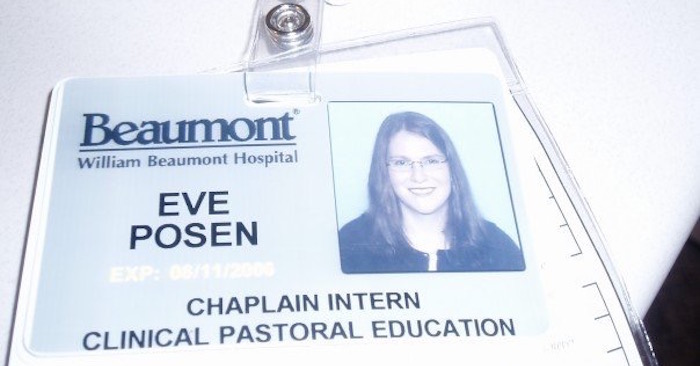
During rabbinical school I spent one summer doing a unit of clinical pastoral education at a hospital in Michigan.  My reasoning for spending that time in a hospital setting was twofold. First, I needed to get over some of my fear of the hospital environment and learn how to bring the most comfort to the most vulnerable.  Second, I have long had a fascination with medicine, and this intensive program put me on overnight on-calls, trauma teams, and in the ICU standing right with the medical professionals.  This was a lifechanging experience for me on so many levels, but most notably with my belief in God.  

I was honored to be invited to sit in on an autopsy as the team worked to identify the cause of death.  I stood in the room with my colleague and watched as the professionals went to work.  To my amazement, their tools included a saw. Our bones are so hard and strong, they need the force of a heavy saw to cut open, and yet this woman died from bleeding caused by the tiniest pinhole tear.  In that instant I became truly aware of the complexities of the human body, the intricacies with which we are created.  In that moment I knew God existed.  In a sense, for me this was the beginning.

This week we read parshat Bereshit, the first portion of the Torah.  We begin again with our familiar story and move quickly from the days of creation through the narrative of Adam and Eve in the beautiful Garden of Eden to the first time someone challenged God.  From there we experience the narrative of Cain and Abel and the first explosive sibling rivalry.  The entire section of texts ends by careening us forward in time to the line of Noah.  

But we begin with the beginning.  “When God began to create heaven and earth, the earth being unformed and void with darkness over the surface of the deep…” The Torah begins with this sentence, acknowledging the beginning of all beginnings.  Rabbi Akiva, a Talmudic sage, taught, “Just as the existence of a house testifies to the builder and the existence of a garment testifies to the weaver, so the existence of the world testifies to God who fashioned it.”  

On the surface, Rabbi Akiva’s proof of God rests in the mere existence of the world, but what he is implying is that the divinity of the architecture is in the complexity of it. The beginning of my belief in God was that moment in the hospital.  I believe in God because I saw firsthand what unique systems and works of art our bodies are, and they are beyond anything my mind can consider creating. In that small, sterile basement room, I met God, and it was a moment that opened my eyes to a miracle which I cannot understand outside the realm of faith.

It’s not my job to persuade you to believe in God. As far as explanations go, you might take an approach that is purely divine, one that is purely scientific, or one that falls somewhere in between. Nevertheless, starting our year and our Torah cycle anew does compel us to see the world in a new light. However the story of creation resonates with you, in this new light may we find moments of belief, moments of clarity, and perhaps moments that acknowledge the presence of God in some way.
Shelter of Peace – Sukkot 5776

shelter-of-peace

Yesterday was a difficult day.  Even’t if I hadn’t been accidentally woken at 5:30 am by an ill-timed Siri alarm, it still would have been a day filled with emotional extremes.

I attended the funeral of a beloved man in our community, and with those touching moments still fresh on everyone’s minds, we learned of the horrid terror attack in Israel against an innocent family and the baseless gun violence that happened in my own state of Oregon at Umpqua Community College.  I was in tears watching the news when my daughter walked in the door from playing.

“Mommy,” she called as she walked in. “Let’s eat in the sukkah.” I gathered my tears and my strength for this beautiful two-year-old so she shouldn’t know my pain.

Ufros Aleinu sukkat shlomeicha.  My favorite line of our liturgy. God spreads over us a shelter of peace.  I meditated on this line as I joined her for a quick dinner in our own sukkah of peace.

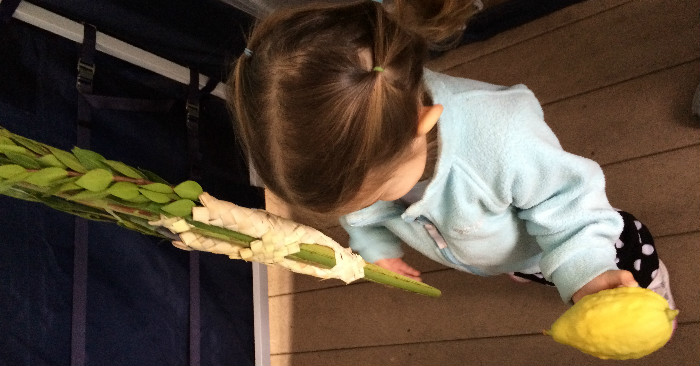
I thought about the symbols of this holiday. While I love the sukkah, I’ve always been uncomfortable with the lulav and etrog.  They feel pagan, phallic, and foreign to me.  But I was determined to show my sweet, innocent two-year-old a world in which our discomfort pushes us to accept, to look beyond.

There is a rabbinic teaching that gives each of the four species of the lulav and etrog a body part, and this teaching helped me to find meaning even in my least favorite part of the holiday.

Hadas:  the myrtle is for our eyes.  I am grateful to raise my child with eyes that can see past discomfort and difference.  I want to raise her with eyes that can see injustice and work to fight it, eyes that see human beings as valuable and worthwhile.

Aravah: the willow, the mouth.  My daughter, and all of our children, should be blessed with mouths that speak love, truth, justice, and kindness.  May her mouth be filled with words of peace, with words that are stronger than violence.

Lulav: the tall, strong palm, and the spine.  May our children grow to be strong, upstanding human beings. May they stand firmly against injustice and violence, and only for peace, love, and what is good in our world.

Etrog: the citron.  This is the heart.  May we raise our children to let their hearts shine through. A world filled with love, passion, and understanding is a world that fulfills God’s promise of a shelter of peace.

This year, may your sukkah represent growth and understanding, peace and listening.  The lulav and etrog represent the foundation on which we must raise future generations so that we may someday see an end to gun violence and hatred of all kinds.  This is the blessing of our holiday.

Head in the Clouds – Parshat Ha’azinu 5776

Head in the Clouds

You probably already know one of my favorite parts of my day is the time I take to walk.  When I got a Fitbit last year as a gift, it spurred me on even more. Here’s the catch: I don’t walk on a treadmill or on a track in the gym.  Indoor exercise feels lacking to me, especially because I use my walks to clear my mind, brainstorm new programs and sermons, and find myself at peace.  Walking outside all the time can mean that sometimes I’m bundled up, and sometimes I’m seriously sweating it out. In Portland, it often means that my walks happen in the morning fog and clouds that hover over our hilly neighborhood.  Ironically, when I’m physically in the clouds is when I find myself most clear-headed.

Weather plays a prominent role throughout the Bible; consider the stories of Noah, Jonah, and Job. Specifically, clouds and fog are referenced in spots as well.  Mount Sinai is described in the Torah as being covered in a heavy cloud, which represents God.  One imagines Moshe needing to wade through the heavens in order to “find God.”  Way back in Bereshit, the descriptions of the earth mention being covered in a fog-like substance that then swirls and whirls and separates into water and sky before the land takes shape.  Walking in fog can be a surprisingly spiritual reminder of a preformed world.

This week we read the penultimate Torah portion, parshat Ha’azinu, which has the special honor of being the last section of Torah read on Shabbat morning.  Parshat Ha’azinu is a poem which warns of the negative behavior of the Israelites, but reminds us of the blessings that will come to them with the good behavior they are capable of.  The text ends with Moshe ascending the mountain into the clouds as he takes his leave of the Israelite nation.  This parshah is the link between generations, between new and old leadership, and between living on earth (in the land of Israel), and living with God (on top of the mountain in the heavens).  

The parshah begins, “Give ear, O heavens, let me speak; Let the earth hear the words I utter!”  The Hatam Sofer, an 18th century commentator from Hungary, interprets the verse in the following way:  “Listen to me you spiritual people whose thoughts are in heaven, and also you down-to-earth people whose concerns are more material.  This message is meant for all of you.”  As the final Shabbat-read section of the Torah, Ha’azinu not only has the unique designation of being a mini summary of the entire Torah, it also points out that Torah is for everyone. Judaism can speak to your soul and your brain; it can challenge your mind and your body.

Wherever you are, with your head in the clouds or your ear to the ground, there is a piece of Torah for you. As we enter a new year of learning and living, may we find ourselves growing and engaging with our spiritual selves as well as with our physical world, and may the journey be filled with blessing, challenge, and success.