We lament that our modern world is devoid of those bigger-than-life “parting of the sea” moments, but the thing is . . . parenting is full of them. This too is Torah.
Author: Eve Posen
Leftovers – Parshat Bo 5776
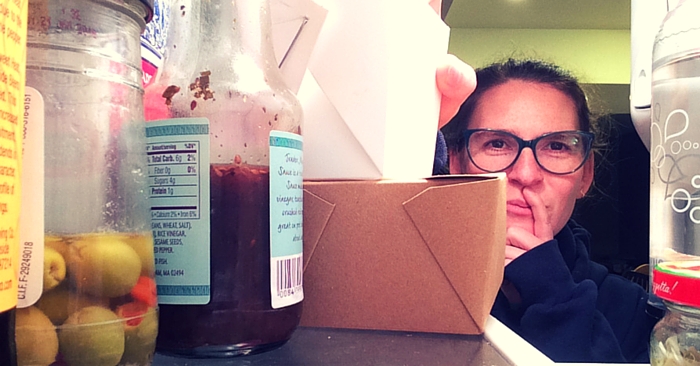
As an executive chef, my Uncle Larry gets culinary inspiration from a variety of places, including my Nana’s recipe box. Of course in order to use family recipes for commercial purposes, he has had to make some serious measurement conversions. This means that when I want to make one of Nana’s famously delicious family recipes at home, Uncle Larry sends it to me with instructions like: “Divide by 40 to get a reasonable size recipe.” Somehow I still always end up with enough food to feed an army.
Maybe it’s the stereotypical Jewish mother in me that’s to blame, but whenever we host a dinner or event, I stress over having enough food. “I’ll just make one more side dish to go along with the other four, just to be safe,” I’ll rationalize. Inevitably, we have leftovers for days.
Oddly enough, there are leftovers in the Torah. It makes sense when you think about it. When you’re feeding an entire Israelite nation, there’s no way to anticipate the precise needs of every meal. Our parshah this week, parshat Bo, is notable for containing the commandment to observe Passover, but it also contains helpful hints about what to do with seder meal leftovers. The narrative picks up with the final plagues that God is sending to Egypt and continues with the holiday of Passover, teaching the Israelites what it means to build a community, beginning with the first laws of their calendar. The text ends with arguably one of the most important commandments we have – that of telling the story of the Exodus in every generation.
In Exodus chapter 12, God gives the commandments for the Passover sacrifice, specifying that each family is to sacrifice their own lamb. But in verse 4 God states, “But if the household is too small for a lamb, let him share one with a neighbor who dwells nearby, in proportion to the number of persons: you shall contribute for the lamb according to what each household will eat.” The Torah teaches that Passover, like a great number of our Jewish traditions, is a family celebration. Specifically, it is meant to be celebrated communally, not in isolation. An abundance of food is simply another reason to share the celebration.
According to Samson Raphael Hirsch, the paschal sacrifice teaches that we are to “let those whose households are too small to absorb all the blessings that God has given them seek out their neighbors and share the bounty with them.” It is our responsibility to sustain others in our community with our “leftovers.”
Nowhere is there a better reminder that we celebrate best when we celebrate together. Every time I make one of Nana’s recipes (thanks to Uncle Larry’s assistance), it takes me back to the big dinners I remember with family and friends. These shared experiences are just as much a part of living Judaism as anything else. By the way, does anyone need two kugels and a challah?
Parenting by the Parshah – Bo
Stories we tell over and over again stick with us; they become part of who we are. As we we affirm each year in the retelling of the Exodus, the Torah is a part of our people not just because it was given to us, but because we continue to give it.
No Pain, No Gain – Parshat Vaera 5776

A 2012 study by a Polish university asked marathon runners several months after a race to recall the pain they had experienced when actually running the race. On average, the level of pain they reported after the race dropped by about 40%, regardless of how long after the race they were polled.
Similar studies have been conducted about the pain during childbirth. It’s common for the memory of the labor pain itself to fade over time. I even experienced this with my C-section. The pain of trying to regain mobility after the surgery was excruciating and I thought I’d never get over that feeling, yet now it seems like a distant memory.
Our brains provide what seems like a coping mechanism, allowing us to move on. For those painful moments that are simply a part of life (childbirth, cutting teeth, accidental injuries) as the wounds heal, the brain heals too, and the memory of the pain fades soon after the pain itself. However, what happens when the pain is something we should remember? What about the instances in which the pain is an important part of the journey or the lesson?
This week we read parshat Vaera, the second portion in the second book of the Torah. The Israelites are deep into their slavery in Egypt working for Pharaoh and are having decrees levied on them daily that control all aspects of their lives. Moshe rises as the leader of the Israelites and is now pressed by God to stand up to Pharaoh, in whose house he was raised, and ask for freedom for himself and his people. God partners with Moshe and Aaron to send the first seven plagues and manipulate Pharaoh’s heart as a method of persuasion.
Chapter 8, verse 28 of this week’s parshah is a turning point for Pharaoh and his enslavement of the Jewish people. “And the Lord did as Moses asked: He removed the swarms of insects from Pharaoh, from his courtiers and from his people; not one remained. But Pharaoh became stubborn this time also, and would not let the people go.” We discover God is no longer the force that is hardening Pharaoh’s heart; rather, Pharaoh becomes stubborn on his own.
How quickly Pharaoh forgets the pain of the previous plague. When he and his people were suffering, we imagine he could empathize with the Israelites and their daily suffering. But when his own suffering was eased, the memory was quickly lost and his compassion was gone. Pharaoh learned nothing from the plagues because he (with some manipulation by God) couldn’t recall the pain in the moment.
Memory is fleeting. This can be helpful when it comes to alleviating some of the pains associated with human existence, but in certain cases it’s the memory of pain that actually helps us move forward. To this day our celebration of Pesach includes symbols like matzah and maror to remind us of bitter hardship. As Jews, part of our tradition is the recollection of pain as a way to pass on the experiences of our people so that we may continually learn and grow.
Parenting by the Parshah – Vaera
Because let’s face it – Pharaoh was the temperamental toddler of the Torah, and God’s plagues represented the fed-up parent counting to ten.
 Rabbi Eve Posen