Even God has temper tantrums. In Ki Tissa, we see a role reversal with Moshe as the “parent” who has to mediate.
Author: Eve Posen
As a Seal Upon Your Heart – Parshat Tetzaveh 5776
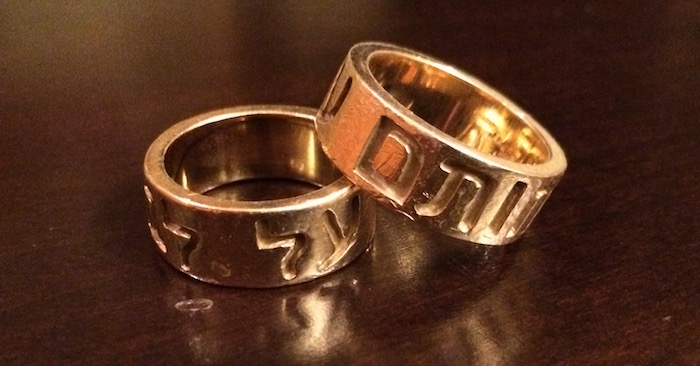
My wedding band is inscribed with the words “As a seal upon your heart” in Hebrew. Originally from Kohelet (Ecclesiastes), this verse on my finger serves as a daily reminder in several ways. When Duncan and I were ring shopping, I wanted the “plain gold band” we’d need for the ceremony to also be one that we both felt comfortable wearing every day. Even if it was simply solid gold, I wanted something that was both beautiful and meaningful. My mother shared with me that she and my father had this verse inscribed on the inside of their rings. It didn’t take much convincing to get Duncan on board, and now we each have a constant symbol of our connection to one another as well as the link to my parents and their love too.
The memories we carry are often attached to certain unforgettable details like a song playing at a specific moment or the smells of a certain location. This also happens with clothing and jewelry. Maybe you remember down to the last detail the outfit you were wearing when you brought your first child home from the hospital. Perhaps there’s a piece of jewelry passed down from generation to generation. The tallit you wear on Shabbat and the person it belonged to before you may hold a special place in your heart.
Parshat Tetzaveh, which we read this week, details the specific clothing items that a priest and those close to him are to wear. This is special attire that distinguishes them from others in their service to God. These clothes are meant to add an aura of holiness to the priests as they complete their sacred duties. Since these vestments and garments are to be used for such a unique purpose, God also gives a special instruction regarding who is to make them. After we receive these specifics, we learn about the details of what is on each garment.
Chapter 28, verse 29 teaches: “Aaron shall carry the names of the sons of Israel on the breast piece of decision over his heart, when he enters the sanctuary, for remembrance before the Lord at all times.” That is to say that in all of Aaron’s work, he is to carry the “seal” upon his heart of those who have come before him. The high priest, in his role, is beholden to the names, experiences, and fates of those who came before him. The Ba’al Shem Tov, a Chassidic master, shares “Remembering is the source of redemption, while forgetting leads to exile.” Our identities have been shaped by those who came before us not only in their actions, but in our memories of them.
While we may not have a high priest today, we too are linked to those came before us. Whether the memory is preserved in the use of your great-grandmother’s candlesticks on Shabbat or telling the same jokes each year at Pesach, the sharing of that past is what will ensure a future.
My wedding band reminds me of the strength and love of my parents’ marriage and of the dedication Duncan and I have to each other to maintain our own bond. May we all be blessed first with the sweetness of fond memories and second with the kavanah, the intention, to learn and grow from the lessons they teach.
Parenting by the Parshah – Tetzaveh
Your clothing can reveal a lot about where you work, the climate in which you live, and even your attitude on a particular day. And yes, this too is Torah.
World Within a World – Parshat Terumah 5776

Our world is filled with microcosms. Walk into a school or an office building, and you’ll observe a fully functioning miniature community with its own rules, operational procedures, and social norms. Airports are another example; I’m always awed by what it takes to operate the world of the airport, from the flight crews to the maintenance workers to the airport employees. These microcosms exist all around us, and we float in and out of them all day, every day.
We already know that the Israelites also had such a world within a world, but in this week’s Torah portion, Terumah, we learn that God had one too. It seems strange to think of God needing a world within a world. Isn’t the whole universe God’s creation? Would it really benefit God to have a separate, more Godly space?
Terumah recounts for us the building of the Tabernacle, and we receive instructions for the beautification of the space. Each vessel, covering, light fixture, and costume piece is listed so that the space is constructed to God’s exact specifications. The Torah lists each piece individually in order to state the exact purpose of each individual item. Assembled together, this will become the dwelling place of God.
So I’ll pose the question again: why does God need a separate dwelling? The fashioning of this sacred space is essentially to create a separate world within God’s universe, but is that necessary? Perhaps the Tabernacle represents not just physical space, but time as well. Consider the construction of Noah’s ark in parshat Noach. The ark was a means of survival, but also represented the new beginning of humanity, a new beginning in time. So too the construction of the Tabernacle represents a new beginning of the Israelite nation, both a physical and symbolic separation of the past and the future.
Take a look at our own microcosm of Congregation Neveh Shalom. Our community – from the building itself to Foundation School to morning minyan to ALIYAH – is without a doubt both a physical and symbolic manifestation of a separate, holy place. We continue to create this sacred space, not to draw God closer to us, but to draw us, together, closer to God.
Parenting by the Parsha – Terumah
Giving freely of yourself to help others – it’s parenting AND Judaism in a nutshell.
 Rabbi Eve Posen